
Stroke Diagnosis
Stroke diagnosis based on the symptoms, family history, any other related conditions, neurological examination, and lab test & procedures.
Stroke Screening Test
- Doctor likes to know about the stroke symptoms such as what, when, how long and how severe are the symptoms.
- Doctor asks, whether you or your family members have or have had a disease condition that can cause a stroke.
- Neurological examination of muscles and nerves is for checking strength, sensation, coordination, and reflexes. Check memory, speaking and thinking abilities.
Depending on the above stroke diagnosis, doctor may suggest some Lab test and procedures for further evaluation.
Lab tests and procedures for stroke diagnosis
- CT scan produces a 3D image of the head, used to diagnose ischemic stroke, hemorrhagic stroke, and other problems of the brain and brainstem.
- MRI scan produces a 3D image of the head, brain and spinal cord in more precise than CT. MRI is useful to diagnose ischemic stroke, hemorrhagic stroke, and other problems involving the brain, brainstem, and spinal cord.
Tests that View the Blood Vessels that Supply the Brain
- Carotid Doppler takes a picture of the carotid arteries in the neck, and shows the blood flow to the brain. This test is useful to examine narrowing of carotid artery.
- Transcranial doppler is useful to measure blood flow in some of the arteries in the brain.
- MRA (Magnetic resonance angiogram) special MRI scans used to see the blood vessels in the neck or brain.
- Cerebral arteriogram – a thin flexible tube called a catheter is inserting in an artery in the arm or leg, and special dyes, which is visible in x-ray, is injecting into the blood vessels. The images show any abnormalities in the blood vessels, such as narrowing, blockage, or malformations. Cerebral arteriogram is a more difficult test than carotid Doppler or MRA, but produces an accurate result.
Other Neurologic Tests
- Electroencephalogram measures the brain waves through several electrical leads painlessly attached to the head. EEG is not common test used for stroke diagnosis, but would be ordered if have had a seizure is suspected.
- Lumbar puncture or spinal tap is by inserting a needle in the lower back to obtain a sample of the cerebrospinal fluid, which surrounds the brain and spinal cord. This test is done if subarachnoid hemorrhage, a bleeding from a cerebral aneurysm is suspected or for nervous system infection (such as meningitis) or inflammation.
- Electromyogram or Nerve conduction test records the electrical signals of the nerves and muscles. It is not useful for stroke diagnosis, but needed if doctor suspect nerve’s problem.
Ayurveda Medicine
Ayurveda is a traditional medicine system native to India and followed in other parts of the world as a form of alternative medicine.
Ayurveda is a Sanskrit word ayur means life, and veda means knowledge; translates literally to the science of life.
What is Ayurveda?
Ayurveda, one of the oldest medical systems in the world has been practicing for 4,000 years in India. It is a holistic medicinal system encompassing the balance of body, mind, and spirit.
Ayurveda affirms a fundamental association between the microcosm and macrocosm. Ayurveda believe cosmos creates people and human are miniature representation of the universe; it contains within them everything that makes up the universe.
Ayurveda view the body functioning as the interaction of three system, they are doshas (vital energy), dhatus (tissues), and malas (waste products). The vital energy controls the creation of all body tissues and removal of unnecessary waste products out of the body.
Ayurveda means
The Caraka samhita states the term ‘Ayurveda’ is derived from two words, ayus and veda. Caraka expands us that ayus is the ‘combination of the body, sense organs, mind and soul’, the factor (dhari) responsible for preventing decay and death, which sustains ( jıvita) the body over time (nityaga), and guides the process of rebirth (anubandha). The second part of the word is veda and can be translated more specifically as a deeply profound knowledge emanates from a divine source, and hence Ayurveda is known as the ‘divine science of life’.
Motto of Ayurveda
The following sentence explains the basic aim of Ayurveda.“Swasthasya Swasthya Rakshanam; Atursya Vikar Prashamanam.” This means:
“Preservation to health of healthy person is treating ailments with breaking causative factors of pathogenesis”.
History of Ayurveda
The history of Ayurveda is as earliest as being the Vedic period with reference in Rigveda and Atharvaveda.
- Ayurveda is considering originated in Heaven from Lord Brahma (Hindu God of Creation), who presented this knowledge, to Daksha Prajapati (the protector of all beings).
- Then this knowledge taught to the Ashwini Kumaras; the twin holy physicians.
- Ashwini Kumaras in turn taught it to Lord Indra (King of the Gods).
- When disease and illness began to trouble humanity, the Maharshi Bharadvaja made the journey to Indra’s court on Mount Kailash, where he studied Ayurveda.
- Bharadvaja returned to establish the first school of Ayurveda, and revealed this knowledge to the assembled sages. These sages in turn taught this knowledge to their own disciples.
- One named Punarvasu Atreya held a competition to see which student best understood kaya cikitsa (internal medicine). Among his students, the treatise of Agnivesa was judged best.
- Agnivesa authored a text called Agnivesa samhita, it became the authoritative text on internal medicine.
- This text is no longer available; however, physician Caraka revised, edited and compiled a text called Caraka samhita.
- Kasiraja Divodasa Dhanvantari, the sage teaches salya cikitsa to his student Susruta, he compiled Divodasa’s teachings into a text, later Buddhist scholar Nagarjuna revised it, forms the Susruta Samhita, the primary Ayurvedic text on the theory and practice of surgery.
- Another important early text is the Kasyapa samhita concerned with the theory and practice of pediatric and obstetric disease (kaumarabhr tya).
- The Caraka and Susruta samhitas are broad enough in scope that they describe almost the entire system of Ayurveda.
- Sharangadhara Samhita described the examination of the pulse for the first time, as a method of clinical examination and use of metals and minerals like gold, silver, iron, mercury and copper for preparing Ayurvedic medicines.
- Rasa Tantra (northern India) and Siddha (southern India) dealt mostly with number of metallic preparations as remedies. The important metal successfully used was mercury in many forms.
Fundamental Principles of Ayurveda
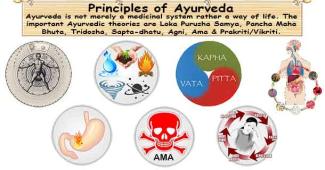
Ayurveda is not merely a medicinal system rather a way of life. The important Ayurvedic theories are:
- Loka Purusha Samya (macrocosm, microcosm continuum - Universe and an individual),
- Pancha Maha Bhuta - Akasha (ether/space), Vayu (air/motion), Teja (fire/radiant energy), Jala (water/cohesive factor), and Prithvi (earth/mass),
- Tridosha - Vata (motional energy), Pitta (chemical activities), and Kapha (solid substratum),
- Sapta-dhatu - Rasa (Plasma), Rakta (Blood), Mansa (Muscles), Meda (Fat), Asthi (Bone), Majja (Bone marrow), and Shukra (Reproductive fluid or Semen),
- Prakriti - is the unique psychosomatic temperament of an individual, encompassing their physical, functional and behavioral characteristics. Vikriti – is the term indicating abnormal state or the diseased state of the body.
- Agni - is the fire drives all digestion and metabolism in the Ayurvedic medical practice.
- Ama - is the residue of undigested or partially digested food results from poor digestive fire.
The body and mind are the two interdependent components of every living being, its harmonic co-existence being responsible for health and its imbalance for disease.
Sapta-Dhatu (Seven body tissues)
The seven dhatus or tissues are the structures of the body responsible for nourishment and retaining health. They are:
- Rasa is a final metabolic juice & plasma (Digestive System),
- Rakta is a blood cells (Circulatory System),
- Mamsa is a muscle & tendons (Muscular System),
- Med is a fat,
- Asthi is a bone (Skeleton),
- Majja is a bone marrow, and
- Shukra is a semen fluid (Reproductive System).
Eight specialties of Ayurveda
Ayurveda has eight specialties originally revealed by Bharadvaja, they are:
- Kaya cikitsa - general internal medicine,
- Bala cikitsa - infants & children treatment,
- Graha cikitsa - treatment of spiritual possession & medical astrology,
- Urdhvanga cikitsa - eyes, ears, nose & throat treatment,
- Salya cikitsa - Surgical treatment,
- Damstra cikitsa - treatment of animal inflicted wounds, poisoning, i.e. toxicology,
- Jara cikitsa - rejuvenate treatment of ageing; i.e. rasayana,
- Vrsa cikitsa - impotence & sterility treatment (aphrodisiac) i.e. vajıkaran
How do we get Sick?
Ayurveda consider the specific disease conditions are symptoms of an underlying imbalance. It does consider the relief of these symptoms; however, its main emphasis is to restore balance by creating healthy lifestyle so that the imbalance would not occur again.
Incontinence Special Treatments
Incontinence treatment by lifestyle changes and medication does not produce any result. Then there are additional treatments available to combat incontinence.
Special Incontinence Treatments
Pessaries for stress incontinence (females) - Pessary is a plastic ring, similar to a contraceptive diaphragm warn in the vagina. It helps to support the walls of the vagina, lifting the bladder and the nearby urethra, leading to reduce or prevent stress leakage. Many women use a pessary only during exercise, and others wear it all the time to reduce stress leakage. If using a pessary, should see the doctor regularly to check for any scrapes in the vagina that can result using the device.
Nerve Stimulation - Small electrical pulse stimulation of the nerves that control the bladder can improve the symptoms of urgency, frequency, and urge-incontinence, as well as bladder emptying problems. Suggest this treatment only to patients who cannot tolerate or do not benefit from medications. Start nerve stimulation using a devise outside the body, and implant electrodes under the skin, if the treatment produces required results. Then implant a permanent device to deliver stimulations to the nerves in the back, much similar to a pacemaker. Place the electrodes in the lower back through a simple surgical procedure.
Surgery - If above said all treatments fail, doctors may suggest surgery. Surgery helps only stress incontinence and not for urge-incontinence. Many surgical options have high rates of success.
Causes of stress incontinence problems are mostly by the bladder neck dropping toward the vagina. To correct this problem, raise the bladder neck or urethra and supported it with a ribbon sling or web of strings attached to a muscle or bone. The sling helps to hold up the bottom of the bladder and top of the urethra to stop leakage.
Catheterization for incomplete emptying - Nerve damage may stop the bladder to empty completely and might cause urine leak called overflow incontinence. Treatment for this might be by the use a catheter to empty the bladder. Insert a thin tube called a catheter through the urethra into the bladder to drain urine. You can use a catheter rarely, few times a day, or always. If you use it all the time, it will drain urine from the bladder into a collection bag, which is hanging near leg. You need to be careful because of possible infections.
Incontinence Medicines
No medication available for stress urinary incontinence, but for an overactive bladder, medicines are available in pills, liquid, patches or gels.
Overactive bladder incontinence medications
Overactive bladder incontinence medications are working by calming the muscles and the nerves. Medications are available as oral medicines both pills and liquid, and thin flexible patches.
Oral medicines for the treatment of overactive bladder
- Oxybutynin chloride (Ditropan),
- tolterodine (Detrusitol, Detrol LA)
- trospium chloride (Sanctura), derifenacin (Enablexï, and solifenacin (Vesicare)
Take orally once a day for overactive bladder. These medications relax the smooth muscle of the bladder, reducing detrusor contraction and thus prevent wetting accidents, usually within two weeks.
Incontinence medication patches
Oxybutynin transdermal system (Oxytrol) is a thin, flexible patch that can apply to the abdomen or hip skin, two times a week for overactive bladder. This treatment delivers oxybutynin continuously through the skin into the bloodstream and relieves symptoms for four days.
Use it with caution in patients with narrow-angle glaucoma or certain kidney, liver, stomach, and urinary problems. Pregnant women should not have these medications without consulting a physician.
Medication gel for overactive bladder incontinence
Oxybutynin chloride gel (Gelnique™) treats overactive bladder by applying the gel on thigh, abdomen or shoulder once daily, which delivers a consistent dose of oxybutynin through the skin for 24 hours. This medication should not be used in patients who have uncontrolled narrow-angle glaucoma or urinary or gastric retention.
Side effects of overactive bladder medicines
- Dry eyes
- Dry mouth
- Constipation
When taking medicine to treat an overactive bladder, need to take steps to deal with the side effects.
- Use eye-moistening drops.
- Dry mouth can be overcome by chewing gum or suck on hard candies. You may choose sugarless gums or candies to avoid tooth decay and if diabetic.
- Take small sips of water throughout the day.
Medicines to treat other conditions can affect the nerves and muscles of the urinary tract in different ways. Water pills or diuretics for treating edema, or high blood pressure medicines may increase urine output and contribute to bladder control problems.
Conventional. vs. Alternative Medicine
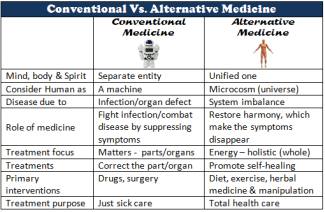
Alternative medicine sees patients as a whole; take care of everything physical, mental, and emotional. Conventional medicine looks them as machine.
Compare Conventional & Alternative Medicine
Alternative medicine are mostly traditionally followed for thousand of years and are well tested, whereas conventional medicine are modern medicine based on science. In this artile let us see how these medicinal system consider the health, disease, role of medicine, goal of treatment, etc.
Origin of disease
Conventional medicine believes germs/genes caused disease and this offending pathogen, metabolic error, or chemical imbalance would eventually correct with an appropriate vaccine, antibiotic, or chemical compound. Conventional medicine believes that we live under constant attack by the thousands of microorganisms causing diseases. We must defend ourselves and counterattack with treatments to kill the enemy is a microorganism). They assume symptoms as harmful manifestations and require suppression.
Alternative medicine believe in vital energy imbalance is a blocked or weakened) caused disease due to reduced vitality of the organ, tissue or cell, oxygen shortage, waste accumulation, and organ degeneration. Correct with appropriate diet, exercise, herb, manipulation to rebalance the vital energy to heal the disease. Alternative medicine believes that microorganism always surrounds us and it makes damage only if energy imbalance happens. A balanced organism exhibits strong defense against external influence is a microorganism or other things). They consider symptoms as the organism’s effort to re-establish balance.
Meaning of Health
Conventional medicine practitioners consider health as the absence of any disease, illness or other abnormal conditions. They define health as a state of well-being.
Alternative medicine practitioners consider health as a balanced and harmony as a whole; that is body, mind, emotions and spirit. Physical health means the optimal functioning of all body systems. Emotional health means the ability to feel/express the whole range of emotions. Mental health means a sense of wellbeing, confidence and self-esteem. Spiritual health is the ability to find life events meaning, demonstrate individual purpose and the ability to be compassionate towards others.
Healing Process
Conventional medicine promotes treatments with drugs, surgery, radiation to cure people, and they trained to fix or repair broken parts. The focus of the treatment is on the infection, disease or abnormal conditions. Treatment purpose is against sickness.
Alternative medicine promotes treatment with diet, exercise, herbs, manipulation to unblock the vital energy and re-established free flowing through the body. Self-healing occurs once we restore the balance and harmony. The purpose of treatment is to total health care.
Incontinence Lifestyle Care
Incontinence treatments start with simple lifestyle changes, in most of the cases, there is some improvement notable with in four to six weeks.
Incontinence treatment by lifestyle changes
Talk with your doctor about which treatments might work best for you. It is always advisable to start treatment with lifestyle modification to combat incontinence.
Pelvic Muscle Strengthening - Many women prefer to try the simplest treatment choices first. Kegel exercises can strengthen the pelvic muscles and to perform the exercise it did not require any equipment. You can do Kegel exercise anywhere the main thing is finding the right muscles to squeeze. You can see a visible change in the bladder control after about six to eight weeks of kegel exercise.
Change habits to combat incontinence - Timed voiding by preparing a timetable after analyzing the times at which urine leak occurs. Follow the timetable and plan to visit a bathroom ahead of time to avoid an accidental leak. Once established a safe timetable, and then build the bladder control by stretching out the time between trips to the bathroom. By forcing the pelvic muscles to hold on longer, makes those muscles stronger.
Diet changes by avoiding certain foods and drinks cause to urinate more often. For example, caffeinated drinks like coffee, tea, or cola should avoid. Instead, choose the decaf version of the favorite drink. Follow a regular fluid volume and so the urine volume thus bladder is practiced to it. You should not avoid drinking fluids just for fear of having an accident; certain quantity of fluid is necessary for proper functioning of the body. If bothered by nighttime urination, drink most of the fluids during the day and limit after dinner.
Weight loss can help to lower extra pressure on the bladder due to over weight and helps to regain the bladder control.
Alternative Medicine Terms
Alternative medicine is commonly calling with different terms; they are Traditional medicine, Holistic medicine, Natural medicine, and Complementary medicine.
Alternative Medicine Terms (Other names)
Literally, alternative medicine means alternative to "something else.” This something is conventional or western medicine or allopathic or orthodox medicine.
Traditional medicine - This is a very old medicinal system practiced from time immemorial, and it is following from tradition to tradition. Effectiveness of the treatment is time tested and proved. Almost all the alternative medicines are following for traditions, and they are time tested.
Holistic medicine - Most of the alternative medical systems consider a human body as a complete being comprises of physical, mental, social, and spiritual dimensions. This whole consideration instead of the physical body alone called as a holistic approach.
Natural medicine | Herbal medicine | Ayurveda - These methods of treatments are base on the laws of nature, and natural substances are use to treat the patients. Ayurveda, herbal, homeopathy, and naturopathic all called as natural medicine.
Complementary medicine - Possibility of treating an illness by the combination of two or more alternative medicinal systems, which one compliments the other in the treatment, and so it called as Complementary medicine.
Integrative medicine - Combination of knowledge of traditional and modern medicinal practices is ultimately superior to a single model approach of treatment, and this combination called as Integrative medicine. This integrated approach can provide safer, faster, and more efficient treatment. Integrative medicine is the combination of alternative medicines and modern medicine.
Incontinence Special Tests
You may require additional test if incontinence still presents after treatment. Urologists will perform urodynamic, endoscopic, and imaging tests.
Special tests for Incontinence diagnosis
If previous treatment fails, then need specialized tests to get a more extensive assessment of the lower urinary tract.
Postvoid residual volume (PRV) - This test requires catheterization or pelvic ultrasound. The patient is requests to voids just before the PRV measurement. Examine the initial void for hesitation, strain, or interrupted flow. A PRV of less than 50 mL indicates adequate bladder emptying (normal). If repeated measurements of 100 to 200 mL or higher indicates inadequate bladder emptying. Repeated measurements may be necessary to confirm the result.
Urodynamic Testing - Cystometry may be useful to assess the anatomic and functional status of the bladder and urethra. The cystometer measures the pressure and capacity of the bladder; it can thus assess the function of the detrusor muscle.
Uroflowmetry helps to diagnose any abnormal voiding patterns. Urethral pressure profilometry measures the resting and dynamic pressures in the urethra.
Endoscopic Tests - Cystoscopy helps to examine the presence of bladder lesions (e.g., cysts) and any foreign bodies.
Imaging Tests - X-rays and ultrasound may be useful to assess physical conditions associated with urinary incontinence. Images of the lower urinary tract before, during, and after voiding may help to examine the anatomy of the urinary bladder and urethra.
Incontinence Diagnosis
Diagnosis of incontinence can start from detail medical history of the patient, physical examination, and bladder function tests.
Incontinence diagnosis
For better diagnosis of bladder problems, the doctor may need your medical history:
- List of medicines taking to include prescribed and over the counter medicines.
- Drink fluids regularly; including sodas, coffee, tea, and alcohol.
- Quantity of each drink has in an average day.
- Inform doctor about any recent surgeries or illnesses.
- Finally, keep a record of the times; when are the urine leakages? Note what physical activities are doing at the time such as coughing, laughing, sneezing, or exercising. Whether have an uncontrollable urge to urinate when heard of running water?
Physical examination for incontinence diagnosis
A detailed physical examination is required to assess the causes of the bladder control problem.
- Checking reflexes can help to assess the possible nerve damage.
- Diagnose urine sample for a urinary tract infection.
- The exam may include a pelvic exam.
- Tests may also include taking an ultrasound picture of the bladder.
- Examine the inside of the bladder using a cystoscope (a long, thin tube that slides up into the bladder through the urethra).
Bladder Function Tests
Pressure test to measure the bladder pressure at which leakage starts, by filling the bladder with a warm fluid. Stress test is by relaxing followed by a strong cough to see if urine leaks.
Bladder testing may sound embarrassing, but the health professionals who perform the tests will make you feel comfortable and give enough privacy.
Alternative Health Benefits
Nowaday alternative medicine is gaining popularity because of its effective healing without any side effect and comparatively cheaper.
Alternative medicines / health Popularity
- Recently there is a boom in various systems of alternative medicine and more patients are opting for alternative systems of medicine. Many articles in leading magazines/newspapers, which reveals the popularity for alternative health approach.
- Now people start showing renewed interest in alternative healing medicines that were long ago discarded in consequent on the dynamic science of Allopathic. However, after decades of serious passion on the modern medicine system that came from the west, now people have started looking at their ancient traditional medicine systems again. The reason behind this comes back from modern medicine is due to its increasing side effects, and people are panic of such effects.
- Modern medicine not only has increased side effects and has steep increase in the price of the diagnosis, medicine, and treatments.
- People with illness are frustrated of not getting the desired cures of their ailments from the orthodox medicine, thus, they are looking for some alternative healing that will bring relief and possible healing.
Hence, an increased interest and importance on the alternative healing system are clearly visible in the minds of the peoples.