
Rasa dhatu

Rasa is a Sanskrit word meaning 'juice' or 'essence'. Rasa dhatu refers to sap, juice or liquid; all extracellular fluids such as blood plasma (non-cellular portion of the blood), interstitial fluid and lymph.
Rasa Dhatu - Plasma, lymph & interstitial fluids
How, what, why & everything about Rasa Dhatu:
- Proper digestion of the food by Jataragni (digestive fire) converts the food into an essence (nutritional extract coming from the gut after the digestion of food) called ahara rasa (food essence) or poshaka rasa (nutritional essence). This Rasa appears in the form of pure ghee.
- Rasagni (digestive fire of rasa dhatu) converts this ahara rasa into rasa dhatu along with minimal waste product mucus.
- This process of converting food to rasa dhatu takes about 12 hours.
- Quantity of rasa dhatu in the body is 9 anjali (measure of 9 own hallow handful). This is the maximum quantity of rasa dhatu in the body.
- Rasa dhatu being pushed by the Vyana vayu (vata subtype) to reach hridaya (heart).
- Rasa dhatu circulates all over the body to nourish each & every cells. However, its main site is said to be hridaya (heart - where it starts).
- From and by the heart, rasa dhatu is circulates to different parts of the body with the help of Vyana vayu.
- Rasa dhatu nourishes the tissues, organs, and every cell in the body.
Extracellular fluids blood plasma (non-cellular portion of the blood), interstitial fluid and lymph are all rasa dhatus.
Blood plasma
The extracellular fluid within the vascular system is the blood plasma. Blood cells and platelets suspended in the plasma. The blood plasma contains dissolved oxygen, carbon dioxide, salts, amino acids, fatty acids, hormones, and plasma proteins. Plasma acts as a protein reserve of the human body.
Interstitial fluid
When blood flows through capillaries, the blood plasma literally leaks out of the capillaries into the tissues (interstitial space), this fluid called interstitial fluid. Interstitial fluid is considering as ultra-filtrate of plasma. It transports nutrients from the plasma to the cells and transport back carbon dioxide and other wastes from the cells. Most of the tissue fluid (about 90%) is returned to the plasma through capillaries by osmosis.
Lymph
Interstitial fluid and lymph are same, although the fluid is not lymph until it enters the lymphatic system. When there is an increase in the interstitial fluid volume, the lymph capillary will open up to absorb the excess fluid, this absorbed liquid called lymph. Functions of the lymphatic system are
- Removal of excess fluids from body tissues,
- Absorption and transportation of fat and fat soluble vitamins from the intestine to the circulatory system,
- Production of immune cells (such as lymphocytes, monocytes, and antibody producing cells called plasma cells),
- Transport back metabolic waste & dead cell particles from the interstitial space to plasma.
When the volume of the blood reduces in the blood vascular system, the lymph rushes from the lymphatic systems to the blood vascular system. A functioning lymphatic system is important for a healthy immune system.
The plasma transports waste products such as uric acid, ammonium salts, creatinine etc. from the cells to the kidneys. The kidneys filter out these wastes from the plasma and excrete through urine.
Indications of healthy Rasa dhatu
Healthy rasagni produces healthy rasa dhatu along with minimal mucus (waster product) formation. The health of rasagni depends on the jatharagni (main digestive fire). A person with healthy rasa dhatu feels satiated both physically and psychologically.
Optimal rasa dhatu provides good physical and mental health. Signs of optimal state of rasa dhatu are:
- A Happy, warm, and loving person.
- Soft and lustrous skin.
- High intelligence and strong memory.
- Low deep voice and slowly talking person.
Rasa dhatu deficiency
Symptoms of rasa dhatu deficiency are skin dryness, fatigue, chest pain, palpitations, blackouts, trembling, and too much thirst.
Dry or cracked membranes indicate depletion of rasa dhatu. Decreased sweating also indicates rasa dhatu depletion. Redness, inflamed, and burning sensation of the membranes indicate depletion of rasa dhatu due to too strong rasagni that burnout rasa dhatu.
Treatment for rasa dhatu deficiency: Depleted rasa dhatu due to low rasagni can be corrected by raising jatharagni and rasagni by taking hot spices such as ginger, cumin and black pepper. Drink lots of liquid (preferably warm at least at room temperature), fruit juices according to your dosha. Home remedy for rasa dhatu deficiency is drinking juice of Jiggery, dates, and raisins in hot water.
Rasa Dhatu Surplus
Symptoms of increased rasa dhatu are nausea, feeling cold, over salivation, lethargy, feel heavy, low Agni, pale color, cold, cough, dyspnea (difficult breathing), asthma, and over sweating.
Treatments for rasa dhatu excesses: Fasting, having drying property foods & herbs, and Vamana (vomiting therapy). Excess of rasa dhatu due to high rasagni, correct it by lowering jatharagni and rasagni by taking heavy to digest foods such as fats and oils (i.e. nuts and meats).
Rasa Dhatu vitiated (imbalanced)
Imbalanced rasa dhatu leads to following symptoms, they are destruction of digestive strength (metabolic fire), anorexia (lack of interest in the food), foul taste in mouth, tastelessness (lack of tasting capacity), nausea, feel heaviness, drowsiness, fatigue, malaise (illness whose exact cause is difficult to identify), body ache, fever, feel darkness before eyes, anemia (pale discolored skin), obstruction of body channels, pain in body parts, impotency, emaciation (abnormally thin or weak - shrunken body parts), weaken digestive power, premature wrinkles in the skin, and graying of hairs.
Causes of contamination of rasa dhatu are heavy to digest foods (consuming excess of oily foods), cold foods, excess eating, and excessive thinking (stress).
Treatment for contaminated rasa dhatu: Therapeutic emesis (induced vomiting), therapeutic purgation (evacuation of the bowels using laxatives), nasal medications, cleansing enemas (liquid injected into the rectum to expel contents and to clean it), not drinking water, exposure to breeze, exposure to sunlight, medicine to eliminate ama (metabolic wastes), fasting (starvation), and exercise.
Avoid all difficult to digest that vitiate rasa dhatu such as fried foods, heavy foods (cheese, meat, oil and fats), and eating or drinking anything cold.
Ayurveda Seven Dhatus

The word dhatu comes from the root word dha means basis or foundation. In Ayurvedic medicine, the dhatus (tissues) are the structural component nourishes the body.
There are seven (sapta) primary dhatus: rasa (plasma tissue, lymph), rakta (blood, red blood cells), mamsa (muscle), meda (adipose tissue, fat), asthi (bone & cartilage), majja (nerve, marrow, connective tissue), and shukra/artava (male & female reproductive system).
During the process of digestion each dhatu nourishes with nutrition to carry our physiological tasks in the body; the left outs becomes the waste product or mala.
- Food we eat is firstly converting into Rasa.
- After Rasa formation, the remaining converts into Rakta.
- After Rakta formation, the remaining converts into Mamsa.
- After Mamsa formation, the remaining converts into Meda.
- After Meda formation, the remaining converts into Asthi.
- After Asthi formation, the remaining converts into Majja.
- After Majjas formation, the remaining converts into Shukra.
Dhatvagni
All the seven tissues of the body contain their own Agni to metabolize the nutrients supplied to them through the channels of circulation.
- Rasagni in the Rasa Dhatu (plasma tissue, lymph)
- Raktagni in the Rakta Dhatu (blood, red blood cells)
- Mamsagni in the Mamsa Dhatu (muscle)
- Medagni in the Meda Dhatu (adipose tissue, fat)
- Asthyagni in the Asthi Dhatu (bone & cartilage)
- Majjagni in the Majja Dhatu (nerve, marrow, connective tissue)
- Shukragni in the Shukra Dhatu (male & female reproductive system)
Ahararasa
According to Ayurveda theory, the foods and liquids are digesting by the digestive system into ahara rasa, a milky substance similar to chyle; the waste becomes feces and urine. Jatharagni is the main digestive fire; if jatharagni is healthy, digestion is perfect.
There are four functional states of jatarāgni according to the influencing dosha or doshas; they are Mandagni, Tikshnagni, Vishamagni, and Samagni.
Ayurvedic Kapha Types
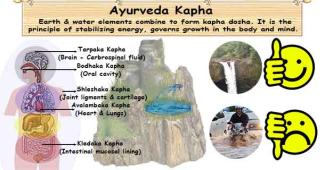
Kapha is a Sanskrit word “Ka” which means water and “pha” which means to flourish. Kapha comprises all our cells, tissues and organs as is responsible for maintaining structure of the body as well as keeping it moist and well lubricated.
The elements earth and water combine to form kapha dosha. It is the principle of stabilizing energy, governs growth in the body and mind, is concerned with structure, stability, lubrication, and fluid balance.
Ayurvedic Kapha Types
Five types of kapha dosha:
Kledaka Kapha located within the mucosal lining of the gastrointestinal tract. It provides protective lining to protect from the acidic (HCL) environment and other acidic gastric enzymes. Abnormality of this kapha leads to high cholesterol, obesity, diabetes, and gastritis.
Avalambhaka Kapha located within the chest cavity nourishing the plueral of the lungs and the pericardium of the heart. It provides structural integrity of the lungs by maintaining the adequate smooth muscular tone of the airways needed for adequate ventilation. Abnormality of this kapha leads to wheezing, asthma, COPD, cough, and pericardial effusion.
Tarpaka Kapha located within the white matter of the central nervous system providing nourishment and protection to the brain in the form of cerebrospinal fluid. Additionally, in the form of myelin sheath of neuron it provides insulation required form proper neuro-electrical impulses. Balanced Taroaja kapha provides wellness and contentment within the mind. Abnormality of this kapha leads to debilitating neurological conditions such as multiple sclerosis; increased secretion (in ear, nasal, eye), memory loss, insomnia, dry eye, and tumors.
Bodhaka Kapha located in the mouth in the form of saliva, which is liquid, sticky and sweet. It keeps the oral cavity moist, well lubricated, helps initial stages of digestion of simple carbohydrates, and supports the passage of chewed food to stomach with low resistance. Abnormalities of this kapha are receding gums, gum infection, and tastelessness.
Shleshaka Kapha predominately present within synovial fluid of the joints, nourishing the articular surface. It ensures lubricate, stability, and flexibility of the joints. Abnormality of this kapha leads to degenerative changes within the skeletal system such as osteoarthritis and rheumatoid arthritis.
What is kapha, what it performs?
Kapha dosha is composed of elements earth and water. This dosha is responsible for growth and homeostasis of the body. It is produced in the body as a post-digestive product (a form of energy), and its quality and quantity depend on the food consumed and their proper digestion.
Its main working locations are the mucous-producing tissues and organs such as those in the chest and gastric regions, palate, joints, plasma and lymph. It provides body structural stability. It lubricates and moisturizes body tissues to maintain normal functioning. It renews old cells, heals wounds and contract corrosive properties of pitta and vata. Kapha on mental and emotional level provides calmness and steadiness.
Factor that disturb kapha balance
An excessive intake of food such as starchy, sweet, cold, oily or fatty foods will prevent pitta dosha from performing its normal functions.
Lifestyle factors that aggravate pitta include too much of sleep, lack of physical/mental activity, sedentary lifestyle, eating of cold heavy foods, and windy wet climate can lead to pitta unbalanced.
Unbalanced kapha manifestations are loss of appetite, dullness, pale body, fast heartbeats, labored breathing, nasal congestion, cold, coughs, sinusitis, pneumonia, asthma, rheumatic conditions, and the body becomes heavy, cold, slow and lethargic.
How do we reestablish kapha balance?
We can pacify kapha and bring back harmony by various means; they are, taking herbs, taking & avoiding certain foods, and making certain lifestyle change.
Below are the tips to harmonize kapha:
- Kapha pacifying herbs and spices are ginger, pippali, lavanga and haritaki.
- Enjoy foods that are pungent, bitter or astringent. Take foods that are warm both in energy and in temperature.
- Avoid foods that are sweet, sour and/or salty.
Ayurvedic Pitta Types

Piita is a Sanskrit word means illumination often associated with the brilliance, which radiates from fire. The elements fire and water combine to form Pitta dosha. It is the principle of transformation energy. It governs heat, digestion, and metabolism.
Ayurvedic Pitta types
The five types of Pitta include,
Pachaka Pitta governs digestion, stimulates digestive enzymes and separates nutrients & waste products. In unbalances, its pathological manifestations are anorexia, rise of body temperature, burning sensation, indigestion, hyperacidity, ulcers, nausea & vomiting, low appetite, poor digestion, bloating, constipation, etc. The most effective ways balancing this pitta is the use of mild purgatives consists of bitter and cooling herbs such as Rhubarb and Amalaki.
Ranjaka Pitta is a Sanskrit word means giving color. It is present in the liver and spleen involved in the production and maintenance of blood through the process called erthyogenesis. The spleen acts as a filter and blood reservoir. If imbalance occurs, its pathological manifestation is anemia, jaundice, hepatitis, and abnormal skin pigmentation.
Sadhaka Pitta is responsible for intelligence and memory. Sadhaka Pitta is present in both the brain and heart. It regulates aspects of the hypothalamus ultimately to maintain balance and homeostasis of the whole body. It can look upon as neurochemistry involving certain neurotransmitters such as dopamine and serotonin responsible for cognition and understanding. Consider Sadhaka pitta as the brilliance, able to make sense from digested incoming information. This pitta accomplishes dynamic transformation of thoughts into feelings and feelings into emotions. The pathological manifestations are lack of concentration, dullness of mind, sleep deprivation, etc.
Alochaka Pitta governs optical perception required for vision. It gives luster to the eyes, responsible for dilation and contraction of pupil associated with clarity and clear perception. The pathological manifestations are pertaining to eye and vision; conjunctivitis, blepharitis, styes, etc. Herb rose petals helps balance this pitta.
Bharajaka Pitta governs luster and body complexion, heat, and skin pigmentation. It helps with the biochemical reactions within the skin and production of Vitamin D and melatonin. The pathological manifestations are pertaining to skin problems such as skin discoloration, eczema, psoriasis, acne, skin cancer and other skin diseases. Sweet and bitter herbs such as Aloe Vera help balancing this pitta.
What is Pitta, what it performs?
Pitta is composed of fire and water. Pitta energy is responsible for digestion, metabolizes food through enzymes and intestinal secretions and converts into blood, bones, muscles, etc. Pitta maintains body temperature and hormonal levels; trigger hunger and thirst; provides complexion to the skin; sharpens the intellect and memory; enhance daring, courage and will.
Pitta energy in the mind is considering as mental fire necessary for will power, decision-making, courage, ambitions, optimism, intelligence and creativity.
Factor that disturb Pitta balance
An excessive intake of food such as hot, spicy, sour, fried, oily, fermented, stale, fast foods, incompatible combinations, artificial colors & flavors, sour-unripe fruits, and alcoholic drinks will prevent pitta dosha from performing its normal functions.
Lifestyle factors that aggravate pitta include excess sun exposure, hot weather, fasting, chemicals, and strenuous exercises. Additionally, too much of mental tensions, economical burden, and competition can lead to pitta unbalanced.
Unbalanced pitta manifest psychological problems such as low will power, indecisive, depressed, lack of interest in life, anxiety, pessimism and mental dullness. Unbalanced pitta manifest physical problems such as digestion problems, elevated/drop in body temperature, burning sensations, ulcers, irritation, redness, skin disorders, hemorrhages, piles, acidity, disturbed sleep, eye problems, loss of confidence, malnourishment, appetite loss/excessive hunger, skin discolorations, and reduced/excessive secretions of hormones & enzymes. Ultimately, the body becomes weak and cold.
How do we reestablish pitta balance?
We can pacify pitta and bring back harmony by various means; they are, taking herbs, taking & avoiding certain foods, and making certain lifestyle change.
Below are the tips to harmonize pitta:
- Pitta pacifying herbs and spices like coriander, cilantro, fennel and cardamom.
- Enjoy foods that are sweet, bitter and astringent. Take foods that are cool both in energy and in temperature. Avoid drinking mild with the meal; instead, take it before or after at least an hour of food. Enjoy your food in a peaceful mind; if not, postpone your mealtime until your mind cool down.
- Avoid foods that are pungent, sour and salty. Avoid foods that are hot both in energy (such as chili and cayenne peppers) and in temperature. Avoid highly processed foods, deep fried foods, red meat, alcohol, caffeine, nicotine, and other stimulants.
Ayurvedic Vata Types
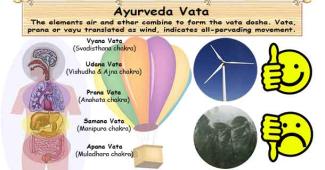
The elements air and ether combine to form the vata dosha. Vata, prana or vayu translated as wind, indicates all-pervading movement.
Vata types in Ayurveda
Vata are five basic types, these pancha pranas (five vatas) are:
Apana Vata working in the kidneys, colon, rectum, bladder and genitals; governs the elimination of waste in general and expulsion of urine, stool, sperm, menstruation, etc. Its location is in between the navel and the anus. Apana Vayu seat is in the Pelvis, Muladhara chakra, and element earth. Mula bandha practice is influence this area and apana vayu. Apana moves from the navel down to the floor of the pelvis. The pathological manifestations of vitiated apana vayu are urinary tract, uterine tract and anal rectal diseases; psychologically feels lazy, dull, confused, indecisive, improper sex drive, and befuddled.
Samana Vata governs peristaltic movement of the digestive system. Samana Vayu seated in the Solar Plexus, Manipura Chakra, and Fire. It corresponds to the area we practice Uddiyana bandha. It unifies prana vayu and apana vayu, the two opposite forces. Samana moves from the periphery of the body into the core. The pathological manifestations of vitiated samana vayu are delusional or unsound mind, shortness of breath, anorexia, bloating, malabsorption, indigestion, constipation, diarrhea and abdominal tumor.
Prana Vata governs inhalation, sense perception, and mind. Prana Vayu seated in the heart/chest, Anahata Chakra, Air. Prana generally means life force. As we inhale, Prana vayu moves upward from the navel to the chest. The Pathological manifestations of vitiated prana vayu are hiccough, flatulence, breathing troubles, etc.
Udana Vata governs speech, self-expression, effort, enthusiasm, strength and vitality. Udana Vayu seated in the Throat and Head, Vishuddha Chakra, Ajna Chakra, Ether. Udana moves primarily up from the throat up to the head. The pathological manifestations of vitiated udana vayu are on the eye, ear, nose and throat. It is consider being the force behind all growth, ability to stand erect, speech, effort, enthusiasm and will. Udana vayu is the force expelling air with the exhalation in a way with speech and the sound production. In the head region, its function is mental expression in the form of ideas and speech. Jalanchara bandha stimulates the energy and movement of Udana and it is consider associating with Vishuddha chakra. This upward moving energy continues through the upper chakra, the Ajna chakra, to the Sahasrara, and purifies during the upward journey. The pathological manifestations of vitiated udana vayu are disconnected speech, cannot speak, not properly articulate ideas, shortness of breath, lack in self-expression, emotional repression, uncoordinated limb movements or loss of balance.
Vyana Vata governs the blood circulation, heart rhythm, ejaculation of sperm, development of all the tissues, and locomotion. Vyana Vayu location is in the center of heart and permeates through the whole body, Svadisthana Chakra, element water. This vayu moves from the center of the body out to the periphery. This vayu pervades the whole body, and runs through the whole network of the 72,000 nadis. This vayu is associating with the energy of the Svadhisthana chakra. The subtler energies involved are enhanced through Mulabandha. The pathological manifestations of vitiated vyana vayu are abnormal cardiac rhythms, poor blood circulation, peripheral edema, tissue ischemia, fever, uncoordinated, lowered sensation, and convulsion.
If vata is balanced, it exhibits mental alertness, muscular body, normal elimination, restful sleep and feeling of happiness. If vata is imbalanced, it manifest restless mind, dry/rough skin, insomnia, constipation, fatigue, headache, cold intolerance, low weight, gas, bloating and shakiness or worry.
What is vata, what it performs?
Vata is composed of air and ether. Vata energy is responsible for the movement in the body, the activities of the nervous system and the process of elimination.
Factor that disturb vata balance
An excessive intake of food such as cold, pungent, bitter, astringent, dry, rough foods and cool drinks will prevent vata dosha from performing its normal functions.
Lifestyle factors that aggravate vata include excess cold exposure, cold weather, and fasting. Additionally, frequent air travel, engage to too many activities, sleep late in night and constantly worrying can lead to vata unbalanced.
Unbalanced vata manifest psychological problems such as doing everything uncontrollably fast; thoughts appears quickly, cannot hold thoughts, hyperactivity, attention deficit, destracted easily, ungrounded, fear, anxiety, depression, and indecisive. Unbalanced vata manifest physical problems such as dryness and manifest as dry skin, dandruff, dermatitis, exzema, chapped lips, brittle nails, dry hair, stiffness, low back pain, constipation, heart palpitations, tremors, gas, and headache.
How do we reestablish vata balance?
We can pacify vata and bring back harmony by various means; they are, taking herbs, taking & avoiding certain foods, and making certain lifestyle change.
Below are the tips to harmonize vata:
- Vata pacifying herbs and spices are cinnamon, nutmeg, ginger, cloves, and cardamom.
- Enjoy foods that are sweet, sour and salty. Take foods that are hot both in energy and in temperature. Enjoy your food joyfully, slowly and masticating it well without any hurry. Prefer Warm Over Cold; Moist and Oily Over Dry; Grounding, Nourishing, and Stabilizing Over Light; Smooth Over Rough.
- Avoid foods that are pungent, bitter and astringent. Avoid foods that are cold both in energy and in temperature.
TCM treatment

Chinese medication involves the use of herbs, animal parts and minerals. They used it based on taste, action, attributive of meridians, and toxicity.
TCM treatment procedure
Traditional Chinese medication involves the use of herbs, animal parts and minerals. The terminology used in describing the pharmacology of Chinese medicine includes; its property; taste or flavor; action of ascending, descending, floating and sinking; attributive of meridians, and toxicity.
- Its property can be describing in four ways, they are cold, hot, warm, and cool. For example, herbs effective for treating heat syndromes are herbs with cold or cool properties, while herbs effective for cold syndromes are herbs with warm or hot properties.
- Tastes or flavors of herbs are sour, bitter, sweet, pungent, and salty. They are expressing the feature of medicine’s actions not the real taste.
- Action of the medicines describing the direction of action, they are ascending, descending, floating and sinking. The ascending and floating medicines have an upward and outward effect, while descending and sinking medicines have a downward and inward effect. They change the action of a medicine, by processing or combining with other ingredients.
- Attribute of meridians, classifies herbs according to the meridians on which their therapeutic action is manifests.
- Toxicity refers to the harmful effects produced by herbs on the human body. Toxicity are marked by highly toxic, moderately or slightly toxic to indicate the different degrees of toxicity.
A typical medicine is composed of principal, associate, adjuvant, moderate, and messenger ingredients. The principal ingredient is a substance provides the main therapeutic action; associate ingredient is a substance enhances or assists the therapeutic action of the first ingredient; the adjuvant ingredient treats the accompanying symptoms, and moderate ingredient diminishes the harshness or toxicity of the combination; the messenger ingredient guides the medicine to the proper organs.
Acupuncture
Acupuncture believed to normalize qi flow along the pathways (meridians) of the body by puncturing with sharp instrument (thin needles). Any potential disruptions of qi flow are responsible for illness or disease. Acupuncture corrects this disruption of qi flow by inserting a needle at specific acupuncture points.
Moxibustion
Moxibustion is useful to treat disease by the application of ignited moxa at acupuncture points. The herb used in moxibustion is mainly Artemisia Vulgaris (mugwort). Moxibustion is generally applicable for conditions associated with cold syndrome, deficient conditions and chronic illness. Moxibustion may be applying in combination with acupuncture or separately for effective treatment.
Qigong
Qigong is the Chinese word; qi means vital energy, and gong means method or performance. Qigong is a method of performing exercise by taking certain posture, breathing and concentrating mind. Qigong is useful for health preservation, prevention and treatment of disease. Qigong works to relax, calm and regulate breathing to accumulate vital energy in the body.
TCM Diagnosis

TCM diagnosis includes two parts; they are diagnosis of disease (nspection, auscultation & olfaction, interrogation and palpation) and differentiation of syndromes.
TCM diagnosis methods
The process of diagnosis involves four major things; they are inspection, auscultation & olfaction, interrogation and palpation.
- Inspection is the process of examining physical & mental state, complexion, behavior, secretion, excretion, and tongue observation.
- Auscultation and olfaction is the process of detecting patient status by listening to their voice, respiration, coughing, and body odor.
- Interrogation is a way to interview the patient to know their family history to assess patient’s health status, major complaints, and progress of illness.
- Palpation is the most important part of TCM diagnosis; it involves pulse reading and body palpation.
They will arrive for final diagnosis using the information gathered from all the above-mentioned diagnosis.

Differentiation of syndromes is a process to decide the characteristics of disease and syndrome. This process also utilizes the result of diagnosis to arrive conclusion. Syndromes in TCM reflect the pathogenesis and pathophysiology as well as provide basis for the prevention and treatment of the disease.
Inspection
Inspection is the process of examining physical & mental state, complexion, behavior, secretion, excretion, and tongue observation.
- Note the physical appearance such as hair, skin, voice, complexion (body color), etc. For example yellow colored eye indicate jaundice. Specifically, pale yellow signifies yin jaundice and dark yellow signifies yang jaundice. The treatment would be different for these two types of jaundice.
- Notify the mental states such as behavior, secretion, excretion, etc.
- Tongue observation is considering as the major diagnostic tool. Tongue is considering as the mirror of the internal environment of the body. The tongue possesses the reflection of the internal organ structure in specific locations. Even TCM doctors look into your tongue in every visit to measure the progress of health improvement. For example, the healthy tongue is pale red with a thin white coat; red tongue indicates heat syndrome; pale indicates qi or blood deficiency; purple signifies stagnation.
Auscultation and olfaction
Auscultation and olfaction is the process of detecting patient status by listening to their voice, respiration, coughing, and smell.
- Observe the respiration, whether it is normal, low or forceful. For example, feeble breathing accompanied by shortness of breath indicates xu syndromes; forceful breathing with a coarse voice indicates shi heat syndromes.
- Course coughing usually indicates shi type syndromes. A low cough with weak breathing indicates xu syndromes.
- Foul breath indicates pathogenic stomach head, indigestion, and unclean mouth; sour breath indicates food accumulated in stomach; offensive smell of secretions or excretions (stool, urine, sputum, pus. leucorrhea, etc.) indicates heat syndrome of shi type; stinking smell indicates cold syndrome of xu type.
Interrogation
Interview the patient to know their family history to assess patient’s health status, major complaints, and progress of illness.
You TCM doctor will hear your health explaining, ask question to know you more, and interrogate to reach specificity.
Palpation
Palpation is the most important part of TCM diagnosis; it involves pulse reading and body palpation. Pulse reading assesses pulse quality in the radial arteries of both wrists. TCM identified 28 different pulse qualities with its own subtle interpretation. This helps to examine the strength and weakness of qi & blood, as well as to predict the progression of the illness. Body palpation is the feeling of the body’s meridians, temperature, and moisture, especially when pain is concern.
Health Condition
According to TCM, health implies that the body system is in a state of dynamic equilibrium, not only between the various parts of the body but also between the body and environmental conditions.
How Does Traditional Chinese Medicine Work?
The Chinese regard the body as a system that requires a balance of yin and yang energy to enjoy good health. Each part of the body thought of as an individual system that requires its own balance of yin and yang to function properly. TCM assumes that a balanced body has a natural ability to resist or cope with agents of disease. Symptoms caused by an imbalance of yin and yang in some part of the body, and illness can develop if the imbalance persists for any length of time.
Disease causing Pathogens in TCM
Disease results when there is disturbance in the equilibrium. That is imbalance of yin and yang by certain factors called pathogenic factors causing disturbance in the harmony and balance of the body. In TCM, these are classifying as exogenous and endogenous pathogenic factors.

In short, health or disease depends on the outcome of the struggle between the vital energy and pathogenic factors. Pathogens cannot do harm, when vital energy is sufficient; however, when the vital energy is in deficiency pathogens can harm the body.
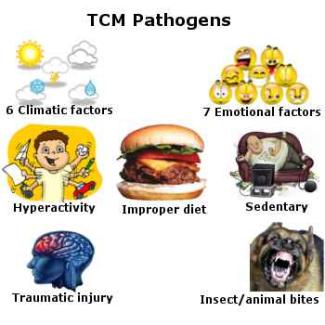
In TCM, the causes of diseases are generally fall into the following categories; they are:
- 6 Exogenous (Climatic) factors
- 7 Endogenous (Emotional) factors
- Improper diet
- Hyperactivity – too much activity
- Sedentary – too little activity (stagnation)
- Traumatic injury
- Insect, reptile or animal bites
Six exogenous factors
Spring-wind, summer-heat, summer-fire, later summer-dampness, autumn-dryness, and winter-cold are the six climatic variations of the four seasons known as the six climatic factors or the six exogenous qi. The human body has the ability to adapt to these climatic variations. However, when there is low adaptability to climatic changes, then the six climatic qi will become pathogenic factors bringing about the occurrence of disease.
Seven endogenous factors
Joy, anger, worry, anxiety, sadness, fear and fright are the seven emotions. The human body has the ability to adapt to these emotion extremes. However, when the emotional stress is more than once adaptability, then the seven emotions will become endogenous pathogenic factors causing disease.
- Anger - associated with the Liver system
- Joy - associated with the Heart system
- Worry/ Overthinking - associated with the Spleen/Stomach system
- Grief - associated with the Lung system
- Sorrow - (chronic grief) associated with the Lung system
- Fear - chronic condition (phobias) associated with the Kidney system
- Fright - acute condition - associated with the Kidney system.
Improper diet
Food partiality - Normally people should take a variety of food in proper proportions in order to ensure a balanced nutrition. There are two different cases in food partiality, partiality to cold or hot food and partiality to the five flavors.
- The five flavors are attributing to the five zang-organs respectively: Sweet linked to the Spleen/Stomach, Sour linked to the Liver, Bitter linked to Heart, Salty linked to the Kidney, and Pungent linked to Lung.
- Unhygienic food - can cause gastrointestinal problems such as abdominal pain, vomiting and diarrhea.
- Starvation and overeating - Starvation refers to prolonged lack of food and insufficient intake of food. Overeating means excessive intake of food.
Disease prevention in TCM
TCM pay its most attention to the maintenance of the vital energy. The traditional Chinese medicine is essentially a health maintenance and disease prevention-oriented medicine. This preventive philosophy of TCM is of two levels: preventing the occurrence of disease and preventing further progression of disease.
Body Fluids

The basic substances are Blood (Xue), Essence (Jing), Spirit (Shen), and Body Fluids (Jin Ye). You will find out about the concept and functions of each substance as well as ways to maintain their health and balance within the body.
What are body fluids in tcm?
Traditional Chinese Medicine consider 4 types of body fluids, they are blood, jing, jin-ye, and shen.
Blood
The first source of blood is mainly produced from food essence and Jing (the essence of life required for the growth and development). The stomach and spleen digest the food and turn into food essence. This food essence is transport by the spleen to lungs where it produces blood with the help of heart and lungs.
A second source of blood produced from Jing, which is a life essence stored in the kidneys. Jing goes to the bones where its forms healthy marrow. The bone marrow in turn produces the blood. Jing also goes to the liver forming clear blood.
The Function of Blood
- Blood nourishes the body, also complements the action of Ying Qi. Blood is considering as a denser form of Qi; it flows with the (Ying) Qi in the vessels and channels all over the body.
- Blood moistens body tissues; prevent dry out.
- Blood nourishes and supports the Shen resides in the blood vessels, which are part of the heart.
When blood is deficient, Shen becomes uneasy with symptoms of vague anxiety, slight irritability, unease and inability to fall asleep.
Jing
Jing is the vital essence of the body, which is the secret of good health and longevity. Jing is of two types they are prenatal jing and postnatal jing.
- Prenatal jing is an inherited congenital essence from their parents (mother and father) at conception. It is a fixed quantity, which considered irreplaceable (cannot renew). It determines the constitution (genetic make-up) you born with, how healthy you are mentally and physically as well as your ability to fight illness. Prenatal essence will be gradually spent during growth, physical and mental development, reproduction, and aging process. A life with an excess utilization of jing due to stress, excess sex, lack of rest, poor nutrition, etc. can lead to health decline involving chronic incurable illnesses.
- Postnatal jing is acquired essence derived from the food you have digested and is distribute to every organs and tissues. When in good health and cultivate jing with proper nutrition, rest, unstressed, moderate sex, etc for optimum functioning of the body. The energy not used on everyday basis gets refined to postnatal jing.
Prenatal converted into postnatal; however, this will replenish prenatal jing. Higher demand of energy due to illness protecting prenatal jing from being used faster. Some even consider a third jing know as kidney jing, it is the combination of prenatal and postnatal jing stored in kidney.
Jin-Ye
Jin-Ye is a generalized term for all bodily fluids includes saliva, gastric juices, phlegm, tears, mucus, and sweat. All these body fluids are extracting from our food and water processed by the spleen and stomach.
Based on the nature, form and location the body fluids are of two categories, they are Jin and Ye.
- Jin means clear fluid. Body fluids, which are clear and thin, are Jin. Jin fluids are transfer partly in the blood, also manifest as sweat.
- Ye mean turbid or cloudy fluid. Body fluids, which are thick and heavy fluids are ye. Ye fluids nourish the inner body parts such as joints, body orifices, brain, and bone marrow.
Body fluids moisten and nourish every body parts. The generation, transportation and excretion of body fluids are a complicated processes by the coordinated activity of Zang Fu organs specifically lung, spleen and kidney.
Jin-Ye circulate through the body under the influence of the spleen, lungs, and kidneys. If there is any weaknesses, in one of these organs may lead to fluid deficiency or dysfunction.
Shen
Shen means spirit or mind, indicating our consciousness, mental functions, and mental health.
Shen resides in the blood vessels (part of heart system) nourishes by the blood. It retires to sleep at night; however, disturbance in the shen may lead to insomnia. As per TCM pathology deficiency in blood fails to nourish the shen, also heat from various organs may disturb the shen.
Through eyes, you can view the state of the shen. Healthy shen produce bright shiny eyes. Disturbed or weaken shen produces dull cloudy eyes; often seen in case of long-term emotional disturbance or serious shock, eve that occurred long ago.
Healthy shen depends on the quality of jing and qi. If the jing and qi are healthy, they will nourish shen.
TCM Organs
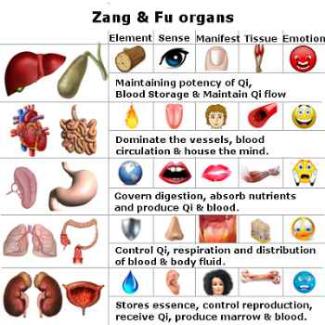
The concept of organs in TCM is entirely different from that of contemporary western medicine.
Category of Organs
The organs in TCM are grouped into two categories they are Zang and Fu.
- Zang – are otherwise call as Yin organs, they are generally more physically solid in nature.
- Fu – are otherwise call as Yang organs, they are generally hallow in nature.
Zang & Fu Organs
Zang organ with Yin energy are generally more solid nature involve in regulation, manufacture and storage of fundamental substances. The organs come under this category are kidney, liver, heart (pericardium), spleen and lungs.
Fu organs with Yang energy are generally hallow in nature involve in receiving, separating, distributing, and excreting substances. The organs come under this category are stomach, gall bladder, large intestine, small intestine, bladder and san jiao.
- Zang organ Liver & Fu organ Gallbladder - Element: Wood, Sense: Eye, Manifest: Nails, Emotion: Anger, and Functions: Maintaining potency of Qi, Blood Storage & Maintain Qi flow. Emotional disturbances such as depression or anxiety cause liver dysfunction and liver problem causes emotional disturbances. Symptoms of liver hyperactive are insomnia, dizziness, and vertigo. Sign and symptoms of liver Qi stagnation are distending chest, hypochondria pain, depression, getting anger easily and indigestion. Symptoms of liver deficiency are numbness of the limbs and joints. Symptoms of liver heat are convulsion of the four limbs, and clenching of the teeth. Symptoms of liver yin & blood deficiency are eye dryness, blurred vision (or night blindness) and nail become soft, thin, crack and even deformed. Symptoms of liver wind heat are red, painful and swollen eyes.
- Zang organ Heart & Fu organ Small Intestine - Element: Fire, Sense: Tongue, Manifest: Face, Tissue: Vessel, Emotion: Joy, and Functions: Dominate the vessels, blood circulation & house the mind. If the heart is strong, the pulse is regular & strong and the face will be rosy. When the heart Qi and blood is deficient, the pulse is weak and thread-pulse and again the face will be pale.
- Zang organ Spleen & Fu organ Stomach - Element: Earth, Sense: Mouth, Manifest: Lips, Tissue: Muscle, Emotion: Anxiety, and Functions: Govern digestion, absorb nutrients and produce Qi & blood. With normal Spleen function, there is a good appetite and taste. Symptoms of spleen Qi deficiency are anemia, abdominal distension, poor appetite, lassitude, loose stools, blood in stool, emaciation, uterine bleeding, malnutrition, weakness of muscles & limbs, pale lips, sticky tongue and poor taste.
- Zang organ Lungs & Fu organ Large Intestine - Element: Metal, Sense: Nose, Manifest: Throat, Tissue: Skin, Emotion: Sorrow, and Functions: Control Qi, respiration and distribution of blood & body fluid. Symptoms of lung Qi deficient are feeble speech, weak respiration, shortness of breath and general lassitude. If lung qi fails to descend and instead ascends, then the signs of stuffy chest, cough asthma, etc.
- Zang organ Kidney & Fu organ Urinary Bladder - Element: Water, Sense: Ears, Manifest: Head hair, Tissue: Bone, Emotion: Fear, and Functions: Stores essence, control reproduction & development, govern water metabolism, receive Qi, produce marrow, and produce blood. Kidney houses both yin (fluid - essence) and yang (warm - Qi) considering as the house of water and fire. Symptoms of kidney yin deficiency are 5-palm heat (heat in chest, palms and soles), afternoon fever, night sweats, male seminal emission and female sexual dysfunction. Symptoms of kidney yang deficiency are coldness, lumbar region pain, knee pain, cold limbs, male impotence and female infertility. Symptoms of kidney qi deficiency are tinnitus and or deafness. The blood and kidney Qi nourish the hair. Its luster or withering, density or scarcity, color and grasping are directly relate to the health of the kidney Qi.