
Reflexology Digestive System
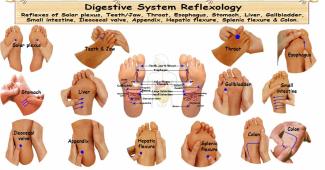
Organs of the digestive system convert food and liquid into useful nutrients. Nutrients from the food carbohydrates, proteins, fats, vitamins, and minerals are absorbed and released into the bloodstream through the intestinal wall. Through the intestinal wall; the nutrients carbohydrates, proteins, fats, vitamins, and minerals are absorbed and release into the bloodstream.
16 Unique Reflexes to Strengthen Digestion
The digestive tract is a long tubular organ comprises the esophagus, stomach, small and large intestines. The digestive tract is 30 feet (9 meters) long, from the mouth to anus.
Solar plexus breathing or push technique
The solar plexus is one of the most crucial reflex points in reflexology. The solar plexus is a complex, dense nerve network or ganglia; thus, called the abdominal brain. This abdominal brain is part of the autonomic nervous system; connecting major abdomen organs to the brain. Solar plexus reflex influences the digestive system as a whole; useful for metabolism and general life functioning. This important reflex point helps the entire body and relax the mind.
How to do reflexology therapy for the Solar plexus? The solar plexus reflex point is straight down the second toe, below foot’s ball within the hollow. Place the thumb as a pivot at the solar plexus reflex on the right foot. Inhale (breath in) for five seconds; make a circle using another hand. Continue pivoting the reflex; hold the breath for 5 seconds. Exhale (breathe out) for 5 seconds; lessening pressure on the reflex point. Take a few calming breaths. Repeat four times.
Repeat the same procedure on the left foot (reversing hand positions if needed).
An alternate method:
Simultaneous apply pressure on both solar plexus reflexes by right & left thumb with a deep inhalation. During exhalation (breath out), lower the applied pressure on the reflex. Finish by releasing the entire pressure on the reflex, while breathing out.
The solar plexus reflex is one of the vital reflex points for stress relief. The solar plexus reflexology therapy is useful for stress relief. Also, it helps to ease symptoms of a hiatal hernia, acid reflux, heartburn, and pain.
The digestive organ reflex:
- Mouth, teeth, and jaw - Teeth reflex are below the big toenails in dorsal aspect. Jaw reflex is below the big toe joint in the dorsal aspect.
- Esophagus – reflex is from the big toe base to the diaphragm line.
- Stomach - reflexes are in both foot from the diaphragm until waistline; in zone 1 (for right foot) and zone 1 to 4 (for left foot).
- Liver and gallbladder - reflex is on the right foot only; from the diaphragm until waistline, in zones 3 to 5.
- Pancreas - reflex is below stomach reflex on both foot; in zone 1 (for right foot) and zones 1 to 4 (for left foot).
- Small intestine - reflex is on both right and left foot; in zone 1 to 4, from waistline until the pelvic line.
- Large intestine - reflex is on both right and left foot; in zone 1 to 5, from waistline until the pelvic line.
Teeth & Jaw reflex areas and Throat reflex point
Teeth and jaw job is to chew food; this plays an essential role in digestion. Jaw and teeth help to break foods; besides, enzymes in the saliva helps to begin the proper digestion.
The throat is behind the mouth; is the pathway linking the mouth, nose, esophagus, and trachea.
How to do reflexology therapy for the teeth, jaw, and throat? For teeth reflex, hold the foot with the left hand; using the index finger, walk horizontally across the big toe below the nail on the dorsal aspect. Repeat three times.
For jaw reflex; using the index finger, walk horizontally across the big toes below the big toe joint on the dorsal aspect. Repeat three lines.
The throat reflex is the joint between the big toe and second toe on the dorsal aspect. Press & rotate, using the index finger.
Esophagus reflex
The esophagus is 8 inches (20 centimeters) long; it moves the food, from the mouth to stomach.
How to do reflexology therapy for the esophagus? Hold the foot with one hand; walk on the diaphragm line between big and first toe metatarsal, using another hand thumb. Cardiac sphincter reflex is a meeting point; trace a route from the junction of the big & first toe, meets the diaphragm line. Press & rotate this point. Repeat four times. Reflexology therapy for the diaphragm and cardiac sphincter helps ease esophagus disorders (e.g., trouble swallowing), unpleasant breath, and heartburn.
Stomach reflex
The stomach digests the food by physical and chemical means. The stomach secretes a mixture of acid, mucus, and digestive enzymes; this helps the chemical breakdown of food. The enzyme pepsin breaks proteins in the diet.
How to do reflexology therapy for the stomach? Hold the foot with one hand; walk from below the thyroid reflex upward towards the solar plexus, using another hand thumb. Repeat three to four times. For people with digestive problems, this reflex is sensitive or contain crystals. Stomach reflexology massage help relieve ulcers, bloating, and indigestion. It also improves digestion and increases digestive juices production). Pyloric sphincter (valve) reflex is present after the stomach. It releases the digested food from the stomach to the small intestine. Press & rotate this reflex point.
Liver reflex
The liver is the second largest vital organ weighing about 3 pounds (1.3 kg). The liver performs many essential works related to digestion, metabolism, immunity, and nutrients storage.
- Digestion: The liver plays an active role in the metabolism by producing bile. Gallbladder stores the bile released by the liver; it releases bile into the duodenum to digest fatty foods.
- Metabolism: The liver converts carbohydrate, lipids, and proteins into useful product or energy.
- Detoxification: The liver removes the toxic substance from the blood. Enzymes in hepatocytes disintegrate toxins such as alcohol and drugs. And convert it into non-toxic inactive products.
- Storage: The liver stores essential nutrients. Glycogen and fatty acids; vitamins A, D, E, K & B12, and minerals iron & copper.
- Production: The liver makes several vital proteins in the blood plasma; prothrombin, fibrinogen, and albumin.
- Immunity: Kupffer cells lining the walls of sinusoids in the liver; it acts as part of the immune system.
How to do reflexology therapy for the liver? The liver reflex is on the right foot only. Hold the foot with the right hand; walk horizontally from lateral to the medial side underneath the diaphragm line, using the left thumb. Walk continuously one-step below horizontal until reaching the heel. Repeat twice. Reflexology therapy for liver improves blood glucose levels, removes unused hormones, and detoxifies the blood.
Gallbladder reflex point
The gallbladder is a hollow, pear-shaped organ, on the right abdomen under the liver; it stores and concentrates bile. The liver secretes a digestive enzyme called bile. Gallbladder kept bile ready to release into the intestine; bile helps break fats to facilitate absorption.
How to do reflexology therapy for the gallbladder? The gallbladder reflex is on the right foot only. Locate the gallbladder reflex by tracing a line from the fourth toe base until the diaphragm line. Hold the foot with the left hand; hook and backup this point for six seconds. Reflexology therapy for gallbladder helps with gallbladder problems.
Small intestine reflex
The small intestine has three parts they are duodenum, jejunum, and ileum; their main job is to absorb nutrients and minerals from the food. Small intestine performs 90% of the digestion and absorption; the other 10% by the stomach and large intestine. Peristalsis (wave-like contraction) helps to move food through the intestine.
How to do reflexology therapy for the small intestine? Small intestine reflex is between transverse pelvic line and waistline; also between zone-4 and zone-1. Using the thumb or finger, walk-in steps vertical and horizontal to cover the entire reflex.
Clean out the small intestine: Using the right-hand palm, stroking upward from the foot bottom help expel the tension build-up.
The small intestine absorbs most food products; thus, stimulating this reflex helps absorb essential vitamins.
Large intestine reflex
The large intestine consists of the cecum and colon. Large intestine begins in the right iliac region of the pelvis, and it ends in the anus. The job of the large intestine is to absorb water from the remaining indigestible foods and send out the waste from the body.
The Large intestine absorbs vitamins synthesized by over 700 species of friendly bacteria present there.
The large intestine contains friendly bacteria that breakdown undigested polysaccharides or fibers into useful materials. And produces large amounts of vitamin K and Biotin (a B vitamin).
The large intestine, specifically the appendix contains several lymphoid tissues; it plays an essential role in immunity. It acts against harmful bacteria, and so prevents infection.
Ileocecal valve
The ileocecal valve is in between the small and large intestine. It is a one-way valve; allows food from the small intestine into the large intestine and prevents the reverse flow. ICV prevents waste backflow from the large intestine to small intestine.
How to do reflexology therapy for the ileocecal valve (ICV)? The ileocecal valve (ICV) reflex is above the heel in between zone 4 & 5. Press & rotate this reflex using the left thumb for 6 seconds. Reflexology therapy for ICV aids proper digestion and mucus balance.
How to do reflexology therapy for the appendix? Trace down from the fourth toe until the redness of the heel, to locate the appendix reflex. Press & rotate this reflex for 6 seconds. The appendix has a lymphoid tissue, working on this point boost body’s immune against local infection. Thus, the reflexology therapy for appendix; boost the body's immunity against local infection.
How to do reflexology therapy for the ascending colon? Using the thumb, walk upwards from ileocecal valve until reaching the liver reflex (hepatic flexure). Repeat two times with slow movement. Reflexology therapy for ascending colon stimulates the peristaltic movement of the colon.
How to do reflexology therapy for the hepatic flexure? To locate the hepatic flexure; trace from the fourth toe until reaching below the waistline. Hook-in & rotate for six seconds. Reflexology therapy for hepatic flexure encourages colon and liver functions.
How to do reflexology therapy for the transverse colon? Hold the right foot with the right hand. Using the left thumb, walk horizontally (from lateral to medial) from the hepatic flexure point until reaching underneath the stomach reflex (in zone 1).
Hold the left foot with the right hand. Using the left thumb, walk horizontally (from medial to lateral) from underneath the stomach reflex (in zone 1) until reaching the splenic flexure reflex point.
How to do reflexology therapy for the splenic flexure? The splenic flexure is on the left foot only. Hold the left foot with the right hand. You can use the right-hand thumb, hook & backup for 6 seconds the reflex point below the waistline in zone 5. Reflexology therapy for splenic flexure helps with splenic flexure syndrome; trapping of gas leads to bloating and distension.
How to do reflexology therapy for the descending colon? Descending-colon reflex is on the left foot only. Using the left thumb, walk from splenic flexure (in zone 4) until reaching the sigmoid flexure (above heel redness). Repeat twice. Reflexology therapy for descending colon promotes enzymatic activity and strengthen the entire gastrointestinal tract.
How to do reflexology therapy for the sigmoid colon? This reflex is on the left foot only. Hold the left foot with the left hand; using the right-hand thumb, walk from the sigmoid flexure (zone 4) above heel redness until reaching the zone 2. Repeat twice. The sigmoid colon squeezes with high-pressure to regulate the stool movement into the rectum. Reflexology therapy for sigmoid colon relieves constipation, hemorrhoids, and diverticulitis.
How to do reflexology therapy for the anus? This reflex is on the left foot only. Using the right thumb, walk from zone 2 to turn downwards until reaching the midpoint of the heel.
Reflexology Immune system
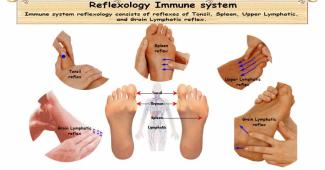
Reflexology therapy for the immune or lymphatic system strengthens immunity. It improves the ability to attack the disease-causing invaders (e.g. organisms and substances).
5 Surprising Reflexes to boost Immunity
The immune system protects against the diseases; identifying pathogens (viruses to parasitic worms) and distinguishing from own body tissues. The immune system uses leukocytes (white blood cells) to destroy disease-causing organisms or substances. Thymus, spleen, and bone marrow are the lymphoid organs; it produces and stores Leukocytes.
The immune system consists of the thymus, spleen and lymphatic. The immune system is set of cells, tissues, and organs; works together to protect the body. Lymphatic is the secondary circulation system (part of immune system); it help to protect, cleanse, and to remove waste products.
Lymph nodes are present throughout the body; but large groups are on the breast, armpit, and groin.
- The lymphatic vessels move lymph (a watery fluid containing protein, salts, glucose, urea, etc.) throughout the body and maintain body fluid level. It defends the body against illness-causing germs (viruses, bacteria, and fungi).
- The thymus gland is part of the immune system; its main duty is during infancy and before puberty. It controls the growth and development of a major part of the immune system.
- The spleen is part of the immune system; located in the upper left part of the abdomen under the rib cage. Major jobs of the spleen are white blood cells production and lymph fluid filtration. Macrophages in the spleen fight infection and protects the body. It destroys bacteria, dead tissues, and foreign substances; additionally, remove them from the blood.
- Tonsils consist of two glands in the backside of the throat. The tonsils and adenoids (nasopharyngeal tonsils) protect the entry of the digestive system and the lungs, from bacteria and viruses. Adenoid is a patch of tissue; it protects kids and they disappear after age 5.
Reflexes of the lymphatic system include tonsils, spleen, thymus, groin, and upper lymphatic.
Tonsil reflex point
Tonsils protect the entry of the digestive system and the lungs, from bacteria and viruses.
How to do reflexology therapy for the tonsil? Tonsil reflexes are above the transverse neckline of the big toe on the lateral side. Using the right thumb; hook & backup this reflexes three times.
Thymus reflex point
The thymus is a lymphoid gland consist of two lobes, located behind the breastbone in front of the heart. The thymus gland is closely associated with the immune system than the endocrine system. It trains and develop, important white blood cell T-lymphocytes or T-cells. T-cells defend from pathogens (bacteria, viruses, and fungi).
How to do reflexology therapy for the thymus gland? Thymus reflex is halfway between the parathyroid and diaphragm. Hold the foot with one hand; press & rotate, using another hand thumb.
Spleen reflex
The spleen acts as a part of the immune system; it helps fight bacteria causing pneumonia and meningitis. Old red blood cells are recycled in the spleen; also, platelets and white blood cells are stored there.
According to traditional Chinese physiology, the role of the spleen is nutrients assimilation and preserving physical strength. Spleen makes nutrients and Qi (vital energy) from the digested food. So, the spleen is considering as a digestive organ.
How to do reflexology therapy for the spleen? Spleen reflex is only in the left leg. Hold the left leg with the left hand; walk underneath the diaphragm line horizontally across the foot, using the right thumb. Walk each row below the previous one until four horizontal lines. Repeat twice. Reflexology therapy for spleen helps fight infection and destroy old blood cells.
Lymphatic reflex
The lymphatic system is a part of immune system.
Lymphatic system performs
- White blood cells transportation to the lymph nodes,
- Absorption of fatty acid,
- Interstitial fluid removal from the tissues.
How to do reflexology therapy for the upper lymphatic? Hold the foot with one hand; using another hand index finger, walk from the base of toes towards the ankle between the metatarsal. Repeat twice. Reflexology therapy for upper lymphatic strengthens the body's immune system.
Using the right thumb, walk three semicircular rows around the lateral ankle from medial to lateral. The first row is near the ankle; the remaining rows are one-step away.
How to do reflexology therapy for the groin lymphatic? It is on either side of the anklebone. Using the index finger, walk on either side of the anklebone in three rows. First row is near the ankle bone; other two are a step away.
Reflexology therapy for groin lymphatic increases the body's defense against infection and cancer. During menstruation, this reflex may be sensitive.
Lymphatic reflexology is useful to treat various conditions; Arthritis, Asthma, Eczema, Chronic fatigue, Fibromyalgia, ME, Sinus problems, Migraines, Headaches, Muscular tension, Aches and pains, and Premenstrual Syndrome.
Reflexology Cardiovascular System
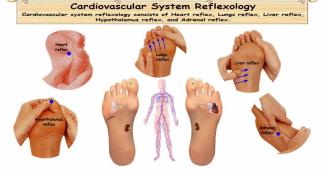
Reflexology therapy for the circulatory or cardiovascular system; strengthen the heart, enhance circulation and alleviate heart-related disorders.
5 Grand Reflexes for Wonderful Cardiovascular system
The circulatory system consists of the heart and a system of vessels (arteries, veins, capillaries, and blood).
- Pulmonary circulation circulates blood between heart and lungs. This enriches the blood with oxygen.
- Systemic circulation circulates blood between the heart and entire body. It provides nutrients and oxygen supply.
- Hepatic portal circulates the blood through the liver.
The red blood cells (RBC) carries oxygen around the body. The white blood cells (WBC) fights disease and infection.
Heart (muscular pump) is the key organ in the circulatory system. It beats; 60 to 100 times/minute, 100,000 times/day, more than 30 million times/year, and 2.5 billion times in a 70-year lifetime. The circulatory system circulates blood throughout the body, more than 1,000 times/day. Every day, 10 pints (5 liters) of blood, circulates 60,000 miles (96,560 kilometers) of blood vessels to link the cells of the organs and body parts. The blood vessels are a network of tubes to transport blood. It helps to transport blood between heart and tissues.
Blood is a viscous fluid; it is 8% of the total body weight. It transports oxygen, nutrients, hormones, and waste. It carries oxygen from the lungs; nutrients from the digestive system to body cells, and used in metabolic processes. In addition, it carries tissue wastes from the body cells and expel from the body by the excretory organs (kidneys, lungs and sweat glands). The circulatory system helps regulate body temperature.
Cardiac
The cardiac reflexes are the heart and blood vessels (arteries, veins, and capillaries). The heart is one of the strongest body muscle. From the veins, it pumps deoxygenated blood to lungs. Also from lungs, it pumps oxygenated blood to arteries.
How to do reflexology therapy for the cardiac? Hold the foot with the left hand; walk from zone 5 until zone 1/2, in three rows using the right thumb. The first row is below the general eye and ear reflex. Then, each row is below the previous one until reaching the diaphragm line.
How to do reflexology therapy for the heart? Hold left foot with the left hand; for heart reflexes, move right thumb straight below the fourth toe until before diaphragm line. Press & rotate this point. Next, place the right index finger on the dorsal (top) aspect corresponding to the thumb. Apply pressure with the index finger.
Pulmonary circulation circulates blood between heart and lungs to oxygenate the blood. Reflexology therapy for lungs helps the lung to work at its optimal level. Thus, blood gets proper oxygenation. To learn more, visit respiratory system reflexology therapy.
Hepatic portal circulates the blood through the liver. For proper detoxification of blood, liver should work to its ideal level and liver reflex therapy can help. Reflexology therapy for the liver helps the liver to work to its optimal level. Thus, helps the liver to perform proper detoxification of the blood. To learn more, visit digestive system reflexology therapy.
Reflexology therapy for solar plexus encourage deep relaxation; thus, gets optimal blood circulation. To learn more, visit the digestive system reflexology therapy.
Hypothalamus
Hypothalamus is in-charge of vital functions such as heart rate, contraction/dilation of blood vessel; thus, take care of proper blood circulation.
How to do reflexology therapy for the hypothalamus?
Support the big toe with one hand; thumb walk to reach the big toe center. Then, hook & backup the reflex point for ten seconds. It keeps the hormones in balance by regulating and controlling its activities.
Reflexology Respiratory System
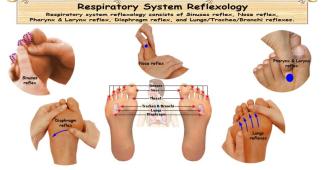
The respiratory system is in the chest; it consists of the lungs and diaphragm. Left lung is smaller than right; thus, provides an extra space for the heart. Beneath the lungs is the diaphragm; a dome-shaped muscle, it works along with lungs during inhalation (breathe in) and exhaling (breathe out).
5 Vital Reflexes for Respiratory System
The organs of the respiratory system are the nose, pharynx, larynx, trachea, bronchi, and lungs. Together these organs send air into the Alveoli; it is a tiny, thin-walled sac of the lungs. Exchange of oxygen and carbon dioxide taken place in alveoli. Carbon dioxide containing blood reach the lungs to expel from the body.
The respiratory system make ensure the oxygen supply to the body cells; furthermore, removes carbon dioxide from the cells. During breathing; the respiratory system filter, warms, and humidifies the air. Sinuses influence the speech or sound production and sense of smell or olfaction.
Reflexes of interest for respiratory system:
- Nose - is within the dorsal aspect of the big toe.
- Throat (pharynx and larynx) – is in the lateral base of the big toe.
- Trachea and Bronchi – is from the base of the big toe.
- Diaphragm – is under the metatarsal heads (half-moon shaped diaphragm) from medial to lateral.
- Sinuses – is in the plantar aspect of the four small toes.
- Chest (Lungs) – is between the shoulder line and diaphragm line in zone 2 -4 of the feet.
Nose
The nose has two nostrils; air enters the respiratory tract through these external nostrils. It conditioned inhaled air; make it warm and more humid. Hairs inside the nose act as a filter; it prevents dust particles from entering the lungs.
How to do reflexology therapy for the nose? The nose reflexes are on the medial aspect; trace a line straight from the big toenail root. Hold big toe with the left hand; press & release the point, using the right thumb. Repeat this for five times.
Throat (pharynx and larynx)
Pharynx in the throat is part of respiratory as well as digestive systems. It allows air to pass through lungs (via larynx); additionally, it allows food to stomach (via esophagus).
How to do reflexology therapy for the throat? Neck or throat is on the lateral aspect of the big toe base. Thumb walk around the big toe base, repeats 3 times.
Lungs reflex
Lungs are on both side of the heart; it is soft, spongy balloon structures. Within the lungs, the bronchi divide into smaller tubes called bronchioles. It ends in tiny sac structures called alveoli. Here the exchange of gasses oxygen and carbon dioxide takes place.
The lungs are the main organs of the respiratory system; take in oxygen when to breathe in as well as expel carbon dioxide when to breathe out.
Trachea and Bronchi
The trachea or windpipe begins below the larynx (voice box) and runs behind the breastbone (sternum). The trachea divides into two smaller tubes called right and left bronchi, one bronchus for each lung.
How to do reflexology therapy for the lungs? Hold foot with one hand; using another hand thumb, walk upward from the diaphragm line straight below between the big & second toe, second & third toe, third & fourth toe, and fourth & fifth toe.
For the proper stimulation of the lungs, thumb walks between the metatarsal. Repeat two times. Reflexology therapy for lungs help heal lung disorders and strengthen lungs.
How to do reflexology therapy for the trachea and bronchi? Trachea and Bronchi reflexes are from the base of the big toe until the diaphragm line. The bronchi reflexes are on the plantar and dorsal aspect of the foot; located between the first and second metatarsal heads.
Diaphragm reflex
The diaphragm is a muscular dome-shaped membrane; it separates the chest (thoracic) cavity from the abdomen. It controls the filling and emptying of the lungs. Contraction of the diaphragm muscle; expands the lungs during inhaling (breathing in air). Similarly, expansion of the diaphragm muscle; contracts the lungs during exhale (breathing out air).
How to do reflexology therapy for the diaphragm? Hold the top of the foot with the left hand; using the right thumb, walk under the metatarsal heads (half-moon shaped diaphragm), from medial to lateral. Repeat four times. Reflexology therapy for diaphragm helps in the treatment of anxiety, stress, and respiratory problems.
Sinuses
The sinuses main function is to produce mucus; it moisturizes the inside of the nose. This mucus layer protects the nose from pollutants, microorganisms, dust and dirt.
How to do reflexology therapy for the sinus? The most effective reflexes for sinuses is on the tip of ten toes. Using the thumb and index finger, apply pressure for twenty to thirty seconds. Do for one to three times every day. Although any discomfort, continue doing reflexology until the problem solved. Many people believe reflexology therapy is useful for sinus problems and congestion.
Hold the second toe with the left hand; using the right thumb, walk upward in the medial side to reach the toe top. Now change the position, hold the second toe with the right hand; using the left thumb, walk upward in the lateral side to reach the toe top. Walk upward from the toe base until reaching the toe top. Rotate the toe top, help drains the sinuses.
Do these to all the five toes. Reflexology therapy to this reflexes; helps drain the sinuses and strengthen it.
Reflexology Spinal Column

Reflexology therapy for the vertebral column strengthens the entire spine: the Cervical, Thoracic, Lumbar, Sacral, and Coccyx. It is useful for spinal disorders.
What are a vertebral column and spinal cord?
The Vertebral Column is of five major regions comprising 33 segments; two segments fused together, thus, the total segments are 31. Nerves are branched out from each segment to connect different body organs/parts:
- Cervical vertebrae have seven vertebrae located below the skull. It carries nerve to connect the head, neck, upper body, arms, and hands. It provides smooth head movement and support the skull.
- The thoracic spine consists of twelve vertebrae T1-T12. The thoracic spine refers to the upper- and middle-back. Thoracic region nerve connects hands, fingers, chest, and abdominal muscles.
- The lumbar spine consists of five vertebrae L1-L5. It is in the lower back; where, the spine curves inward toward the abdomen. Lumbar region nerve connects hips, knee, ankles and toe muscles.
- The sacrum is a large triangular bone at the spine base; formed by the fusion of sacral vertebrae S1–S5 happen during 18 to 30 years of age. Sacral nerve connects legs, toes, bladder and anal muscles.
- The coccyx or tailbone is at the bottom end of the spine. This part of the spine formed by the fusion of three or more tiny bones. Coccygeal region nerve connects skin around the coccyx.
The spinal cord lies within the vertebral canal, protected by three membranes.
Spinal nerve carries motor, sensory, and autonomic signals between the spinal cord and the body. There are 31 pairs of spinal nerves; one on each side of the vertebral column. There are eight pairs of cervical nerves, twelve pairs of thoracic nerves, five pairs of lumbar nerves, five pairs of sacral nerves, and one pair of coccygeal nerves.
5 Fuzzy Reflex Segments of Spinal Column
The spinal column divides the physical body in two; right and left. Similarly, the spine reflexes divided into two present in the right and the left feet.
The spinal reflexes are on the medial side, from the big toe until heel bone through arch bone. Feel this arch bone, by tracing on the medial side of the foot.
How to do reflexology therapy for the vertebrae column?
- Reflexology for Cervical vertebrae: Hold the foot with the left hand; using the right thumb, walk downwards from the big toe top edge until base. To cover the entire cervical vertebrae takes seven bites (walking step). Repeat walking three or five times.
- Reflexology for Thoracic vertebrae: Continue walking downward for 12 bites to cover 12 thoracic vertebrae. Should end on a bone called the navicular. Repeat walking twice. Apply gentle pressure to avoid healing-crisis reaction; instead, may increase the treatment frequency by 3 to 4 times a week.
- Reflexology for Lumber vertebrae: Continue walking downwards for 5-bites to cover five lumbar vertebrae, until reaching a point straight below the medial malleolus. Repeat walking two times.
- Reflexology for Sacral vertebrae: Continue walking downwards five bites to cover the five sacral spines. Repeat walking twice. Reflexology therapy for sacral reflexes reduces the lower backache pain.
- Reflexology for Coccyx vertebrae: Continue walking downwards three bites towards the heel bone. Repeat walking three times.
Spinal friction is a special technique; it stimulates & warm the spinal column. Place the hand palm on the inner edge of the foot and rub it. Before and after the spinal column reflexology therapy, perform spinal friction technique.
Reflexology Nervous System
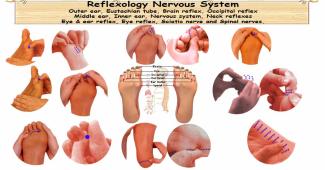
Reflexology therapy for the nervous system optimize the roles of central, peripheral and autonomic nerves, so harmonize every organ.
12 Brilliant reflexes for stronger Nervous System
The nervous system has three parts; central, peripheral, and autonomic nervous system. The nervous system is the control and communication system of the body; messages send & receive, as well as to control thoughts and movements. Brain exchange information; act as an information center of the body.
The spinal cord attached at the end of the brain stem. Through the spinal cord, all the nerves are branch out to the entire body.
The nervous system is of two groups:
- Central nervous system - it comprises the brain and the spinal cord.
- Peripheral nervous system - serves as a communication; it connects the central nervous system (CNS) to the limbs and organs.
The peripheral nervous system is of two groups:
- Somatic nervous system - it controls voluntary actions; walking and smiling.
- Autonomic nervous system - it controls involuntary actions; smooth muscle of the internal organs and glands.
The autonomic nervous system (ANS) is of three groups:
- Sympathetic nervous system - manage fright or flight response; vasoconstriction during emergencies. Associated with spending energy; makes blood pressure rise, gooseflesh, pupillary dilation, minimal thick saliva secretion, the decline in the gastrointestinal act and increasing the heart rate.
- The parasympathetic nervous system - is dissimilar to sympathetic nervous system function. It governs wine & dine response; makes vasodilation and calms the body. It makes the blood pressure drop, pupillary contraction, plenty and thin saliva secretion, a boost in the gastrointestinal act, and heart rate reduction.
- The enteric nervous system - is a meshwork of nerve fibers; stimulate the gastrointestinal tract, pancreas, and gallbladder.
Reflexes for the nervous system includes:
- Solar plexus often called as the second brain or abdominal brain. The solar plexus is closely related to the digestive system; please refer digestive system for solar plexus reflex therapy.
- The brain provides coordination between the central and autonomic systems.
- Spinal column comprises of cervical, thoracic, lumbar, sacrum and coccyx.
- Sense organs eye, ears, nose and tongue (mouth) gives important information about the universe to the brain through cranial nerves.
Head and brain reflex
The brain is one of the most complex organs in the human body. To exchange information; it has over 100 billion nerves and trillion connections. The brain regulates the human behavior.
How to do reflexology therapy for the head and brain? The head, brain, and skull reflexes are on the top of five toes in both feet. Support the toes with the left hand; with the right thumb walk at the top of five toes, do three times. Hold the toe with left-hand fingers; using the right thumb, walk from the toe base until reaching the toe tip. Have to do three times on the five toes.
These reflexes improve the sense of well-being and balance, help fighting depression, relieve headaches & stress, and coping positively with life.
Occipital - visual processing center of brain
The occipital lobe is the visual processing center of the brain; it contains a most anatomical region of the visual cortex.
How to do reflexology therapy for the occipital? Hold the foot with the left hand; using the right thumb, walk along the big toe base. Hook and back-up the crease between the big toe and second toe for ten seconds. Because of daily stressors, this reflex point is very sensitive for most people.
Neck reflex (front and back)
The important role of the neck is to support the head. Additionally, it protects the arteries carry blood to the brain from heart.
How to do reflexology therapy for the neck? Hold the big toe; using the right thumb, walk on the dorsal and lateral aspect. Walk medial to lateral in three rows; each row lower than the before until reaching the big toe base.
Spinal nerves
The spinal column is a protective sheath for the spinal nerves. At various points, the spinal nerve branches connect major body organs. It carries motor, sensory, and autonomic signals. Human has 31 pairs of spinal nerves, one on each side of the vertebral column. They are eight cervicals, twelve thoracics, five lumbar, five sacral, and one coccygeal.
How to do reflexology therapy for the spinal nerves? The spinal nerves are beneath the spinal column; thus, reflex therapy for the spinal column can help spinal nerves. Please refer vertebral column for spinal nerves reflex therapy.
Sciatic nerve reflexes
The sciatic nerve is the single largest nerve. The sciatic nerve separated into branches to either side of the buttocks from the lower spine; then reaches to the thigh and foot. It connects the spinal cord with the leg and foot muscles.
How to do reflexology therapy for the sciatic nerve? Hold foot with the left hand; place the right thumb on the red spot in the heel. This spot is halfway from the toe. In the plantar aspect, walk from medial to lateral and then from lateral to medial.
Begin at the fifth metatarsal bone; using four fingers (except thumb), walk upward toward the ankle bone until reaching the sciatic nerve reflex (zone 4 & 5). This point is in a cavity. Hook & back-up this reflexes three times.
Reflexology therapy on this reflexes; helps sciatica pain, extend to the legs and foot. Repeat this five times. Sciatica is any pain or neurological symptoms felt along the sciatic nerve.
Using the right thumb, walk from the last row of the medial ankle towards the heel. The sciatic reflex is just before the heel; press and rotate this point. Thumb walk the sciatic area on the sole from medial to lateral. Once reached the lateral side of the sole, walk back from lateral to medial.
Eye reflex
The eye is the organ of vision; help to learn the surrounding world, then other senses. Sight is most valued than other senses. The outer ear converge sound, the middle ear converts this sound into vibrations, inner ear converts this vibration to nerve signals, and the brain understands it as sound.
How to do reflexology therapy for the eye reflex? Eye reflexes are in the base of the second and third toes. Right eye reflex is on the right foot and left eye reflex is on the left foot. Hold right foot with the left-hand; place right thumb below the second toe base. Using the right thumb, walk on the area under the toes, from the second to the fifth toe. These reflexes cover the entire eye; reflexology therapy helps any problems of the eye.
Ear (inner, middle and outer) reflex
The ear has two important roles; hearing sounds and aids in balance and body position. When bending forward to take any object on the floor; ears balancing mechanism help prevent falling. The ear comprises three sections the outer, middle, and inner ear.
Inner ear reflex point:
How to do reflexology therapy for the ear? Inner ear reflex point is three bites up towards the top of the toe from the occipital reflex point. Hook & back-up the inner ear reflex point for ten seconds, using the thumb.
Middle ear reflex
The middle ear receives sound from the outer ear through the canal. The sound converted into vibration by the eardrum and delivered to the inner ear.
How to do reflexology therapy for the middle ear? Middle ear reflex point is between third and fourth toes. Hold the foot with the right hand; hook & backup this point for six seconds using the thumb. Alternate method: Using the left index finger (on the top side) and thumb (on the bottom side) to press the fourth toe base.
Reflexology therapy for middle ear helps to heal middle ear disorders, aches, infections, and balancing disorders.
Eustachian tube
The Eustachian tube is a tube from the middle ear to the top of the throat at the nose backside.
How to do reflexology therapy for the Eustachian tube? Eustachian tube reflex is between the base of the third and fourth toes. Hook & backup this point towards the big toe for six seconds. Using the index finger and thumb, walk downwards between third and fourth toes for 1 cm. Reflexology therapy for Eustachian tube helps to heal inner ear disorders, aches, and infections.
Outer ear reflex
The outer ear is the part of ear visible to the eye. Its main job is to collect sound.
How to do reflexology therapy for the outer ear? Outer ear reflexes are between the fourth and fifth toe. Hold the foot with the left hand; hook & backup this reflex towards big toe, using the right thumb. Reflexology therapy for outer ear helps to heal outer ear disorders such as eczema.
Reflexology Endocrine System

Endocrine reflexology therapy supports normalize glandular secretion; thus stabilizes mood, growth, metabolism, and sexual functions.
7 essential reflexes for efficient Endocrine system
The endocrine system comprises glands that secrete hormones into the bloodstream. The major glands of the endocrine system are the pineal, pituitary, hypothalamus, thyroid gland, parathyroid gland, pancreas, adrenal glands, and reproductive. The reproductive system of the female is ovaries and male is testes.
Hormones send a chemical signal to different organs and tissues in the body. In response to the chemical signal from the hormones, the specific organ modifies the work or structure. The endocrine plays an important role in regulates mood, growth and development, tissue role, metabolism, sexual act, and reproductive processes.
The endocrine glands are the main hormone producers. Nevertheless, non-endocrine organs also produce and release hormones; they are the brain, heart, lungs, kidneys, liver, and skin.
Hypothalamus Reflex – Pineal, Pituitary, Hypothalamus
The hypothalamus is in the lower central part of the brain; it is the main link between the endocrine and nervous systems. Major functions of the hypothalamus are preserving internal balance (homeostasis); it controls the body temperature, hunger, water balance, and sexual act. It controls the pituitary gland; either stimulates or suppresses hormonal secretions.
The pituitary is pea-sized gland; at the skull base, attached to the hypothalamus. It is the master endocrine gland; its hormone controls other endocrine glands such as thyroid, adrenal, and reproductive glands. Endorphins secreted by the pituitary; acts on the nervous system and reduces pain. Below is the set of hormones secreted by the pituitary gland:
- Human-growth hormone manages growth and regulates metabolism.
- Thyroid-stimulating hormone stimulates the thyroid gland, to secrete thyroid hormones.
- Follicle-stimulating hormone produces immature egg cells in the ovaries and produces sperm in the testis.
- Luteinizing hormone stimulates secretion of estrogen (development of sexual characteristics) and progesterone (thickening the lining of the uterus).
- Prolactin stimulates milk production.
- An adrenocorticotropic hormone secreted in the event of stress; it stimulates the secretion of glucocorticoids (cortisol) by the adrenal cortex.
- Melanocyte-stimulating hormones exact role is unknown.
- Oxytocin is also called as love hormone; it stimulates contraction of the uterus during childbirth, as well as milk production.
- Antidiuretic hormone decreases urine volume to conserve water, decreases water loss through sweating, raises blood pressure by constricting arterioles.
The pineal gland is in the middle of the brain, it produces hormone melatonin in the night. Melatonin is a derivative of serotonin and it is found throughout the body. Melatonin regulates circadian rhythm (daily bodily rhythms) of the body; is sleeping in the night (dark) and waking in the morning (light). Pineal gland is the “third eye.”
The pituitary gland and the hypothalamus reflex point are in the middle of the second phalanx of the big toe. The pineal reflex point is on the lateral side of the big toe, above the pituitary reflex point.
How to do reflexology therapy for the hypothalamus, pituitary, and pineal reflex? Support the big toe with one hand; thumb walk to reach the big toe center. Then, hook & backup the reflex point for ten seconds. It keeps the hormones in balance by regulating and controlling its activities.
Thyroid & Parathyroid reflexes
The thyroid gland is a butterfly-shaped organ at the base of the neck; it produces the thyroid hormones that control metabolism (the rate at which cells burn fuels from food). This gland requires the pituitary's help to produce thyroid hormones. The thyroid hormone regulates vital body functions; breathing, heart rate, central and peripheral nervous systems, body weight, muscle strength, menstrual cycles, body temperature, and cholesterol levels. Improper functioning thyroid affects normal protein breakdown as well as carbohydrates & vitamins usage.
Parathyroid glands contain four tiny glands attached to the thyroid glands. Parathyroid hormone regulates calcium and phosphorus levels in the blood. It supports the thyroid gland functions.
How to do reflexology therapy for the thyroid? Hold the foot with the left hand; with the right thumb-walk from the diaphragm line three or four column upward until reaching the neckline. Thumb-walk the thyroid area from lateral to medial; from the base of the big toe until reaching the diaphragm line. Thumb-walk the thyroid area from medial to lateral; from the diaphragm line until reaching the base of the big toe. Thyroid reflexology therapy helps regulate the body's energy levels and maintain body weight.
How to do reflexology therapy for the parathyroid? Hold the foot with the right hand; using the left index finger and thumb, presses the point between the big and second toe for six seconds. This reflex point is in charge of; controlling blood calcium level; regulating muscle & bone density; and nerve role.
Pancreas reflex
The pancreas a narrow 6-inch long gland on the left side of the stomach is in the posterior and inferior abdominal cavity area. Pancreas is an endocrine gland, secreting the hormones insulin and glucagon. These hormones work to maintain ideal blood glucose level; thus, the body gets the needed fuel. Pancreas is also an exocrine gland; secrete enzymes to break the proteins, lipids, carbohydrates, and nucleic acids in food.
How to do reflexology therapy for the pancreas? Pancreas reflex point is on the right foot; locate by tracing a line from the third toe below the diaphragm line. Hold the foot with one hand; push & hook-up the reflex point for 6 seconds using another thumb. This reflex point helps digestion; by secreting digestive enzymes to break fats; by secreting optimal quantity of insulin to maintain blood sugar level.
Adrenal Glands
Adrenal glands are triangular shaped gland present on top of the kidney.
It's hormones help to
- Conserve sodium (mineralocorticoids),
- To increase blood glucose level (glucocorticoids – most often cortisol involved in the stress response, and help to regulate body metabolism),
- Regulate sex hormones (gonadocorticoids),
- Development of the male sex organs, and women during puberty (Adrenal androgens),
- ‘Fight or flight’ is a stress response (adrenaline or epinephrine, noradrenaline, and a small quantity of dopamine).
How to do reflexology therapy for the adrenal? The Adrenal reflexes are on top of the ureter tube reflexes. Place two thumbs over the adrenal reflexes; for ten seconds pull-apart or press & rotate. This reflex point helps; lessening pain and cope with stress.
For reproductive glands therapy, please visit reproductive system reflexology.
Relax the feet

Start a reflexology session with foot relaxation, similar to warm-up exercise. Foot relaxation is useful in the starting and finishing off the reflexology therapy.
6 Effortless Relaxing Reflexology Technique
Aged prefer more relaxation technique time; because of reduced pain & discomfort and increased circulation. Relaxation technique before bedtime, for young children’s help to get good sleep.
Rotate the foot
Hold the right foot heel by the right hand. Hold the metatarsal arch using the left hand; make a big circle, by rotating clockwise and then the anticlockwise. Repeat it five to ten times. Do the same to the left foot.
Stretch the Achilles
Support right heel with one hand; using another hand push back the metatarsal arch, and stretch Achilles' tendon. Hold for ten seconds and have to do this on the left foot.
Healing vortex
Support right foot with one hand; place fisted hand on the bottom of lung reflexes and make a small then large circle with a gentle pressure. Do this for 30 seconds, then have to do the same on the left foot.
Toe Rotation
Support the right foot with the left hand; using the right-hand thumb and index finger, hold the big toe. Rotate the big toes, first clockwise then anticlockwise, each five times. Have to do this on other toes; the second, third, fourth and fifth toes. Have to do this on the left foot also.
Open and stretch the chest
Using both hand fingers, place the top side of the right foot. Place the thumbs 2.5 cm (1 inch) gap, underneath the metatarsal arch. With gentle pressure, pull outwards with a gliding movement, hold for 30 seconds. Have to do this on the left foot.
Solar plexus breathing or push technique
The solar plexus reflexes are useful for the entire digestive system; healthy digestion gives total wellness. Often the solar plexus is called the second or abdominal brain.
The solar plexus reflexes are in a cavity, below the transverse diaphragm line in the zone 3.
On the solar plexus reflexes point, place flexed thumb/finger as a pivot; then rotate the foot using another hand. Inhale for five seconds, with the support of another hand, make the small rotation. Hold the breath for five seconds; continue rotating. Lower the pressure, while exhaling for five seconds. Take few calming breaths. Repeat this for four times. Next, have to do this on the left foot.
Alternatively, work on the solar plexus reflexes on both foot simultaneously with deep breathing. During exhale, lower the applied pressure on the reflexes. Repeat this for two times, and conclude by removing the pressure on the reflexes during breathe out.
Have to do the same relaxation technique on the left foot; if required, reverse the hand positions.
Reflexology Sequence
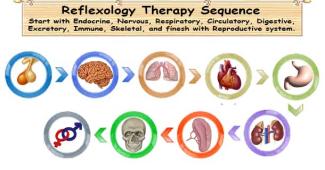
What is the best reflexology sequence? Reflexology sequence is a specific order of reflexes to make the treatment effective.
Author’s suggestion is for males preferred side to start is the right foot. Moreover, for females it is the left foot (This idea based on the Ayurveda concept). After completing a foot; to protect warm, cover it with a towel and continue doing on the next foot. This reflexology therapy can take around 30 minutes for the two foot. To support the body's own healing; have to do the reflexology sequence for three times a week.
Natural Reflexology Sequence
Greet the feet with relaxation techniques such as rotate the foot, stretch Achilles, toe rotation, phoenix rising, open and stretch the chest and solar plexus breathing.
Work on one foot at a time.
- The endocrine system release hormones (chemical signals) into the blood regulates the body's physiological processes. Hormones secreted by the glandular organs are pituitary, pineal, hypothalamus, thyroid, parathyroid, thymus, adrenal, pancreas, and gonads (ovaries and testes). Work on all the endocrine reflexes except reproductive glands; later have to do along with reproductive organs.
- To regulate the physiological processes, organ coordination, and sensations; the nervous system sends electric impulses throughout the body. Organs of the nervous include the brain, spinal cord, nerves, eyes, and ears.
- Respiratory organs are nose, pharynx, larynx, trachea, bronchi, and lungs. During inhalation, the respiratory system receives oxygen to improve blood oxygen level. During exhalation, the respiratory system expels carbon dioxide from the body.
- Circulatory organs are the heart, blood, and blood vessels. The circulatory or cardiovascular system circulates blood throughout the body; it delivers oxygen and nutrients to tissues as well as remove waste products.
- Digestive system duties are transport food, break down food, absorb nutrient, and expels waste. Primary digestive organs are the mouth, esophagus, stomach, small intestine, large intestine, rectum, and anal canal. Supportive digestive organs are teeth, salivary glands, tongue, liver, gallbladder, pancreas, and appendix.
- The Excretory or Urinary system functions are to expel excess of water & wastes, preserves pH and maintain blood volume. It aids formation of the red blood cell and metabolism of vitamin D. Urinary organs are the kidneys, ureter, urinary bladder, and urethra.
- The lymphatic system or immune system main function is to defend the body against microorganisms and other foreign bodies. Additionally, it controls body's fluid balance; fluids from the tissues is transferred to the blood. Lymphatic organs are the lymph, lymph nodes, lymph vessels, thymus, spleen, and tonsils.
- The skeletal system is a structural framework; it support, shape, and protects internal organs of the human body. It stores minerals, lipids and form blood cells. Organs of the skeletal are bones, cartilage, tendons, ligaments, and bone marrow.
- The reproductive system functions are germ cells (eggs and sperms) production and environment for the growth of the fetus in women. Male reproduction comprises the testes, vas deferens, urethra, penis, scrotum, and prostate. Female reproduction comprises the ovaries, uterus, Fallopian tubes, vagina, vulva, and mammary glands.
Integumentary and muscular systems do not need specific reflexology therapy. Work on the endocrine, digestive and urinary reflexes; also benefits the integumentary system. Work on the skeletal, circulatory, digestive and urinary reflexes; benefits the muscular system.
- The Integumentary system acts as a protective barrier for the human body against microorganisms, chemicals, dehydration, temperature control, and injuries. Integumentary organs are hair, nails, sebaceous glands, sudoriferous (sweat) glands, and skin (the largest organ of the body). Sebaceous gland is an exocrine gland of skin secretes an oily or waxy matter.
- Muscular system functions are body movement, nutrient supply through organs, support posture, and produces heat. The muscular system comprises skeletal muscle, smooth muscle, and cardiac muscle. Skeletal muscles comprise muscles attached to bones by bundles of collagen fibers known as tendons. Smooth muscles are in the digestive walls, urinary tract, other hollow organs, and blood vessels. Cardiac muscle is in the heart muscles. While working on the skeletal system, activates the skeletal muscles. While working on the digestive and urinary system, activates the smooth muscles. While working on the circulatory system, activates the cardiac muscles.
Do the same reflex sequence on the left foot. In addition, finish with the solar plexus rocking and holding.
Zone Therapy

You know, the modern Reflexology is the evolution of Zone Therapies developed by an American Doctor. Are you interested to relieve pain simply using clothes pegs or elastic bands? Read on to learn, how Zone Therapy relief various pains?
Birth of new healing technic! Zone therapy
An American Dr. William Fitzgerald developed Zone therapy and he is one of the fathers’ of modern reflexology. He researched on the pain relief and found pressure applied at one part produced an anesthetic effect on another part away from it.
Dr. William Fitzgerald (1872-1942) in his book on Zone Therapy; he said, treatment by pressure point massage was used 5000 years ago in India and China. This knowledge has lost, forgotten, or leave aside in favor of acupuncture to gain strong growth.
Longitudinal Zones divide entire body into ten segments
The simplest ways to make the longitudinal zones is by divide each foot longitudinally into 5 parts, totally ten parts right and left side each five parts. In theory, it splits the body into ten longitudinal zones.
- Center zone 1 - runs from the head top through the forehead center, nose, center of the body, and branches off the thumbs and the big toes. Organs within this zone are the pituitary, pineal, hypothalamus, thyroid, thymus, pancreas, brain, larynx, nose, tongue, sinuses, esophagus, heart, spine, small and large intestines, breast, and prostate.
- Left zone 2 - runs from the head top through the left eye, the body, and branches off to the left index finger and the second toe. Organs within this zone are the adenoids, spleen, pancreas, brain, eye, lungs, heart, stomach, breast, and small and large intestine.
- Right zone 2 - runs from the head top through the right eye, the body, and branches off to the right index finger and the second toe. Organs within this zone are the brain, eye, lung, breast, liver, small intestine, large intestine, and adenoids.
- Left zone 3 - runs from the head top through the left eye, the body, and branches off to the left middle finger and the third toe. Organs within this zone are the spleen, pancreas, adrenal gland, brain, eye, lung, breast, stomach, kidney, and small and large intestine.
- Right zone 3 - runs from the head top through the right side eye, the body, and branches off to the right middle finger and third toe. Organs within this zone are the adrenal gland, brain, eye, breast, liver, gallbladder, kidney, and small and large intestine.
- Left zone 4 - runs from the head top through the middle ear, the body, and branches off to the left side ring finger and fourth toe. Organs within this zone are the brain, eye, breast, lung, large intestine, and ovaries.
- Right zone 4 - runs from the head top through the middle ear, the body, and branches off to the right side ring finger and fourth toe. Organs within this zone are the brain, eye, the main lymphatic duct, lungs, breast, liver, large intestine, ileocecal valve, and appendix.
- Left zone 5 - runs from the head top through the external ear, the body, and branches off to the little finger and the fifth toe. Organ within this zone is ear.
- Right zone 5 - runs from the head top through the external ear, the body, and branches off to the little finger and the fifth toe. Organ within this zone is ear.
Body zones begin in the head top and end at the feet. All organs, glands, and nerves fall into these zones; so, a full body map is on the feet. By pressing areas within a zone on the feet and possible to stimulate specific parts of the body. Reflexologists believe energy moves through the zones, connecting everybody part in the same zone.
Transverse Zones
Transverse zones partition the body horizontally into three segments that help to find the body parts. The three main transverse zones are Shoulder line, Diaphragm line, and Hip or pelvic line.
Longitudinal zoning technique is thumb-walk upward from heel to toe in zone 5. Repeat the same for the remaining zones 4, 3, 2, and 1. Next, thumb-walk from the base of the big toe upward in each zone of the big toe.
Learn, how Zone Therapy relief various pains?
Zone therapy is the application of pressure on bony surfaces in the hand and foot joints such as phalanges (bone of fingers and toes). The pressure needed for zone therapy may be between 2 and 10 pounds (1 and 4.5kg) for 30 seconds to 5 minutes to relieve the pain. Applied pressure should be firm enough to cause bearable pain, but not severe enough to harm any underlying tissues.
They use various gadgets to apply a firmer pressure, such as clothes pegs or elastic bands used in finger joints. Also, can apply pressure using thumbs, fingernails, round-ended probe, toothbrush, or metal combs. If any body part turn into blue color after applying pressure, immediately remove the applied pressure and massage the area to restore normal blood circulation.