
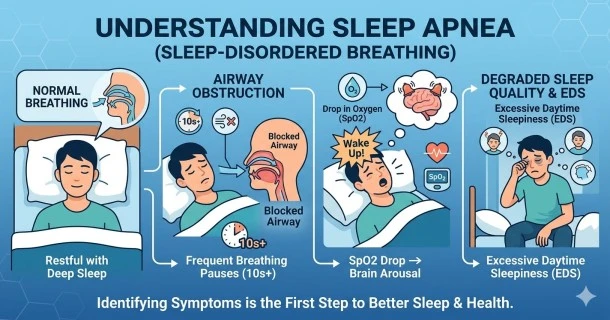
Learn about sleep apnea, a widespread sleep-disordered breathing condition marked by repeated pauses in breathing. Discover its symptoms, causes, and impacts.
What is Sleep Apnea? Definition, Mechanisms, and Impact
Sleep apnea is a widespread, serious sleep disorder characterized by repeated pauses in breathing or instances of abnormally shallow breathing during sleep. Derived from the Greek word apnoia, which literally translates to "without breath," this condition compromises your body's oxygen supply and drastically reduces sleep quality.
It falls under the medical umbrella of sleep-disordered breathing (SDB). Because it occurs exclusively while a person is asleep, it is frequently called an "invisible" epidemic, leaving millions of individuals undiagnosed and vulnerable to long-term health complications.
Defining Sleep Apnea: What Happens to Your Body?
During a normal sleep cycle, the muscles controlling the airway remain stable, facilitating continuous, uninhibited respiration. For individuals experiencing sleep apnea, this process breaks down:
- Breathing Pauses (Apneas): A complete cessation of airflow lasting anywhere from 10 seconds to multiple minutes.
- Shallow Breathing (Hypopneas): A significant reduction in airflow rather than a total stop, which still limits tissue oxygenation.
- Frequency: These disruptions can occur 5 to 30 times or more every single hour, persisting throughout the entire night.
When these pauses occur, your blood oxygen saturation levels drop sharply, causing your brain to sense an emergency. To save you from suffocation, the brain briefly wakes you up from deep sleep into a lighter stage of sleep, or a brief micro-arousal. This awakening is typically accompanied by a loud snort, gasp, or choking sound as the airway abruptly reopens.
Why Sleep Apnea Frequently Goes Undiagnosed
Sleep apnea is inherently chronic and progressive, typically disrupting rest three or more nights every week. Despite its frequency, it remains vastly underdiagnosed:
- Invisible Symptoms: Because micro-arousals last only a few seconds, patients rarely remember waking up or choking during the night.
- No Diagnostic Laboratory/Blood Biomarkers: There is no blood test or standard physical examination that can screen for sleep apnea during a routine daytime doctor visit. Diagnosis requires specialized nocturnal testing.
- Reliance on Bed Partners: Most individuals only seek evaluation after a spouse, family member, or bed partner witnesses them snoring loudly, gasping for air, or completely stopping their breathing.
The Consequences: Excessive Daytime Sleepiness
Because your body is forced to bounce out of deeply restorative, slow-wave sleep and REM sleep to breathe, your overall sleep architecture is fragmented. Even if you spend 8 full hours in bed, the actual quality of your sleep is severely degraded.
Consequently, sleep apnea stands as one of the leading medical causes of excessive daytime sleepiness (EDS). Individuals living with untreated sleep apnea often struggle with:
- Waking up feeling unrefreshed, often with a dry mouth or a morning headache.
- Severe daytime fatigue and chronic exhaustion.
- A dangerous tendency to fall asleep during passive activities, such as reading, watching television, or operating a motor vehicle.
Frequently Asked Questions (FAQs)
What is the exact clinical definition of sleep apnea?
Sleep apnea is defined as a chronic sleep disorder characterized by involuntary, repeated pauses in breathing (apneas) or shallow airflow breaths (hypopneas) during sleep. These breathing events last 10 seconds or longer and occur multiple times per hour, severely lowering blood oxygen levels.
How do I know if I have sleep apnea if I am asleep when it happens?
Because it occurs while sleeping, most people cannot self-diagnose sleep apnea. The most common indicators are excessive daytime sleepiness despite spending a full night in bed, waking up gasping for air, waking with a morning headache, or a bed partner telling you that you snore loudly or stop breathing.
Can a doctor diagnose sleep apnea using a standard blood test?
No, sleep apnea cannot be detected through a standard blood test or a routine office check-up. The diagnostic gold standard requires a specialized test called a polysomnography (an overnight sleep study), which can be completed in a laboratory setting or via a comprehensive home sleep apnea test (HSAT).