
Calculate your LDL cholesterol accurately in mg/dL or mmol/L using both the Martin-Hopkins and Friedewald formulas. Ideal for high triglycerides and low LDL.
How This LDL Cholesterol Calculator Works
Standard lipid panel blood tests directly measure Total Cholesterol (TC), High-Density Lipoprotein (HDL-C), and Triglycerides (TG). Because directly measuring Low-Density Lipoprotein Cholesterol (LDL-C) via ultracentrifugation is expensive and time-consuming, clinical laboratories rely on validated mathematical equations to estimate LDL-C.
This calculator simultaneously computes your LDL-C in both mg/dL (US units) and mmol/L (International SI units) using two established clinical methods: the traditional Friedewald equation and the modern Martin-Hopkins algorithm.
Martin-Hopkins vs. Friedewald Formula: Which Is More Accurate?
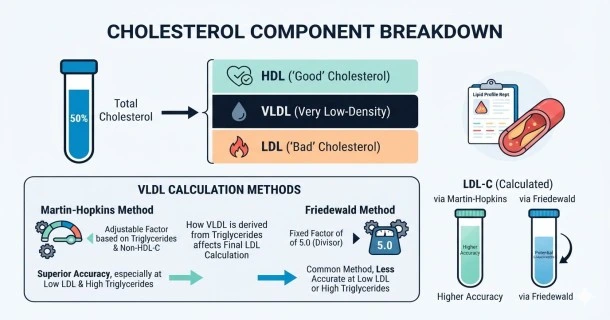
Both formulas estimate LDL cholesterol by subtracting HDL cholesterol and Very Low-Density Lipoprotein cholesterol (VLDL-C) from your Total Cholesterol. The difference lies in how each equation estimates VLDL-C from your triglyceride level.
1. The Friedewald Equation (Fixed Factor of 5)
Introduced in 1972, the Friedewald formula assumes a constant 5:1 ratio between triglycerides and VLDL cholesterol:
- In mg/dL:
LDL-C = Total Cholesterol − HDL-C − (Triglycerides ÷ 5) - In mmol/L:
LDL-C = Total Cholesterol − HDL-C − (Triglycerides ÷ 2.2)
Clinical Limitation: While reliable for patients with normal triglycerides and moderate cholesterol, the fixed divisor of 5 frequently underestimates true LDL-C when triglycerides are elevated (above 150 mg/dL) or when LDL-C levels are very low (below 70 mg/dL). It becomes invalid when triglycerides reach 400 mg/dL or higher.
2. The Martin-Hopkins Formula (Adjustable Factor)
Developed by researchers at Johns Hopkins University and endorsed by the American Heart Association (AHA) and American College of Cardiology (ACC), the Martin-Hopkins method replaces the fixed divisor of 5 with a personalized adjustable factor (ranging from 3.1 to 11.9):
- Formula:
LDL-C = Total Cholesterol − HDL-C − (Triglycerides ÷ Adjustable Factor)
The adjustable factor is determined using a 180-cell matrix matched to your specific Triglyceride and Non-HDL Cholesterol levels. This prevents dangerous underestimation of LDL-C in patients taking statins, PCSK9 inhibitors, or those with diabetes and metabolic syndrome.
| Clinical Feature | Martin-Hopkins Equation | Friedewald Equation |
|---|---|---|
| TG-to-VLDL Divisor | Personalized (3.1 to 11.9 based on 180-cell table) | Fixed at 5.0 (mg/dL) or 2.2 (mmol/L) |
| Accuracy at Low LDL (<70 mg/dL) | High accuracy; avoids false low readings | Often underestimates true LDL-C |
| Accuracy with High Triglycerides (150–399 mg/dL) | Superior clinical accuracy | Significantly less accurate |
| Non-Fasting Lipid Panels | Validated for non-fasting samples | Requires 9–12 hour fasting for best accuracy |
| Triglycerides ≥ 400 mg/dL | Reduced accuracy (Direct LDL recommended) | Clinically invalid |
LDL Cholesterol Target Ranges & Reference Chart
Understanding your calculated LDL-C number helps evaluate your risk for plaque buildup in the arteries (atherosclerosis). According to conventional cardiovascular guidelines, optimal thresholds depend on your overall health profile:
| LDL Cholesterol Category | US Units (mg/dL) | SI Units (mmol/L) | Clinical Interpretation |
|---|---|---|---|
| Very Low / High-Risk Goal | Below 70 mg/dL | Below 1.8 mmol/L | Target goal for patients with known heart disease, prior stroke, or very high ASCVD risk |
| Optimal | Below 100 mg/dL | Below 2.6 mmol/L | Ideal level for healthy adults with low cardiovascular risk |
| Near or Above Optimal | 100 – 129 mg/dL | 2.6 – 3.3 mmol/L | Acceptable for low-risk individuals; lifestyle optimization advised if other risk factors exist |
| Borderline High | 130 – 159 mg/dL | 3.4 – 4.1 mmol/L | Increased long-term plaque risk; diet and exercise modifications recommended |
| High | 160 – 189 mg/dL | 4.1 – 4.9 mmol/L | Elevated cardiovascular risk; medical evaluation and lipid-lowering therapy often considered |
| Very High | 190 mg/dL and above | 4.9 mmol/L and above | Strong indicator for high-intensity statin therapy and screening for Familial Hypercholesterolemia |
What Is Non-HDL Cholesterol and Why Does It Matter?
Along with your LDL-C, this calculator displays your Non-HDL Cholesterol (Total Cholesterol − HDL Cholesterol). Non-HDL-C measures all potentially artery-clogging particles in your blood, including LDL, VLDL, IDL, and Lipoprotein(a).
Many cardiologists consider Non-HDL-C an even stronger predictor of heart attack and stroke risk than LDL-C alone, particularly in people with elevated triglycerides or Type 2 diabetes. An optimal Non-HDL cholesterol level is generally below 130 mg/dL (3.4 mmol/L), or below 100 mg/dL (2.6 mmol/L) for high-risk individuals.
Martin-Hopkins LDL-C
Friedewald LDL-C
Frequently Asked Questions About Calculating LDL Cholesterol
Why does my lab report show a slightly different LDL number than the Friedewald formula?
Many modern clinical laboratories have switched from the older Friedewald equation to the Martin-Hopkins equation or a Direct LDL-C assay. If your triglycerides are above 150 mg/dL or your LDL is low, the Martin-Hopkins result on this calculator will usually match modern lab reports much closer than Friedewald.
How do I convert LDL cholesterol from mmol/L to mg/dL?
To convert Total Cholesterol, LDL-C, or HDL-C from mmol/L to mg/dL, multiply the value by 38.67. To convert Triglycerides from mmol/L to mg/dL, multiply by 88.57. You can toggle between both unit systems directly at the top of the calculator above.
Can I calculate LDL cholesterol if my triglycerides are over 400 mg/dL?
When triglycerides reach 400 mg/dL (4.5 mmol/L) or higher, the Friedewald formula is invalid and even the Martin-Hopkins formula loses precision due to chylomicrons and excess VLDL particles. In this scenario, doctors order a Direct LDL-C blood test or evaluate Apolipoprotein B (ApoB) and Non-HDL Cholesterol instead.
Do I need to fast before using values for this LDL calculator?
If you use the Martin-Hopkins result, non-fasting lipid panel numbers are clinically validated and accurate. However, if you are relying on the Friedewald calculation, a 9-to-12-hour fasting blood draw is recommended because recent meals temporarily raise triglyceride levels and skew the fixed divisor calculation.