
Arjuna
Arjuna (Terminalia Arjuna) is an herbal remedy for heart ailments; it can lessen effects of the heart’s stress and nervous conditions. Arjuna improves cardiac functioning and regulates blood pressure.
What is Arjuna? How does it reduce cholesterol?
What is Terminalia Arjuna herb? Arjuna refers to a bark of Terminalia Arjuna; this tree is an evergreen tree that grows in Himalayan forests. Arjuna is a medicinal herb, used in Ayurveda treatment to treat numerous disorders particularly used as a cardiac tonic.
How does Arjuna reduce cholesterol? The researchers clarify that lipid-reducing property of Arjuna is due to inhibition of hepatic cholesterol biosynthesis, increased fecal bile acid excretion, and simulation of receptor-mediated catabolism of LDL cholesterol.
Terminalia Arjuna inhibits hepatic HMGCoA reductase activity; suppression of this enzyme by Arjuna induces the expression of LDL receptors in the liver, which in turn increases the catabolism of plasma LDL and reduces the plasma concentration of cholesterol, an important determinant of atherosclerosis.
The widely available cholesterol-reducing drug statins are working similar to Arjuna. However, Arjuna has no side effects. It also lowers your risk for cardiovascular diseases. The Terminalia Arjuna can significantly reduce total cholesterol and LDL cholesterol levels.
How does Arjuna reduce your risk for heart diseases?
Arjuna is considering as a Cardiac Tonic & improves Vitality!
Arjuna improves cardiac muscle function and pumping activity of the heart. Its strength of contraction of heart muscle improvement is due to the saponin glycosides. The flavonoids and OPCs provide free radical antioxidant activity and vascular strengthening.
8 Medicinal Uses of Arjuna
- Arjuna shows improvement in lipid profile; there will be a significant decrease in total cholesterol and LDL cholesterol.
- Arjuna can also normalize high blood pressure.
- COQ10 in Arjuna supports the heart's energy output, and enhances overall energy levels, stamina, immunity, and boosts antioxidant levels.
- Arjuna herb helps to reduce the effects of stress and nervousness on the heart.
- Arjuna can successfully decrease the persistence of angina attacks. Angina attack is a pain or tightness experiencing in the chest causing due to reduced blood flow to the heart.
- Arjuna shows a significant improvement in patients with congestive heart failure; the patient may find improvement in dyspnea, fatigue, edema and walking tolerance.
- Arjuna can help shed excess body weight.
- Arjuna has compounds that protect against DNA damage from toxins.
Recommended Arjuna daily dosage
A typical dose of dried bark of 1 to 3 grams daily, while for congestive heart failure, you can use 500 mg, bark extracts four times a day. So far, there is no documentation available regarding any toxicity of Arjuna.
Arjuna available in different forms
Over-the-counter Arjuna supplements are available in various forms; they are powder, oil, and tincture. Arjuna volatile oil is much more concentrated compared to other forms, and it may cause temporary oral or skin irritation or burning.
How do you take Arjuna?
Take 1 to 2 grams of Arjuna bark powder with milk every morning on an empty stomach. It is an effective heart stimulant.
Bioactive constituents of Arjuna
Calcium, Magnesium, Zinc and Copper, Arjunone, Arjunolone, Luteolin is the natural antioxidants. Gallic Acid, Ellagic Acid, Oleanolinic Acid, OPCs or Oligomeric Proanthocyanidins, Phytosterols (beta-sitosterol), TRITERPENOID SAPONINS: Arjunolic Acid, Arjunic Acid, Arjungenin, Arjunglycosides, TRITERPENOID GLYCOSIDES OR Arjuna Glycosides - Arjunine, Arjunetein, Arjunetosides, Coenzyme Q10, Friedlin, Cerasidin, and Tannin.
Scientific evidence for Arjuna as natural cholesterol herb
A study with a title “Anti-Atherogenic Activity of Ethanolic Fraction of Terminalia Arjuna Bark on Hypercholesterolemic Rabbits” it is published in Evidence-Based Complementary and Alternative Medicine. 2011; 2011:487916. The result shows that T. Arjuna significantly decreases total cholesterol, LDL, and triglyceride levels and increases HDL and lessen atherosclerosis. Hence, T. Arjuna extract can effectively prevent the progress of atherosclerosis. It is likely due to the effect of its antioxidant and anti-inflammatory properties.
Possible side effects & medicine interaction of Arjuna
Terminalia Arjuna can be in use with standard heart medications, including digoxin, diuretics, angiotensin-converting-enzyme inhibitors, and vasodilators, without any adverse effects.
Arjuna lessens the ability of the blood to clot, so be caution if taking blood thinners.
Cinnamon
Cinnamon has a historical use as a spice and as medicine. Traditionally, it is in use to control blood sugar and high cholesterol levels and may also relieve digestive problems or improve your appetite.
What is Cinnamon? How does it lower Cholesterol?
What is Cinnamon? Cinnamon is the brown bark of a cinnamon tree. Cinnamon is a spice obtained from the inner bark of several trees from the genus Cinnamomum. It is in use both as sweet and savory foods.
How does Cinnamon lower cholesterol? Cinnamon inhibits hepatic HMGCoA reductase activity and suppresses lipid peroxidation in the liver. Suppression of this enzyme by cinnamon induces the expression of LDL receptors in the liver, which in turn increases the catabolism of plasma LDL and lowers the plasma concentration of cholesterol, an important determinant of atherosclerosis.
The widely available cholesterol-lowering drug statins are working similar to cinnamon. However, cinnamon has no or low side effects as compared to statins. Additionally, Cinnamon reduces your risk of cardiovascular risk.
How does cinnamon lower your risk for heart diseases and strokes?
Cinnamon can lower blood glucose, cholesterol, and blood pressure levels. Cinnamon can lower LDL cholesterol level responsible for the plaque formation. Cinnamon also has antioxidant property, which helps prevent the oxidation of LDL cholesterol, thus prevent inflammation of arteries and further plaque formation.
8 Health Benefits of Cinnamon
- Cinnamon improves lipid profiles and attenuates body fat deposition to the body weight ratio.
- Cinnamon lowers LDL (bad) cholesterol, raises HDL (good) cholesterol, and lower triglyceride’s levels.
- Cinnamon helps in weight loss and obesity treatment.
- Cinnamon normalizes the blood glucose level by improving insulin sensitivity.
- Cinnamon also improves your HbA1c level.
- Cinnamon reduces your risk to coronary heart diseases and strokes by reducing the plaque formation.
- Cinnamon can increase your brain function. It boosts your memory, contributes to a healthy brain function, and improves cognitive ability.
- Cinnamon powder combined with one tablespoon of honey every morning before breakfast had significant relief in arthritis pain.
Recommended cinnamon daily dosage
The daily dose of cinnamon you need to take for cholesterol control may vary depending on your age, weight and health status. Only your doctor can recommend the appropriate dosage for you, consult your doctor before you begin taking cinnamon supplements for cholesterol.
The daily dosage of 2 g to 6 g of cinnamon powder may improve the way your body uses fat if you have high cholesterol levels. Your doctor may adjust your dosage of cinnamon to meet your cholesterol regulation needs.
Cinnamon available in different forms
Over-the-counter cinnamon supplements are available in various forms; they are powder, oil, and tincture. Cinnamon volatile oil is much more concentrated compared to other forms, and it may cause temporary oral or skin irritation or burning.
How do you take cinnamon?
Cinnamon is importing especially in Mexico for the preparation of chocolates. It is also in use in various dessert recipes, such as apple pie, doughnuts, and cinnamon buns as well as spicy candies, tea, hot cocoa, and liqueurs.
You can also prepare a flavorful cinnamon tea by mixing 1/2 tsp. of cinnamon powder with boiling water for 10 to 15 minutes and can sweeten it with honey.
Bioactive constituents of cinnamon
Different terpenoids are present in the volatile oil of cinnamon; they are eugenol and cinnamaldehyde. Both cinnamaldehyde and cinnamon oil are potent antifungals, antibacterial, antiallergic, antihyperglycemic, and antihyperlipidemic properties.
Scientific evidence for Cinnamon as natural cholesterol herb
A study of this cholesterol-lowering natural herb as reported by Diabetes Care of the American Diabetes Association shows some positive sign about Cinnamon’s effect to control cholesterol. In 2003, a small study suggested that cinnamon might help lower blood-glucose levels, modest drops in LDL (bad) cholesterol, as well as triglycerides and total cholesterol.
Cinnamate supplementation enhances hepatic lipid metabolism and antioxidant defense systems in high cholesterol-fed rats this study is conducted by Lee JS, Jeon SM, Park EM, Huh TL, Kwon OS, Lee MK, Choi MS. at Department of Food Science and Nutrition, Kyungpook National University, Daegu, Korea. This study result shows Cinnamate inhibits hepatic HMG-CoA reductase activity, resulting in lower cholesterol content, and suppresses lipid peroxidation by improvement of antioxidant enzyme activities.
Possible side effects & medicine interaction of cinnamon
Cassia cinnamon is mostly safe when used in amounts commonly found in foods and in medicinal dose. However, in large quantity for long-term may cause some side effects.
People with diabetes may experience low blood sugar (hypoglycemia). Cinnamon may harm your liver if you already have a liver problem do not take in large quantities.
Foot Tapping

I am happy to bring you a simple technique that improves your health known as foot-tapping that can make you or bring back your health.
What is foot tapping?
The names itself explain that tapping, slapping, or clapping the foot; slapping foot with an opposite hand and repeat the same on the other foot.
{"preview_thumbnail":"/drupal8/sites/default/files/styles/video_embed_wysiwyg_preview/public/video_thumbnails/bellx1z_sXE.jpg?itok=OhDpZSge","video_url":"https://youtu.be/bellx1z_sXE","settings":{"responsive":1,"width":"854","height":"480","autoplay":0},"settings_summary":["Embedded Video (Responsive)."]}
How do you perform foot tapping?
- Sit on a chair or bed, close your eyes, take few deep natural breathing, and relax your body.
- Open your eyes. Place your right foot on your left knee.
- Take your left hand; all fingers jointed together; palm slightly cupped, keeps the wrist area loose and relaxed (not stiff or rigid).
- Slam, tap or clap the right foot with the left palm with a firm gently force (not too hard). You should hear clapping sound. Tap at an interval of about one second for each tap. Tap for 100 times or break-up into four installments of 25 each.
- Remove your right foot from the left knee. Close your eye, take a few deep natural breathing, and relax.
- Open your eyes. Place your left foot on your right knee and slap it with your right-hand palm as said before.
- Remove your left foot from the right knee. Close your eye, take a few deep natural breathing, and relax.
Foot slapping technique can open-up the energy points on foot (i.e., reflex points of the internal organs). Slap or clap your foot for 50 to 100 times, once a day before bedtime. If you do not have any feeling of pain, numbness, burning sensation in the foot, then slap 50 times, a day is sufficient. Do not overdo; it may exhaust you.
What are the benefits of foot slapping?
Food slapping provides fresh blood and energy circulation to the reflex points of the internal organs such as liver, gall bladder, kidney, heart, eye, brain, pancreas, and the whole body. By which it nourishes and invigorates every organ and provides total wellness.
Foot clapping can help to restore normal vision for all eye problems such as near, far and poor sightedness. Even for diabetes (both type 1 and type 2) and high blood pressure, it supports better diabetes and blood pressure management as well as prevents complications such as nerve damage, heart and kidney problems. Be prepared; you may even need to lower your medication dosages.
Foot tapping is also trusted to provide relief for various health problems such as night sweats, heart palpitations, loss of memory, insomnia, mental stress, neurasthenia, migraine headaches, knee and back pain, blood deficiency, burning red face, depression, eyesight disorders, liver and gall bladder problems, etc. I named few; the list may include extent endlessly, and I request your feedback and contribution to this list.
How is foot-tapping work?
As per Traditional Chinese Medicine to have good health, the body requires water to move upward and fire downward. It is because the head and brain must remain cool and calm, while the hands and foot remain warm. When one falls ill, you can find their head is in hot (with fire), and the hands and foot are at cold or moist. Foot tapping balance's water and fire in the body and restore normal health.
Note that our foot contains 7,000 nerve endings, 19 muscles, 107 ligaments, and 26 bones. Also, foot sole has reflex-points (i.e., nerve endings) of all the major organs in our body. Thus by stimulating these points by tapping, helps to nourish the essential organs, and restore normal health.
Caution
Beginners should tap your foot more gently for first one or two weeks. Protect yourself from pain or sore; you should increase the force only once you gain experience. If you have low blood pressure, anemia, hypoglycemia, giddiness or vertigo, then place one hand over the top of your head while the other hand slaps your foot. Practicing foot slapping is unsafe if you suffered from any severe health problems such as cancer, a heart condition, or feeling extremely weak. If you seriously fall ill, then rub the foot and finish by rubbing around your belly a few times.
Insulin Dose Calculator
This insulin dose calculator helps people with type 1 diabetes to determine the total daily dose of insulin, basal & bolus insulin, insulin to carb ratio, carb insulin dose, insulin sensitivity factor, BS correction insulin, and total meal-time bolus-insulin.
Insulin calculator for type 1 diabetes
To calculate the type 1 diabetes insulin requirement, you need to input certain details such as:
- Enter your body weight, select unit (pounds or kilogram), click "calculate total insulin" to get total, basal & bolus insulin and proceed further by pressing Next (insulin to the carb ratio). You do not require to note down the value, because finally, you will be presented with all the values.
- Select your bolus insulin type (regular or Humalog & Novolog), click "calculate ICR & BSCF" to get insulin to carb ratio & insulin sensitivity factor, and proceed further by pressing Next (BS correction insulin).
- Enter your present BS & target BS, select the unit (mmol/l or mg/dl), click "calculate BS correction" to get BS correction insulin and proceed further by pressing Next (total meal time insulin).
- Enter grams of carbohydrate in your meal, click "calculate meal bolus insulin" to get the insulin dose to cover meal time carbohydrate and total meal-time bolus-insulin and proceed further by pressing Next (consolidated result).
Here you are presented with all the details of your insulin treatment dosages. Thanks for using our insulin calculator.
The insulin dosage provided by this calculator is for your reference purpose only, you need to consult with your doctor before start taking the suggested insulin dosage.
You need to adjust your daily dose of insulin
Insulin dose adjustment has based on the TDD (total daily dose of insulin) you received in the preceding 24 hours.
- If your BS at any time is less than 80 mg/dl; you need to reduce your TDD to 80% of yesterday’s TDD insulin dosage.
- If your BS at any time is greater than 180 mg/dl, and none of the BS numbers are less than 80 mg/dl; you need to increase 110 % of yesterday’s TDD insulin dosage.
- Other considerations: You may only adjust specific parts of your dosing based on highs or lows. If your dinner blood sugar is high, increase your meal insulin given at lunch. If bedtime is high, increase your meal insulin given at dinner, etc.
Body Mass Index

BMI stands for Body Mass Index. It is an indirect measure of body fat based on height and weight that applies to adult men and women. it actually measures excess weight rather than excess body fat. Factors such as age, sex, and muscle mass can influence the relationship between BMI and body fat.
What is Body Mass Index (BMI)?
BMI is a measure of adult men's and women's body fat based on their height and weight. A high BMI indicated a high amount of body fat. BMI helps to categorize the human body based on the weight in proportion to height, in which certain categories may have an increased risk of certain health problems. However, BMI does not diagnose the health of an individual. A BMI of between 18.5 and 24.9 is considered ideal..
BMI Formula
The formula used for calculating BMI is:
weight (kg) / height (m)² or weight (lb) / height (in)² x 703
Classification of BMI
BMI in adults is classified into the following categories:
- Less than 18.5: Underweight
- 18.5 to 24.9: Healthy weight
- 25 to 29.9: Overweight but not obese
- 30 to 34.9: Obese class I
- 35 to 39.9: Obese class II
- 40 or greater: Obese class III
Ideal Body Weight Formula
The formula to calculate ideal body weight is:
Men: Ideal Body Weight (kg) = [Height (cm) - 100] - ([Height (cm) - 100] x 10%)
Women: Ideal Body Weight (kg) = [Height (cm) - 100] + ([Height (cm) - 100] x 15%)
What are the factors that might disturb your BMI?
- Junk foods (empty calories) and sugar (sugary drinks and snacks) can affect your BMI as much as possible because they are the major contributor to a high BMI and obesity.
- A sedentary lifestyle with less physical activity is one of the important reasons behind the cause of high BMI.
- Sleep deprivation, daytime sleeping, stress, and late-night dinner are some of the factors that might negatively affect your BMI.
- Disturbed digestion is another major reason behind unhealthy BMI specifically low BMI. If you have a low BMI, then taking a small piece of ginger with a pinch of Himalayan salt can help to normalize digestion.
What are the ways to improve the BMI?
- To reduce your BMI, you need to consume fewer calories than you burn. You can start by lowering your calories by 500 each day, which can result in about a pound of weight loss per week.
- Incorporate real foods; adding healthy fruits and vegetables in at least 5 portions per day is optimal for your health and well-being.
- Aerobic exercises such as brisk walking, swimming, running, or cycling are cardiovascular conditioning activity helps to improve BMI.
- If your BMI is below normal, then include healthy grains and nuts in your daily meals to build a healthy layer of body fat
- Strength training helps reduce body fat and increase muscle mass. High-Intensity training is another effective way to burn calories and reduce BMI.
Complications of high BMI
High BMI can lead to health risks such as heart disease, stroke, type 2 diabetes, high blood pressure, sleep apnea and other breathing problems, gallbladder disease, fatty liver disease, high cholesterol, chronic lower back pain, arthritis, and osteoarthritis. It is important to maintain a healthy weight to avoid these complications.
Body mass index calculator BMI
You need to enter your gender, body weight, height, and corresponding units then press calculate BMI. You are provided with your BMI, BMI classification (whether your weight is normal, obese, or overweight), and what should be your ideal body weight range.
Underweight
Being underweight may weaken your immune system and increase your risk of osteoporosis. To improve your weight, eat healthy by choosing a variety of nutrient-rich foods, such as fruits, vegetables, and whole grains, and energy-dense foods like olive oil, nuts, and dried fruits.
Additionally, you can take healthy snacks in between your meal. Some healthy snacks are whole-grain crackers and nuts that increase calories. Strength training exercises can promote lean muscle development and gaining weight in a healthy way.
Consult your doctor to achieve a healthier weight or to address unexpected weight loss.
Normal BMI
Congratulations! You are at a healthy weight; it reduces your risk of serious health conditions such as high blood pressure, heart disease, stroke, and diabetes.
To maintain your healthy weight; be healthy eating choose a variety of nutrient-rich foods, such as fruits, vegetables, whole grains,, and small amounts of energy-dense foods like olive oil, nuts, and dried fruits, and exercise for 30 to 60 minutes of moderately intense activity daily.
Overweight and Obese
Keep in mind, the benefits of a healthy weight; such as reduced risk of heart disease, stroke, and diabetes, increased energy, and improved mental alertness.
From now give up your unhealthy eating habits and strongly adhere to healthy eating by choosing a variety of nutrient-rich foods, such as fruits, vegetables, and whole grains mostly rich in fiber. Start medium to intensive exercising for 30 to 60 minutes per day most days a week.
Consult your doctor for the best weight-loss approach specifically for you. Set an achievable goal and try achieving it, after achieving fix another stronger goal and work for it, and so on.
Diabetes Acupressure Point Stimulation

Acupressure is simple to do; even self-acupressure treatment is possible after proper training/practice. Self-acupressure treatment may be difficult if the acupoint is not reachable, in such case get help from your loved ones.
Acupuncture may be effective in treating diabetes also in preventing and managing complication of the disease.
Acupressure Tool
For tools to perform acupressure treatment, you need a blunt object or can use your fingers, but be careful about your nail that should not hurt you. If you decided to do with a blunt object, then choose an object such as a backside of the pencil or pen or other similar objects.
What is Cun?
One cun in acupressure/acupuncture is a measure of the width of a person's thumb (it is specifically patient's thumb) at the knuckle, whereas the width of the two forefingers denotes 1.5 cun and the width of four fingers side-by-side is three cuns.
How to locate acupressure point (acupoint)?
You need to locate the acupressure point perfectly to your best. If you can locate it exactly, then the result will be the best. Otherwise, the result will be slightly lower than expected. Surely, you will get benefits, even if you cannot locate the exact acupressure points; only quantities of benefit vary. Acupoint Location is mention in “Cun” from any physical location.
How do you stimulate Acupoint for diabetes healing?
Now using a blend object or your finger, apply gentle firm pressure on the acupoint for about 15 counts (approximately 15 seconds) and then release the pressure. Then apply gently pressure with anticlockwise rotation for 15 times on the acupoint. You have done, you have successfully stimulated that particular acupoint, and you are required to do it for the other acupoints.
What can you expect from diabetes acupressure?
After diabetes acupressure self-treatment; just sit back, relax and ready to welcome amazing health benefits. Some of them are better blood-glucose control as well as overall physical & mental health improvement.
Physically, you can be able to get sound sleep in the night, fresh and energetic in the day. Mentally, you feel happiness, stress-free and anger-free, simply a new personality loved by all.
Important before diabetes acupressure
On the first day of the acupressure treatment, you may experience extreme weakness or fatigue, particularly during sleep. You may feel numbness or twinkling sensation in your foot soles. It might be due to the unlocking of Qi blockage and restoration of normal Qi flow.
You can manage this extreme weakness by taking any multivitamin supplement on the first day of acupressure treatment. This weakness is only on the first day of the treatment; it also confirms that your acupressure healing touch is working.
You will not experience any weakness from your next acupressure treatment.
Lower Warmer Diabetes Acupressure
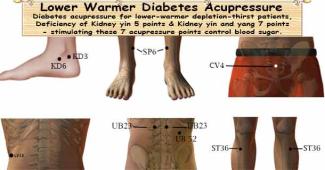
As per Traditional Chinese Medicine, the treatment for diabetes is of three categories. Based on your symptoms (the category you belong), the treatment will be decided (and provided) for effective healing. If your diabetes symptoms, predominantly from kidney origin (that is severe polyuria, night sweating, sore back, tiredness), then you are considered to have the lower warmer depletion-thirst disease.
Acupuncture may be effective in treating diabetes also in preventing and managing complication of the disease.
The author suggests you read the symptoms of all the three depletion-thirst diseases. Then only you can be able to decide what category of depletion-thirst disease you belong? Once you confirm your category, you follow the acupressure treatment plan of that particular depletion-thirst disease.
Lower-warmer depletion-thirst diabetes acupressure
The excessive heat of the kidney ( an organ at the lower part of the body) consumes (depletion) the kidney yin or yin & yang.
A) Deficiency of the kidney yin
The excessive heat of the kidney consumes the kidney yin.
Symptoms of Kidney yin deficiency: The symptoms are: Dizziness, vertigo, tinnitus, poor memory, deafness, night sweating, sore back, the ache in bone, polyuria, dark scanty urine, constipation. Tongue: red, no coatings, cracks. Pulse: Empty (weak) and rapid.
The treatment goal for Kidney yin deficiency: Replenish the kidney yin.
5 Diabetes acupressure points for Kidney yin deficiency
Lower-warmer depletion-thirst (kidney yin deficiency) acupressure point is for diabetes individuals with urination predominated with dark scanty urine.
- KD 3 - tonify KD, Location: In depression, midway between the tip of the medial malleolus and the attachment of the Achilles tendon. This point tones the Kidney's Yin & Yang, strengthens the low back, relieves heel/ankle pain.
- KD 6 - tonify KD Yin, Location: In a depression below the tip of the medial malleolus.
- SP 6 - nourish Yin, Location: three cun directly above the tip of the medial malleolus on the posterior border of the tibia. This point nourishes the Kidneys, clears deficiency-Heat, and beneficial to the throat & eyes.
- CV 4 - nourish Yin, Location: two cun above CV 2 (pubic symphysis). This point strengthens/nourishes the Kidneys (Qi, Yin and Yang), nourishes Essence, improves Original Qi, and good to menstruation & the uterus.
- LV 13 - a meeting of the yin organs, Location: On the lateral side of the abdomen below the free end of the 11th rib. This point harmonizes the Liver & Spleen and regulates Liver Qi.
b) Deficiency of the kidney yin and yang
The excessive heat of the kidney consumes both the kidney’s yin and yang.
Symptoms of Kidney yin and yang deficiency: The symptoms are: Severe polyuria, sore and weak back, and knees, the sensation of cold, shortness of breath, weak lower limbs, lassitude, clear copious urine, spontaneous sweating, poor appetite, loose stools, edema (which can be severe). The tongue is pale, swollen, wet, and mostly with a white coat. Pulse is deep, weak, and mostly slow.
The treatment goal for Kidney yin and yang deficiency: Replenish the kidney Qi and nourish the kidney yin.
7 Diabetes acupressure points for Kidney yin and yang deficiency
Lower-warmer depletion-thirst (kidney yin & yang deficiency) acupressure point is for diabetes individuals with urination predominated with clear copious urine.
- UB 23 - KD Shu, Location: 1.5 cun lateral to GV 4, level with L2. This acupressure point strengthens the Kidneys, tones Kidney Yang, nourishes Kidney Yin and Essence, strengthens lower back, resolves Dampness.
- KD 3 - tone KD, Location: In depression midway between the tip of the medial malleolus and the attachment of the Achilles tendon. This point tones the Kidneys (Yin and Yang), strengthens the lower back, relieves heel/ankle pain.
- UB 52 - tone KD and effect willpower, Location: three cun lateral to GV 4, level with L2. This point tones the kidneys, normalizes urination, strengthens the lower back.
- KD 6 - nourish KD Yin, Location: In a depression below the tip of the medial malleolus. This point nourishes the Kidneys, clears deficiency-Heat, benefits the throat, benefits the eyes, calms the Shen.
- SP 6 - nourish Yin, Location: three cun directly above the tip of the medial malleolus on the posterior border of the tibia. This point strengthens the Spleen & Stomach, resolves dampness, harmonizes the Liver, strengthens the Kidneys, nourishes Blood & Yin, regularizes menstruation, cools invigorate the Blood, normalizes urination, and calms the Shen.
- CV 4 - nourish Yin, Location: two cun above CV 2 (pubic symphysis). This point strengthens/nourishes the Kidneys (Qi, Yin and Yang), nourishes Essence, improves Original Qi, and good to menstruation & the uterus.
- ST 36 - (tones qi), Location: three cun below ST 35, one finger width lateral from the anterior border of the tibia. This point tones Qi & Blood, strengthens the Spleen & Stomach, strengthens the body & Wei qi, raises Yang, calms the Shen, activates the meridian, and stops pain.
If your symptoms confirm you as a diabetes of upper-warmer-depletion-thirst disease, then you can start acupressure treatment. Now you should stimulate acupoint, learn; How do you stimulate Acupoint for diabetes healing?
Middle Warmer Diabetes Acupressure

As per Traditional Chinese Medicine, the treatment for diabetes is of three categories. Based on your symptoms (the category belongs) decide (and provide) the treatment for effective healing. If your diabetes symptoms, predominantly from stomach origin (that is digestion related), then you are considered to have the middle warmer depletion-thirst disease.
Acupuncture may be effective in treating diabetes also in preventing and managing complication of the disease.
The author suggests you read the symptoms of all the three depletion-thirst diseases. Then only you can be able to decide what category of depletion-thirst disease you belong? Once you confirm your category, you follow the acupressure treatment plan of that particular depletion-thirst disease.
Middle-warmer depletion-thirst diabetes acupressure
The excessive heat (fire) in the stomach (middle part of the body) consumes (deplete) stomach yin fluid.
Symptoms of Middle-warmer depletion-thirst: The symptoms are; feel constant hunger (Polyphagia), emaciation, painful, swollen, and bleeding gums, regurgitation, and vomiting after eating, burning sensation in the epigastrium, nausea, and constipation. The tongue is red, dry with thick yellow coat and pulse is full, deep, rapid.
The treatment goal for Middle-warmer depletion-thirst: Clear heat, normalizes stomach fire and replenishes the stomach yin.
7 Diabetes acupressure points for Middle-warmer depletion-thirst
Middle-warmer depletion-thirst acupressure point is for diabetes individuals with hunger predominated.
- PC 6 - calm the spirit, Location: 2 cun above the wrist crease between the tendons of palmaris longus and flexor carpi radialis. This points is useful to open the chest, regulates Heart Qi, calms the Shen, harmonizes the Stomach, relieves nausea and vomiting, regulates Qi.
- SP 6 - tonify Yin, Location: 3 cun directly above the tip of the medial malleolus on the posterior border of the tibia. This point strengthens the Spleen & Stomach, resolves dampness, harmonizes the Liver, strengthens the Kidneys, nourishes Blood and Yin, regulates menstruation, cools and invigorates the Blood, benefits urination, and calms the Shen.
- CV 12 - ST Mu, Location: Midway between CV 8 and CV 16, four cun above CV 8 (umbilicus). This point strengthens/harmonizes the Spleen & Stomach, resolves Dampness, and relieves pain.
- ST 21 - assist CV 12, clear heat, Location: 2 cun lateral to the AML level with CV 12. This point stops diarrhea.
- CV 13 - descend rebellious Qi. Location: 5 cun above CV 8 (umbilicus). This point is useful to stop vomiting.
- ST 44 - clear heat from the channel, Location: Proximal to the web margin between the 2nd and 3rd metatarsal bones, in a depression distal and lateral to the 2nd metatarsi digital joint. This point clears Heat from the Stomach meridian, resolves Damp-Heat in the intestines, relieves pain.
- ST 45 - clear heat from the face/mouth, calm the spirit, Location: 0.1 cun posterior to the corner of the nail on the lateral side of the 2nd toe. This point clears Heat from the Stomach meridian, and revives consciousness.
If your symptoms confirm you as a diabetes of upper-warmer-depletion-thirst disease, then you can start acupressure treatment. Now you should stimulate acupoint, learn; How do you stimulate Acupoint for diabetes healing?
Upper Warmer Diabetes Acupressure

As per Traditional Chinese Medicine, the treatment for diabetes is of three categories. Based on the respected category of symptoms, the treatment will be decided (and provided) for effective healing. If your diabetes symptoms, predominantly from lung’s origin (that is cold, breathing related), then you are considered to have the upper warmer depletion-thirst disease.
The author suggests you read the symptoms of all the three depletion-thirst diseases. Then only you can be able to decide, what category of depletion-thirst disease you belong? Once you confirm your category, you follow the acupressure treatment plan of that particular depletion-thirst disease.
Acupuncture may be effective in treating diabetes also in preventing and managing complication of the disease.
Upper-warmer depletion-thirst diabetes acupressure
The excessive heat of the lungs ( an organ at the upper part of the body) that consumes (depletion) the lung’s yin.
Symptoms of Upper-warmer depletion-thirst diabetes: The symptoms are thick nasal discharge, tender sinus area, heat signs (such as flushed face, severe thirst accompanied by mouth and tongue dryness, feelings of heat, etc.), reddened tip and margin of the tongue with thin, yellow coating, full and rapid pulse.
The treatment goal for Upper-warmer depletion-thirst diabetes: Remove excess heat from the lungs by purging fire and replenish the body fluids.
6 Diabetes acupressure points for Upper-warmer depletion-thirst diabetes
Upper-warmer depletion-thirst acupressure point is for diabetes individuals with thirst predominated.
- LI 4, LI 11 & GV 14 - used together to clear heat. Location: LI 4 - Between the 1st and 2nd metacarpal bones on the dorsum of the hand, in the middle of the 2nd metacarpal bone on the radial side. Expels Wind, tones qi, strengthens immunity, heal pain, normalizes the face & head area, and induces labor. Useful for Wind-Heat conditions (flu). LI 4 is known as the pain point, it removes pain anywhere in the body.
- LI 11 – Location: With the elbow flexed, the point is on the lateral end of the transverse cubital crease when the elbow flexed. The point is at midpoint between LU 5 and the lateral epicondyle of the humerus. This point helps to clears Heat, cools Blood, resolves dampness, expels, exterior Wind, regulates Qi and Blood, activates meridian, relieves itching.
- GV 14 – Location: In the depression below the spinous process of the 7th cervical vertebra (C7). This point can clear heat, dispels wind, regulates Wei and Ying Qi, treats malaria. This point is useful in treating summer heat.
- LU 7 - restore the LU Qi. Location: 1.5 cun above the wrist crease, superior to the styloid process of the radius. Expels Wind, helps descend Lung Qi, useful for the head & neck area, and good for the bladder.
- LU 10 - fire point of the LU, clears lung heat. Location: in a radial aspect of the first metacarpal at the midpoint of the bone at the junction of the red and white skin. This point is useful in clearing Lung Heat, benefits the throat.
- LU 9 - Tone LU Qi and Yin. Location: wrist crease on the radial side of the radial artery. This point tones Lung Qi & Yin, resolves phlegm, descends Lung Qi, tones Gathering Qi, and influences the pulse.
If your symptoms confirm you as a diabetes of upper-warmer-depletion-thirst disease, then you can start acupressure treatment. Now you should stimulate acupoint, learn; How do you stimulate Acupoint for diabetes healing?
Type 2 Diabetes Remission (Reversal)
Can type 2 diabetes be reversed permanently? Yes, it can be reversed by choosing the right healthy path and following it consistently with confidence. Firstly, you should know yourself and make the necessary changes to achieve diabetes remission.
Are you newly diagnosed with type 2 diabetes? Then you will most likely ask; Is diabetes reversible in the early stages?
Are you with diabetes on medication for a while will always ask; Has anyone recovered from type 2 diabetes? What is the secret to reverse type 2 diabetes? What is the remission rate for type 2 diabetes?
Luckily, you are in the correct place, Welcome.
Can type 2 diabetes go into remission permanently? In 2008 the twin cycle hypothesis put forward that there were vicious cycles of fat accumulation in the liver and pancreas that led to the development of type 2 diabetes over at least a decade.
It predicted that major calorie restriction would lead to a rapid fall in liver fat, normalization of liver insulin sensitivity, and normalizing glucose production by the liver.
Diabetes remission is considered by many as a reel, not real. However, it is really possible “even for you”. The trick is what you correctly do and how consistently you do it!
How long does it take to reverse type 2 diabetes? It varies from person to person, but some anecdotal evidence suggests that it may vary from a few weeks to months to even years.
Definition of type 2 diabetes remission
Diabetes remission is defined as HbA1c remaining below 6.5% for at least three months, without any diabetes medicine. Some people may call it ‘reversing of type 2 diabetes’.
HbA1c is considered to be an unreliable marker of long-term glycemic control. So, fasting plasma glucose of less than 126 mg/dL (or <7.0 mmol/L) on two occasions separated by at least six months without medication can be used as alternate criteria.
Is remission a reversal or a cure for type 2 diabetes?
How long remission can last? Evidence shows it is possible to be in remission for up to 15 years or more based on how consistent we are in a healthy lifestyle.
The remission is not always permanent (i.e., a permanent cure). It needs to be maintained; blood glucose levels may rise again if patients revert to unhealthy lifestyles. The trick is how well you adapt to a healthy lifestyle forever.
The healthcare profession thought that it is somewhat easier for remission, if you take the necessary steps immediately after diagnosis. However, some people have been able to put their diabetes into remission even after 25 years of being diagnosed. So, strategy should be your consistent effort with confidence.
How can you get diabetes into remission?
Diabetes remission is possible; if you make your body cells sensitive to insulin and restore your pancreas to release enough active insulin.
The pancreas and liver are the two vital organs involved in blood glucose control. Fat cells (Adipocytes) are involved in glucose consumption. Shedding fat from muscle cells and these organs was key to remission from type 2 diabetes in people living with obesity or overweight.
We now know that the processes that cause type 2 diabetes can be reversed to normal functioning by restriction of food energy to achieve weight loss of around 15 kg. Diabetologia. 2011 Oct;54(10):2506-14.
People diagnosed within the first 10 years and who manage to follow food energy restrictions achieved around half of people return to non-diabetic glucose control. Cell Metabolism. 2018 Oct 2;28(4):547-556.e3.
Obese or overweight patients should strive to lose weight; this helps to improve insulin secretion and sensitivity. People who lose on average 8% of their body weight go into remission. A Diabetes UK-based study called the ReTUNE found that 70% of participants with lower body weights went into type 2 diabetes remission after losing weight through a low-calorie diet program.
However, it is not advisable for healthy weight or underweight individuals without central obesity to lose weight; instead, they have to increase physical activity and shift towards nutritious food without losing weight even if they can add some healthy weight.
Firstly, you should know your body
Overweight or obese people with central obesity have fat build-up around the vital organs such as the liver and pancreas. This puts a strain on these organs and makes it difficult to work properly which leads to type 2 diabetes and other health conditions.
But people with normal or underweight without central obesity have no fat build-up. Instead, they have shrunken or low-functioning organs due to malnutrition (mostly in their childhood) that may lead to type 2 diabetes.
Type 2 diabetes can be classified into 3 based on body type; they are:
- Obese before and after diabetes,
- Obese before and lost major junk of weight after diabetes,
- Normal or lean before and after diabetes.
All clinical studies and diabetes institutions are interested in suggesting weight loss for all patients diagnosed with diabetes. However, this is not always the case for example, normal-weight and lean individuals (without central obesity) with diabetes need to switch to a healthy lifestyle without any further weight loss. They can even try to increase their weight by building muscle mass with nutrient-rich food and exercise.
The healthy-weight individuals with central obesity are also at risk of diabetes and thus need to lose this central obesity (abdomen). Because the excess fat coats over the abdominal organs such as the liver, and pancreas, and disturb their normal functioning.
Firstly, you should know which category you are from and the health of your internal organs that are responsible for putting you on diabetes. Then only you can able to devise a strategy to bring back the lost health.
For that, you should first assess and understand your health which might lead to the development of diabetes. To reverse diabetes, you need to bring back your lost health; for the same, we have a diabetes health assessment calculator that helps to assess as well as validate improvement in your health. Visit how to use diabetes health assessment calculator to know further.