
Calculate Mean Arterial Pressure (MAP) and Pulse Pressure (PP) from systolic and diastolic blood pressure. Includes formulas, normal ranges & chart.
How to Calculate Mean Arterial Pressure (MAP) and Pulse Pressure
Mean Arterial Pressure (MAP) and Pulse Pressure (PP) are critical hemodynamic measurements calculated directly from your systolic and diastolic blood pressure readings.
1. Mean Arterial Pressure (MAP) Formula
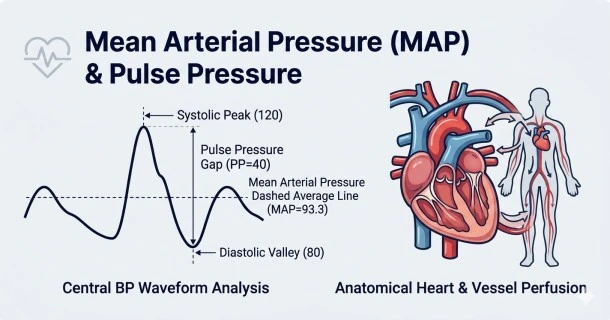
MAP represents the average arterial pressure during a single cardiac cycle, weighted heavily toward the diastolic phase because the heart spends more time in relaxation than contraction.
- Standard Formula: MAP = DBP + 1/3 × (SBP − DBP)
- Alternative Formula: MAP = [SBP + (2 × DBP)] ÷ 3
- Example (120/80 mmHg): MAP = 80 + 1/3 × (120 − 80) = 93.3 mmHg
2. Pulse Pressure (PP) Formula
Pulse Pressure reflects the force generated by the heart during each contraction, calculated as the difference between systolic and diastolic pressure.
- Formula: Pulse Pressure = SBP − DBP
- Example (120/80 mmHg): PP = 120 − 80 = 40 mmHg
Normal Ranges & Clinical Interpretation Chart
| Metric | Low / Narrow | Normal Range | High / Wide | Clinical Significance |
|---|---|---|---|---|
| Mean Arterial Pressure (MAP) | < 60 mmHg (Critical) / 60–69 mmHg (Borderline) | 70 to 100 mmHg | > 100 mmHg | Measures vital organ blood flow and perfusion. |
| Pulse Pressure (PP) | < 30 mmHg (≤ 25% of SBP) | 30 to 50 mmHg (Avg: 40 mmHg) | > 50–60 mmHg (≥ 100 mmHg wide) | Reflects arterial elasticity and stroke volume. |
Clinical Importance and Causes
A MAP of at least 60 mmHg is required for basic organ perfusion, with ICU targets typically set at ≥ 65 mmHg. Values consistently exceeding 100 mmHg strain the cardiovascular system.
- Wide Pulse Pressure (> 50–60 mmHg): Often driven by arterial stiffness (arteriosclerosis), aortic regurgitation, or high-output states like hyperthyroidism.
- Narrow Pulse Pressure (< 30 mmHg): Indicates reduced stroke volume from heart failure, cardiogenic shock, severe hypovolemia, or aortic stenosis.
Mean Arterial Pressure (MAP) & Pulse Pressure Calculator
Enter your systolic and diastolic blood pressure readings in mmHg to calculate MAP, Pulse Pressure, and Proportional Pulse Pressure.
Top number (heart contraction)
Bottom number (heart relaxation)
Mean Arterial Pressure (MAP)
--
Pulse Pressure (PP)
--
Step-by-Step Calculation:
Frequently Asked Questions (FAQ)
What is a good MAP for 120/80 mmHg?
A reading of 120/80 mmHg yields a normal MAP of 93.3 mmHg and a Pulse Pressure of 40 mmHg.
Can you have a normal MAP with an abnormal Pulse Pressure?
Yes. For example, 150/60 mmHg gives a normal MAP of 90 mmHg but a wide Pulse Pressure of 90 mmHg.
Why is diastolic pressure multiplied by 2 in the alternative formula?
Because the cardiac cycle spends roughly two-thirds of its time in diastole and one-third in systole at normal resting heart rates.