
Eye Palming

Eye palming is a very simple eye exercise but is very effective for relaxing your mind & eyes.
Eye palming - mental stress & eye relaxation
Owing to the importance of eyes & stressful life, there should be some way out to maintain/improve eye health with an additional benefit of relaxation.
Indian Yogis & Chinese Taoists practiced eye palmed for thousands of years. It is very much beneficial for eye relaxation; relax eyestrain, eye fatigue, and mental stress. It is particularly good for those, who spend most of their time in front of Computers (Computer Professionals) or to those who strain their eye all the time. Additionally, it provides mental relaxation.
This page contains different eye palming techniques they are:
- Eye Palming Soothes and Rests the Eyes
- Secret 'Black Globe' Palming Technique
- Yoga Fetal Palming
- Squatting Position Palming
- Sit Down Palming
The ancient Indian Yogis and Chinese Taoists practiced eye-palming techniques for thousands of years. They "palmed" their eyes as a form of meditation or inner visualization and relaxation.
"Palming" is performing by gently 'cupping' both palms over the eyes, blocking out as much light as possible, and palm for five minutes daily.
The Masters say that too much outward gazing at all the 'exciting', bright and fast-moving things in the world upsets the inner balance of our 'spiritual third eye. The physical eyes and brain become clouded confused and agitated, like a muddy stream.
Palming calms the mind, emotions, spirit, and body. The inner and outer eyes take on the qualities of a clear, tranquil, peaceful pool of water. When the mind and emotions are tranquil, vision focuses on the outer world with clarity and insight.
Palming is one of the most important methods for relaxing eye muscles and eye nerves. Palming helps to calm the mind and improve color clarity. It is very helpful for many degenerative eye conditions when performed regularly.
Eye Palming Soothes, Relax the Eyes and mind
All you have to do is gently rub your hands, cover your eyes with cupping hands by placing the fingers on the forehead and visualize complete darkness.
Palming is practiced and taught by many Visual Training Teachers throughout the world, i.e., in the United States, Germany, the Yogis of India, Chinese Taoists, Tibetan monks, Naturopaths, and Holistic Doctors.
This superior technique can bring about a complete transformation and restoration of the eyes. When learning how to palm correctly, everyone will be inspired to palm daily, because it relaxes the eyes, the body, and the mind.
When first start palming, one may see the color gray, a white light or other colors while performing palming; this indicates eye strain. As you continue practicing, however, you will be able to see only black darkness.
Total 'blackness' while palming means that the mind is relaxed & calm, and the eyes can heal & regenerate quickly.
"Let Go" Mentally While Palming - While palming, let go mentally, because the eyes cannot completely relax when the mind or body is full of stress and tension. The brain is like a camera-we see through the brain.
Eye gets strain while palming, if the brain is in "tension," thinking about the problems, the same as with them open. It is necessary to relax the "brain-stuff" (thoughts) while palming. Then there will be improved eyesight.
For complete relaxation, breathe slowly, evenly and naturally. Give the problems to the Universe or Higher Power. Let allow the mind to dwell on something beautiful-a blue ocean, sandy beach, sunset, mountains, a loving face, etc.
Complete relaxation leads to complete healing. This is the goal!
Avoid strain or negative thoughts while palming. Shut out all light and think of a black box lined with black velvet. When the inner mind can see, visualize, and remember black while palming, the vision will improve.
'Black Globe' Palming for eye & mental relax
The real inner secret behind perfect eyesight is to relax the eyes, body, brain, and mind completely!
Complete relaxation means complete healing of body, mind, and vision. To do this, one must be able to visualize complete black space while palming with the eyes closed.
While palming, have to picture a background as black as it can imagine a ‘round’ very black ‘Globe’ picture against that background. Let go of the background and let concentrate on the Black Globe, and then imagine it spreads out until it becomes the background itself.
Try to picture a still blacker globe on the new background and so on, until getting a background so black that nothing blacker can be imagined.
Perfect blackness equals perfect relaxation, and perfect relaxation equals perfect vision.
Ten to fifteen minutes of "seeing black" while palming will prove to what a marvelous relaxation technique this is. Some people have reported eyestrain relieved in only a few palming sessions. After ‘seeing black,’ he/she will be able to see much more clearly and strongly-at either the close point or far point.
To see the fullest degree of "blackness,” first look at a perfectly black object, i.e., black car, black cat/dog, black velvet, etc., and then (while palming to try to remember that blackness).
Yoga Fetal Palming - relax, heals the mind and eye
The Yogis of India discovered that performing palming in the Fetal Kneeling Position or Fetal Squatting Position is more relaxing and healing than in the upright sitting position. However, all three palming positions are beneficial and can perform at any time.
Always finish the eye exercise routine with palming. Palming in the kneeling or squatting position is an excellent method of complete eye, mind, and body relaxation. It greatly enhances fresh blood circulation and nerve flow to the eyes.
How to do: Kneel in the fetal position (on knees and body bent forward with the face down); bring the head to the floor in front of knees, with "cupped" palms over eyes). Rest on the heel of the palms on the cheekbones, fingers crossed over the forehead. Be sure the palms do not touch the eyeballs; keep out as much light as possible.
Squatting Position Palming - relaxation for eye and mind
Squat down with your feet 8 to 10 inches apart. Place arms over the knees and cup palms over eyes. Relax in this position with palms covering eyes. In the East people squat in this position to have babies, eat and eliminate. It is a natural position and very conducive to relaxation, meditation and palming.
Sit Down Palming Technique
Place palms over the eyes, elbows on the table, with back and neck straight. You can use a small pillow under the elbows if need; this helps to relax the arms. Use this method at work if unable to perform the Fetal Floor Palming Technique. (Would not want to catches on the floor when the boss walks in)! Both palming techniques will work. Just "do it" and "see" the vision improves. Happy Palming
Important Eye Improvement
Palm correctly means to see "perfect blackness." The blacker while palming, the faster eyesight improvement will be. Perfect blackness equals perfect eyesight. Perfect blackness indicates that the visual nerve senses are relaxed and are functioning correctly.
If seeing gray or various colors while palming, it indicates that the vision is unclear and blurry. Palming while visualizing "black" helps to darken the palm area.
Key to See Perfect Blackness
Perfect blackness that is recalled and perceives indicates that the mind is perfectly relaxing.
When cultivating the power to "remember and visualize black,” then the brain & mind rests and relaxes instantaneously, thus the vision strengthens tremendously.
The mastery in remembering to see black go beyond relaxation. It enables to see the letters 'much blacker' on a page, thus making them sharper and easier to read. Practice a few minutes each day and will see marked improvement.
The subconscious memory of "perfect blackness,” carried in the mind when the eyes are open, will give a high degree of mental and visual clarity and strength. Consequently, the vision can improve immediately, if the memory and the mental image of "perfect blackness" are visualizing and retain.
The natural eye training specialists state that many cases of imperfect eyesight-nearsightedness, farsightedness, aging vision-have been cured by the simple practice of "seeing black" while palming, over a period of time.
Eye palming benefits
What are the benefits of eye palming? Below is the list of benefits of just a few minutes of eye palming.
- Palming calms the visual system; relieve tired, strained or bleary eyes
- Improves eyesight
- Provide mental relaxation
- promotes visualization
- Better memory and creativity
- Feel energetic
- Restful sleep
Eye Massage
Eye massages are worthwhile for eye problems by relieving, firming, and healing the eye. It is also good for preserving normal eye health.
Eye Relief Healing massages
Eye massage can increase blood circulations inside the eye, and thus most of the eye problem can relieve by its own by self-healing. Some of the valuable eye massages are:
- Acupressure Eye healing massage
- Naturopathic Eye firming massage
- Do-In Eye massage techniques
- o Chinese’s scalp rubbing for eye relief
- o Palm eye firming massage
- o Stroking eyebrow’s technique
- o Ironing the face technique
Acupressure Eye healing
Acupressure has been around for thousands of years introduced by the Chinese.
How to do Eye Acupressure: Exert heavy finger pressure on each of the points surrounding the eyes for 10 seconds. Next, rub each point for 5 seconds. Any pain stands for eye weakness. Healthy eyes have no pain, even under heavy finger pressure. If your eyes are weak, spend more time on eye massage. Next with the pads of the first three fingertips, press lightly on closed eyelids for 30 seconds - this helps nearsighted. Finish with the Eye Palming: Rub hands together until warm and place-cupped palms over both eyes for 30 seconds. Imagine dark black. Feel your mind and eyes relaxing. Perform Eye palming daily; it is restful and healing for the eyes, mind, and entire body.
Naturopathic Eye firming
- Step l. Place the palm of each hand on the bony ridge above each eye, press hard on the brow and move the skin up-and-down, side-to-side and in small circles. Perform twelve times with each area.
- Step 2: Place your open palms on each side of your temples. Move the skin up and down, forward and back and in a circular motion a dozen times each.
- Step 3: Place your fingers on each cheekbone under the eyes, while moving the skin up and down, right and left, a dozen or more times each. "If you faithfully carry these instructions out it will prove important in restoring your vision."
Do-In Eye Massage
Zen masters practice a form of self-healing massage called Do-In (Doe-Inn). Do-In is a chi-energy technique, which combines with Chi Kung breathing movements to revive and regenerate the body, mind, emotions, and spirit, harmonizing all levels of being with the rhythm of life. Do-In, practiced daily helps one to keep balance and harmony in life. It helps keep one centered, grounded, and focused in life.
Chinese Scalp Rubbing for Eye relief
Sit straight and relax mind and body. Simply rub your scalp with fingers slowly from the front to back, and in small circles for 30 to 60 seconds. This helps to clear the heart of toxins, relax the brain, calm nerves, invigorate the scalp, and improve eyesight by bringing blood circulation to the head and eye region. Scalp massage lessens tension and stress. It is better, if you exchange scalp massage with your partner or friend. It is more relaxing and soothing when someone else does it for you.
Palm Eye firming
Close eyes slightly and 'knead' closed eyelids over eyeballs with the inside your palms. Circle palms 16 times clockwise and 16 times counterclockwise. Next, place palms on the eyes and move up and down 16 times, and side to side 16 times. This is from my experience, the best eye massage for all conditions: Nearsightedness, farsightedness, astigmatism. It also helps to prevent eye diseases of the middle-aged and elderly.
Stroking Eyebrows Technique
Place thumbs on temple and stroke eyebrows with second knuckle of each forefinger, over eyebrows. Rub 16 times, close your eyes, and use light and even pressure. This helps to clear the eyes, regulate the nerve role, prevents hardening of cerebral arteries, and degenerative eye diseases.
Ironing the Face Technique
Scrub the face with open palms from the forehead, down to the chin, and up to the ears in a circular motion for 16 times. The Chinese Taoists' call this as "Ironing the Face," it helps to remove wrinkles, brings fresh blood to the eyes, and improves ones' complexion.
Yogic Eye Exercises
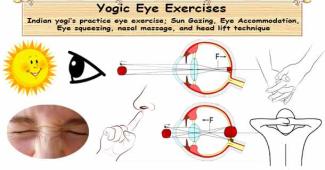
Indian yogi’s practice eye exercise for better vision, they are Sun Gazing, Eye Accommodation, Eye squeezing, nasal massage, and head lift technique.
Yogic eye exercise for Vision correction
- Secrets of Yoga Sun Gazing as eye correction
- Yogic eye accommodative eye training
- Eyes Squeeze for vision improvement
- Indian Yoga nasal massage for eye correction
- Head lift technique for eye and ear problems
Secrets of Yoga Sun Gazing as eye correction
The ancient Yogis use "Yoga Sun Gazing" as a meditation to infuse the body, mind, and spirit with healing solar light and power.
How to do: Go outside at SUNRISE or SUNSET when the solar is red or orange. Open the eyes wide and take in nine deep breaths (in and out gently) while looking at the sun. Feel the "sun energy' traveling into the eyes and down to the belly button area (Hara). After sun gazing, gently cover the eyes with the palms, for a few minutes while visualizing color black. This helps to relax and heal stress and tension in the mind and eyes.
Yogic eye accommodative eye training
Eye Exercise Part I (Improve Close & Distant Vision)
The ancient Indian Hindu Yogi has devised many techniques, for improving the eyesight.
This marvelous eye exercise helps the eyes to improve their ability to change focus and see clearly, in the distance, and at the close-up.
Modern science tells us that the accommodative eye muscles weaken with age. However, this is not true, if he/she continues to use the accommodative focusing eye muscles regularly; eyesight will remain clear and strong throughout life.
If one lost their "accommodative eye focusing ability,” this eye exercise can bring back the natural eye accommodation for distance and close-up seeing:
This exercise mainly helps farsightedness or old age sight, the ability to focus at the close-up clearly. Practice this exercise outside in good light or inside in a well-lighted room, while looking out the window.
- One: Pick out a distant object, about twenty feet or more away (tree, car, building, etc. This is the distant vision object.
- Two: In the hand, hold a 2 x 3 card with black letters, large enough to see clearly.
- Three: Hold card at the eye level at arm’s length away, so that it can see clearly.
- Four: Look at a distant object; see it clearly. Now, move the eyes back to a letter on the card (at the close point) and see it clearly for a few seconds. Perform this accommodative eye movement three times (in and out).
- Five: When the letter on the card becomes easier to see, then move the card a couple of inches closer and repeat this "close point and distant point" movement three times, as in Step 4.
- Six: Next, move the card a few inches closer, while still seeing it clearly. Again, repeat the "close" and "distant" eye movement, always focusing the eyes as clearly as can be.
The accommodative eye muscles, just like any other body muscles, become weaker because of disuse.
Eye exercises induce fresh blood flow, chi flow and nerve energy to the eye muscles and nerves, thereby enhancing vision. Perform this movement two or three times a week.
Eye Exercise Part 2 (To Improve Distant Vision)
Follow the steps in the above exercise, but reverse the procedure by looking at a card with letters on it,
- Held at a reading distance that is 15 to 18 inches away from the eyes.
- Hold the card where he/she can be able to see the letters' clearly, then immediately look at an object twenty feet away, i.e., tree, car, building, etc.
- Focus the eyes from the card to the distant object, seeing both as clearly as possible, three times back and forth.
- Look at an object twenty to thirty feet further away than the first object.
- Repeat the back and forth eye movement three times. Continue with this exercise by looking at objects further into the distance. Practice this distance seeing accommodative eye movement for five minutes, two or three times a week.
Eyes Squeeze for vision improvement
Breathe in slowly and gradually squeeze the eyes tightly for 10 to 15 seconds. Slowly exhale, making the sound "ssshhh" while opening the eyes widely. Repeat 3-6 times.
This Taoist eye technique increases circulation to the eyes, prevents watery eyes, strengthens the eyelid and tear gland muscle. This normalizes lachrymal glands. These glands furnish an alkaline solution that purifies the eyes and imparts a brilliant, sparkling luster to the eyes.
The Healing Sound "Ssshhh" is useful to purify the liver and calm the nervous system. Opening the eye wide while exhaling the sound "ssshhh" releases anger and tension from the liver and the eyes.
Indian Yoga nasal massage for eye correction
Ayurveda (Indian Medicine) teaches us that chronic colds, flu, mucus and lung congestion are the basic cause of most eye problems. The eyes are in close proximity to the nasal and sinus passages.
Nasal massage helps to improve sinus conditions and allows seeing objects with clarity.
How to do: Dip the baby finger into sesame oil, ghee, or one drop of eucalyptus oil and insert it into each nostril. Massage as deep as possible, slowly massages in a clockwise and counterclockwise direction. It may feel soreness. Go easy.
It may also sneeze and blow the nose several times. Do not panic.
This is a cleansing reaction by the body. It will clear the sinuses quickly! It opens up the lung breathing channels, releases pent-up emotions, and improves eye clarity. Gently perform the Yoga Nasal Massage three times a week, one minute for each nostril.
Head lift technique for eye and ear problems
Head Lift Technique is an excellent exercise to clear up ear and eye problems. It also helps to overcome headaches, neck and shoulder pain.
How to do: Place both hands (fingers and palms) around the neck at the lower part of the skull (mastoid process). Lift the head upward (face pointing bit forward), while turning the head to the right when lifting. Turn and lift head to the left in the same manner.
This simple movement can help unblock any pinched nerves in the neck or trapezius muscles. Lift up the head gently, but do not squeeze the neck too hard. Turn as far as comfortable without straining or jerking. Practice the "Head Lift" several times daily, especially before sleep.
Tibetan Eye Exercises

Tibetan has used natural methods to correct visual weakness and improve eyesight.
They are peripheral vision technique, Tibetan chart, and eye exercise.
Tibetan eye exercise for vision correction
- Tibetan peripheral vision technique
- Tibetan eye chart
- Eye exercise using Tibetan chart
Tibetan Peripheral Vision Technique
How important is a peripheral vision? Everyone uses peripheral vision while driving, walking, playing sports, at work and at home.
One not using their peripheral vision would end up with "tunnel vision.”
Gazing hard, straightforward, makes the eyes lose the ability to see clearly peripherally (side-vision).
How well do you see on the sides? Before being taught to read, children can see with their side (peripheral) vision clear and sharp. "The normal eye sees one thing BEST, but not one thing only." By developing the "Peripheral" (side vision), one can have "eyes behind the head." Gazing straight (forward) without moving to either side, just pay attention to what is going on "peripherally" on the right and left sides.
- Hold a pencil in each hand, twelve inches in front of the eyes.
- Gaze straight out past the pencils into the "distance,” without looking directly at the pencils. See the pencils with the "Peripheral Vision." Do not look directly at the pencils.
- Move each pencil sloooowly to the sides of each eye, as far as it can be seen them peripherally. Repeat this front-to-side movement at least ten times.
- Next, move the pencils, right hand upward and left hand downward, ten times.
- Next, move the pencil’s right hand diagonally upward, and left hand diagonally downward, ten times.
- Next, move the pencil’s left hand diagonally upward, and right hand diagonally downward, ten times.
- Next, hold pencils twelve inches in front of the eyes and make a circle about two or three feet in diameter, from in front of the eyes, out to the sides.
Keep the eyes looking straight ahead in all Seven Steps? Perform circles clockwise and counterclockwise.
Eye exercise using Tibetan chart
These exercises do without eyeglasses or contacts. Perform each movement for 30 seconds while in a sitting position, spine straight and do not move the head but eyes.
- With the palm of each hand, cup, both closed eyes to relax them.
- Move the eyes clockwise around the outer circle of dots
- Repeat this movement in a counterclockwise rotation
- Move the eyes back and forth between the dots at 2 and 8 o'clock
- Repeat this movement back and forth between dots at 4 and 10 o'clock
- Blink the eyes briefly and finish therapy with the eye palming.
Repeat exercises as desired being careful to avoid strain. Once after beginning the therapy, you try to wear eyeglasses and contacts as little as possible. In time, these crutches will become unnecessary.
Egyptian Eye Exercise
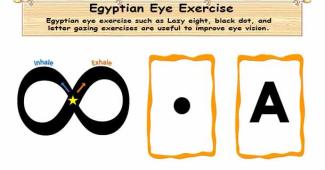
Egyptian eye exercises strengthen your eye muscles and thus useful to improve eye vision.
Egyptian eye exercise for eye vision correction
- Lazy Eight
- Egyptian black dots exercise
- Egyptian letter gazing exercise
Practicing these eye exercise techniques two or three times a week. Take 2 or 3-day rest between each eye session, depending on the energy level.
The day after the first eye routine, the eye muscles may be sore; do not worry. The "soreness" will gradually leave. Soreness means that it has "worked-out" weak eye muscles lying dormant for many years.
The rest period between each eye exercise session is also important. During periods of rest, the eyes and body heal and rebuild, imparting strength and health. Never wear glasses while performing eye exercises. If you are able to move around without glasses, then do so.
"Lazy Eight" Neck Loosening Exercise
Lazy eight exercises slowly and smoothly loosen the back of the neck, calms the nervous system, and enables to focus the eyes clearly.
It is a Pre-Eye Exercise Warm-Up Technique. Simply draw imaginary "eights" with the nose, while moving the head. Large "figure-eight" drawn with the nose helps to relax the larger muscles of the eyes, while tiny "figure eights" relax the smaller muscles of the eyes.
How to do: Draw figure eights with the nose; move the head slowly and smoothly. Vary the "figure eights" by drawing them vertically, then horizontally. Draw large ones and finally tiny "figure eights." Perform them in both directions - the right to left and left to right top to bottom and bottom to top. Spend at least three minutes on this exercise.
The Lazy Eight Neck Exercise is performing first in routine because it relaxes the neck muscles and allows fresh blood to flow to the eyes and brain. It prepares for the rest of the eye routine and ensures greater success in improving the vision. The eye exercises that follow, if practiced regularly and consistently, can help bring the vision back to 20-20 and beyond! Perform the eye exercises with joy and relaxation. Results will be forthcoming.
Egyptian Black Dot Technique
Egyptian black dot eye technique Part I
First prepare the Black Dot on a two-three white card. Draw a Black Dot about the size of a button on the card with black ink. Do not move the head; move the card - in and out. If you have trouble seeing close (farsightedness) does not perform this first part of the Black Dot Technique. Perform the second part only below.
Hold the card in front of the eyes, move the card to the tip of the nose and gaze at the black dot for 30 seconds. You must see only one dot, if you see two dots, move the card away from the nose until only see one dot.
After 30 seconds, moves the card straight out in front of the eyes, then rest and close the eyes for a few seconds. Raise the card up between eyebrows and gaze at the dot for 30 seconds. Move the card as close as possible to see only one dot. Then rest for a few seconds.
Be sure that only see one dot; this means that both eyes are working together. Be persistent and consistent and the results are amazing. Remember to breathe gently, deeply and naturally.
Egyptian black dot eye technique Part II
While keeping the head straight, move the black dots to the right shoulder and gaze at it for 30 seconds. Then, move dots to the left shoulder and gazes at it for 30 seconds close eyes, and rest.
Farsighted people can perform this shoulder-to-shoulder Black Dot Exercise with a great benefit. The Black Dot Techniques make the eye muscles focus in positions it does not normally focus in. This helps to reshape and balance the eyeball itself.
Egyptian Letter Gazing Technique
Egyptian letter gazing part I (Exercise for Close & Distant Vision)
Cut out three 1 /8" to 1 /4" thick letters from a newspaper or magazine and glue them on a 2 x 3 white card.
Perform each exercise with one eye at a time, then both eyes together. Cover the eye with the palm is to keep open during the exercise. This enables both eyes to work together during the exercise.
Start out with three repetitions in each direction. Every two to three weeks add one repetition, until reach six.
- Hold the card twelve inches in front of the eyes. Concentrate on one of the letters, always focusing to see it clearly. Move the card above the eyes and below the chin, three times. Perform this one eye at a time and then both eyes together. Keep the head still move the eyes only.
- Hold card twelve inches in front of the eyes. Move the card slowly from the right eye to the left eye-always keeping sight of the letter. Perform with one eye, then both eyes together, three times each.
- Hold the letter in front of the face, and move the card in right and left diagonally. Perform three times each way. Again, perform one eye at a time, then both eyes together.
- Move the card in large circles, at arm’s length. Perform three times each way, one eye at a time, then both together.
- Hold the card about one foot in front of the head and move the card smoothly in a ten-inch diameter circle. Perform ten times clockwise and ten times counterclockwise. Perform with one eye at a time and both eyes together.
Important while doing Egyptian eye exercise: Breathe deeply and naturally and try not to blink. See the letter as clearly as possible without eyestrain.
Egyptian Eye Techniques are superior exercises for reshaping the eyeballs and strengthening the eye muscles. They help to create eye muscle balance.
You do not confuse this exercise with an ordinary eye exercise; there is no comparison! It helps to reshape the eye back to its normal position, so that light can focus on the retina properly for perfect eyesight. This technique coordinates the mind and eyes to work in perfect harmony. Persistence is the key to success in vision improvement.
Egyptian letter gazing Part II (Exercise for Close & Distant Vision)
Paste a black letter on a 2 by 3 cards and tape the cards to one end of a 12-inch ruler. These letters should be big enough to see easily at two feet.
Hold the card at least two to three feet from the eyes. To improve the distant sight, must use the eyes to see beyond two feet to overcome myopia (nearsightedness). As the eyesight becomes clear at this distance, use smaller letters to help obtain further improvement.
To improve the close vision (farsightedness), simply perform the eye exercise holding the letters less than twelve inches from the eyes. Perform this "Advanced" exercise in the same sequence as did in the above Beginning Egyptian Letter Gazing Technique - Part I.
Chinese Eye Exercises
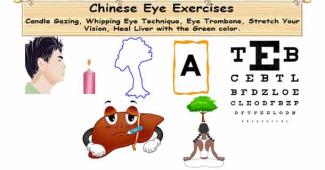
Chinese Monks practice eye exercises for better eyesight, they are: 'Yang Eye' Candle Gazing, Whipping Eye Technique, Eye Trombone, Stretch Your Vision, Heal Liver, and Eyes with the Color of Green.
'Yang Eye' Candle Gazing Technique for beautiful eye
It is known to give one glowing magnetic eyes. The whites of the eyes become clear, full of luster, and shine with brightness.
How to do: Light a candle and sit in front of it at arm’s length and at eye level. Gaze steadily at it without blinking. Breathe naturally, and continue gazing for five minutes without moving the body. Try not to move the eyelids. Less movement brings more magnetic power and control into the eyes and nervous system. Keep the eyes open and allow the tears to flow down the cheeks; open the eyes wider as the tears flow down. For every minute, close the eyes for 10 or 15 seconds. Finish by closing the eyes and palming for two minutes to cool down the eyes.
Tracking Eye Technique
Tracking or Edging technique is the secret behind crystal sharp vision!
Tracking or Edging means seeing the outline of an object. It helps one to regain the natural ability to focus upon the macula.
To improve the distant vision, 'Edge' or 'Trace' the eyes around a picture or a large letter on a sign that can see clearly. Edge or Track around a table 20 or 30 feet away.
Practice edging, objects become sharp and clear to see. Each week pick out smaller and smaller letters until reading the smallest print easily. Remember to close the eyes for a few moments between Tracking or Edging.
Also, do by point the nose at an object that has chosen and move the tip of the nose along its edges. At first, move slowly around the object, seeing each part of the Edge. Later as one become proficient, he/she can speed up the Edging.
Close vision exercise (farsighted)
Accommodative "Whipping Eye Technique"
Whipping is one of the best eye exercises for strengthening the accommodative eye muscles to improve close vision.
How to perform the Whipping Eye Exercise: Cup the left palm over the left eye. Hold a card with a black letter on it that can easily see, at arm’s length in front of the eyes. Pull the card toward the right eye at a moderate speed within a few inches of the face. Next, quickly 'whip' the card suddenly back to arm's length. Repeat this movement several times.
Then, use the left eye while the right eye is cupped with the right palm. Repeat several times. Next, practice 'whipping' with both eyes open at the same time. Repeat several times.
Perform two to three times a week. "Whipping" is an exercise that greatly helps presbyopia (middle-age sight), farsightedness, and any other close vision problems.
Tromboning
How to Perform the Tromboning Eye Exercise: Hold a 2 x 3 card with a small black letter that can easily see at arms' length. From arm’s length, 'slide' (move) the card three inches toward the right eye, and then move it back to arms' length. Next, 'slide' the card six inches toward the right eye, and then move it back out to arm’s length. Next 'slide' the cards nine inches toward the right eye, and then move it back out to arm’s length. Progress in this manner three inches at a time until the card is a couple inches away from the eye. Practice several times with the right eye. Next, perform 'Tromboning' with the left eye, then with both eyes together.
Move the card at a moderate easy speed. Relax and breathe easily. After practicing this exercise for a few weeks, vary the speed of the card-- moving the card more slowly, other times at a brisk speed.
Whipping and Tromboning eventually awakens and strengthens the focusing muscles for the close point, to see the print sharp and clear.
Close Point Eye Sharpening Technique
Many people go through middle age with blurry vision at the close point. And this exercise, as well as the previous one is a positive step in doing something to strengthen and improve the close vision.
- Hold "Eye Chart" in front of the eyes, from 12 to 20 inches, where it can be seen without strain.
- Trace a letter of the first paragraph with the eyes, for example, "V".
- Close the eyes and trace and visualize the letter "V" in the mind.
- Open the eyes look at the letter "V" and trace it again.
- Close the eyes and trace letter "V" again, then open eyes while inhaling and exhaling a gentle deep breath, and look at the letter "V".
- Move the letter "V" in slowly towards the eyes while trying to see the letter as clearly as possible--when the letter starts to blur, stop the movement.
- Close the eyes for a few seconds. Open the eyes with a deep breath and move letter "V" away from the eyes, and notice the letter become clearer.
- Place both palms over eyes for twenty seconds, while visualizing a black color.
Repeat Steps One through Eight with the first letter of all eleven paragraphs, for example, 'T" for paragraph #2. "R" from paragraph #3 and so forth. Or go down to the smallest paragraph that can see clearly. Practice this exercise at least 15 to 20 minutes, two or three times a week.
Distance vision exercise (nearsightedness)
"Stretch the Vision" is extremely valuable in extending the limits of the distant vision, especially for myopic vision (nearsightedness).
Practice "Stretch the Vision" at least 15 to 30 minutes each session, two or three times a week.
- Step 1: Stand straight and select one of the "letters" on the chart.
- Step 2: Trace the chosen "letter in the mind, then close the eyes for a few seconds. Relax the hands, shoulders, eyes, legs, neck etc.
- Step 3: Open the eyes and look at the letter again. Next, place both palms over eyes and "Palm" while visualizing the "letter" in the mind for 15 seconds.
- Step 4: Open the eyes with a deep inhalation and exhalation of breath, noting the "letter" becoming blacker.
- Step 5: While looking at the "letter", begin swaying slowly from side to side. While continue to sway, move sloooowly away from the chart, taking very short backward steps. Breathe naturally and allow the print to come in clearly. When reaching the point where the print becomes indistinct or unreadable, STOP! At this point, bend forward at the waist, continuing to sway, and again read the "letter". Now, resume the short backward steps. Again, even though lean far forward, when reaching the point at which the printed letters are no longer legible. When this occurs, straighten up, move close to the chart and repeat the exercise on the next smaller line, following the above instructions. Repeat each line until he/she reaches the bottom line of the chart. It is important to relax the entire body while performing this exercise. Mentally and physically feel the shoulders, neck, face, eye, arms and hands relax. Let go of the jaw muscles and let them drop. Let the eyes become soft and calm.
Heal Liver and Eyes with the Color of Green
In the Orient, the Taoist Masters teach us that "green" is associated with the liver and the eyes.
Nature’s green colors such as trees, grass etc.and green vegetables, help to heal the liver and eyes. Gently visualize green trees, green grass, blue-green Ocean, and the eyes and mind become calmer, happier and more peaceful. Palming at any time when feeling the need to relax and let go--it refreshes the mind and rejuvenates the eyes.
Eye Exercise
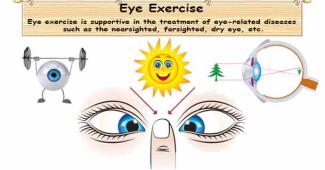
Eye exercise is supportive in the treatment of many eye-related diseases, Such as the nearsighted, farsighted, dry eye, etc.
Improve eye vision with eye exercise
Persistent eye training (exercise) can improve vision quickly.
Eye exercise gives some physical exercise to our eye muscles thus; they regain its lost strength and elasticity.
What is a normal eye? What is 20/20 vision? What is 6/6 vision?
In 1862, Dr. Herman Snellen created a test to measure the visual acuity; he created a chart for easily assessing visual acuity. He created this chart using a definition for standard vision; this helps doctors to work towards comparing and correcting vision.
He designed this chart with the size of the letters, and the white space around them is the same? This uniform design helps it easier to test the visual acuity from various distances. He in-addition arrives at a definition for standard vision after vigorous studies; a person with a normal vision should be able to read a particular line of the chart with ease, this is 20/20 vision (or 6/6 vision).
Someone with a normal vision of 20/20 (or 6/6) means; the numerator refers to the distance in feet (or meter) between the chart and you, and the denominator indicates the distance that a standard eye can read those letters; this is mention in each line of the Snellen chart.
For example, if you have 20/60 (or 6/18) vision, it means that you can see clearly at 20 feet (or 6 meters) what a standard vision would see at 70 feet (18 meters). This means a person with a normal eye can see from 70 feet (18 meters) what you can see from 20 feet (6 meters), and then your eye needs correction to see well.
It is possible to have a better vision than 20/20. It is rare to have a vision efficient than 20/15.
What is a telescopic vision? Is it possible?
A person with above average-eyesight can easily read the 10-foot line (smallest letters on the Snellen Eye Test Chart) from a distance of 20 feet is 20/10 vision! There are people who can read the 10-foot line from a distance of 50 to 60 feet is 60/10 vision. They are considering having a telescopic vision. There is also no limit to reading small ‘Microscopic Type Print’ known as microscopic vision. There is no limit to how sharp and clear one can see, in the distance, and close-up.
Sunlight is necessary for bright eyesight
A new study indicates that a lack of direct sunlight may reshape the human eye and impair vision.
Increased UVB exposure was associated with reduced myopia, particularly in adolescence and young adulthood. Ref: JAMA Ophthalmology. 2017; 135(1):47-53 and Arch Ophthalmol. 2008;126(4):527-530.
The sages say human beings are "solidified sunlight," because our eyesight and our very life are fully dependent on the Solar Orb! We would all become blind without the healing rays of sunlight upon our retina.
Sunlight also gives us natural Vitamin D for healthy skin and eyes. The eye training secrets contained in this site can take you from 20-600 (progressively advanced myopia, or blind without glasses), to be better than 20-20 vision.
The secret of eye accommodation
While seeing an object from a distance to near, the eye changes focus by changing the shape of the lens resulting from the action of the ciliary muscle on the zonular fibers called accommodation.
The normal eye when looking at a distant object becomes shortened, and when looking at a close object is elongated.
While looking at the farther object of more than twenty feet away, the rays come into the eyes parallel. When looking at close point rays come into the eyes at an angle.
The normal eye must accommodate these rays in order to see clearly a close or distant object. All rays from nearby objects come to a focus behind the retina. The eyes must accommodate these rays by adjusting the shape of the eye so that the rays will focus on the retina.
The reason behind eye defects
In a healthy eye, the pupil is tinier when viewing a distant sight, and grows larger when seeing a close object.
The pupil becomes smaller in sunlight and grows bigger when in darkness.
Precisely, the external muscles focus the rays of light; the iris adjusts the light, and the ciliary's muscle focuses on the object.
In short, poor eyesight, according to actual experience, can correct by strengthening the eye muscles through eye exercises, good reading habits, proper nutrition, and overall improvement of health.
Eye Herbs
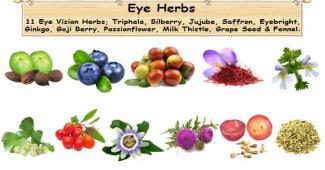
Herbs are traditionally used for many eye problems; herbs can increase blood circulation to the eye and remove eyestrain.
11 Useful Eye (Vision) Herb
- Triphala - a combination of three (fruit); Amla, Haritaki, and Vibhitaki.
- Bilberry extracts (Vaccinius myrtillus) - It helps protect the retina, it also helps improve poor night vision.
- Jujube (Ziziphus jujube) - it is prescribing as a Qi tonic to strengthen liver function.
- Saffron (Crocus sativus) - it is useful for cataracts, macular degeneration, and to improve eye vision.
- Eyebright (Euphrasia Officianales) - it is a special herb for an eye, so-called as an Eyebright.
- Ginkgo biloba - it is a well-researched herb that may improve retinal deterioration.
- Goji Berry (Lycium Barbarum) - have a long history of use in the treatment of eye problems. Tibetan medicine includes these berries in the treatment of kidney and liver problems.
- Passionflower (Passiflora incarnata) - it helps relax the eyes' small blood vessels.
- Milk Thistle (Silybum marianum) - it supports healthy liver and weak eyesight or blurred vision.
- Grape Seed Extract - it can help cataracts, diabetic retinopathy, macular degeneration, and even simple eye strain.
- Fennel (Foeniculum vulgare) - protects your eyes from inflammation, and help reduce macular degeneration.
Triphala – A combination of Amla, Haritaki, and Vibhitaki
Triphala contains three (fruit) ingredients – Amla, Haritaki, and Vibhitaki. Triphala churna is a super formula with multiple health benefits. Antioxidants rich Triphala has been in use as an eye tonic in Ayurveda.
Triphala improves your eye muscles functioning and improves eyesight. Also helpful in curing glaucoma, myopia, conjunctivitis, and computer vision syndrome (relieves eye strain due to computer overuse).
Dissolve one teaspoon of Triphala herb powder in a glass of hot water and stir well. Let it cool, allow the deposits to settle down, and dip a clean cloth in this herbal water. Place this Triphala dipped cloth over your eyes. Allow the herbal water to enter your eyes by blinking your eyes, do this for at least 5 minutes just before bedtime. You can drink the remaining Triphala water; it has numerous health benefits.
Bilberry extracts (Vaccinius myrtillus)
Billberry contains anthocyanins, which protect the retina. The bluish-black berries of this plant make a tasty jam consumed by British air force pilots in World War II. Reference: Bilberry for night vision.
According to the British air force pilots in World War II, the Bilberry jam improved night vision and gave them a tactical advantage during evening sorties.
Scientists studied bilberry and found it contained bioflavonoids called anthocyanosides. These antioxidant compounds help prevent free-radical damage and capillary fragility. They also help the eyes adapt to darkness. It helps protect the retina. It also helps improve poor night vision if it is due to a deficiency in certain coloring pigments. However, It will not help poor vision due to misshapen eyes, near- and farsightedness, or cataracts.
Bilberry is useful in treating varicose veins, which causes impaired blood flow to the legs. It can act as a blood thinner and prevent blood clots from forming. Bilberry extracts can prevent the development of atherosclerosis (hardening of the arteries) caused by the build-up of plaque in blood vessels.
Jujube (Ziziphus jujube)
In Chinese’s medicine, it is prescribing as a Qi tonic to strengthen liver function and has proven to have a positive effect on the eye vision.
It strengthens the liver and helps patients recover from hepatitis and cirrhosis. Chinese has also found that the wild fruit improves skin color and tone, which are both indications of physical well-being.
In modern Chinese’s medicine, jujube is used to tone the spleen and stomach, to treat shortness of breath and severe emotional upset and debility caused by nervous conditions. Pakistan and India people use it as a blood cleanser, an overall tonic, a strengthener, and disease prevention.
Saffron (Crocus sativus)
Saffron or Kesar is a spice derived from its flower, used as a food coloring agent. It has wonderful results for eye problems such as cataracts.
Notably, there have been reports of saffron significantly helping vision in the instance of cataracts, macular degeneration, and to improve eye vision.
This herb has been linked to improved eyesight and improved results for cataracts. This herb can prevent loss of sight among the elderly. Clinical trials have shown saffron has positive results for the early stage of macular degeneration (Macula is the central part of our visual field), reference saffron macular degeneration.
Other health benefits of Saffron include learning & memory retention, vitality increase, treat cold & fever, cancer protection,
Use a daily supplementation of 20 mg saffron tablets for eyesight. It can protect and repair retinal cells. Add 8-10 fresh organic saffron strands to a teaspoon of honey or a cup of boiling water or milk. Keep it closed for 10 minutes. Have a cup of warm saffron water daily in the morning or evening to preserve eye health.
Eyebright (Euphrasia Officianales)
Euphrasia officianales' flower looks like eyes; the name (Eyebright) alone tells you how powerful this herb is when it comes to preserving eyesight.
Studies have shown what has been believed for years that this herb soothes itchy or red eyes, such as those suffering from conjunctivitis. Another study used 12 general practitioners and ophthalmologists in Europe that administered a single dose of eyebright in an eye drop form to those suffering from conjunctivitis. Complete recovery occurred in 81.5 percent of these subjects, and there was a significant improvement in another 17 percent.
Ginkgo biloba
It is most commonly used to treat the elderly with disorientation, depression, memory loss, headaches, tinnitus, and vertigo because of its positive effects as a circulatory aid. It helps to increase blood flow to the brain, which makes it a possible treatment for cerebral insufficiency.
Flavonoids in ginkgo are helpful for retinal problems common among diabetes and macular degeneration.
The flavonoids found in ginkgo may help halt or lessen some retinal problems (that is, problems to the back part of the eye). Retinal damage has some potential causes, including diabetes and macular degeneration. Macular degeneration (often called age-related macular degeneration or ARMD) is a progressive, degenerative eye disease that tends to affect older adults and is the number one cause of blindness in the United States. Studies suggest that ginkgo may help preserve vision in those with ARMD.
Ginkgo (Ginkgo biloba) is a well-researched herb that may improve retinal deterioration and a host of other ailments such as memory loss, tinnitus, and poor circulation, according to research reports.
Goji Berry (Lycium Barbarum)
Goji berry are reported to contain 18 amino acids (six times higher than bee pollen), more beta-carotene than carrots, more iron than spinach, and 21 trace minerals. Goji berries also contain vitamin B1, B2, B6, and vitamin E (rarely found in fruits). Goji berries are 13% protein.
Tibetan medicine includes these berries in the treatment of kidney and liver problems. Goji berries have a long history of use in the treatment of eye problems.
Tibetan medicine includes these berries to lower cholesterol, lower blood pressure, and cleanse the blood. They also use it to increase longevity and as a general health-strengthening tonic. Other uses of Goji berries are for skin rashes, psoriasis, allergies, insomnia, chronic liver disease, diabetes, and tuberculosis
Passionflower (Passiflora incarnata)
Passionflower extract can heal eye strain also do wonders as a nerve relaxer. It can relax the small blood vessels in the eyes.
Passionflower is a useful herb for the eyes; it improves visual acuity, enables you to read without eyestrain even in dim light.
Passionflower is useful for stress reduction, it has a calming effect without sedation, and treat nervousness & insomnia (when combining with valerian and lemon balm). Aside from eye care, passionflower is also good for heart disease, burns, ADHD, asthma, and piles. It is used for first aid treatment for wounds, boils, and ear pain.
Milk Thistle (Silybum marianum)
Milk Thistle has so much to offer besides supporting a healthy liver. However, weak eyesight or blurry vision is sometimes a reflection of our liver health.
Milk thistle can bring benefit for us because they have many marvelous healing properties, especially on the liver (fatty liver, cirrhosis, hepatitis and toxic liver) and Gallbladder. Research shows milk thistle inhibits a reductase, which plays an important role in the sugar deposit in the eyes of people with diabetes. Milk thistle maintains eyes moisture and makes it look bright. So milk thistle is useful for both liver and eyes.
Grape Seed Extract
Grape seed extract is helpful for eye disease related to diabetes.
Grape seed extract contains numerous phytochemicals such as flavonoids, linoleic acid, vitamin E, and oligomer proanthocyanidins. These compounds can help cataracts, diabetic retinopathy, macular degeneration, and even simple eye strain. Oligomer proanthocyanidins have antihistamine and antioxidant properties, which improves overall eye health.
Other benefits of grape seed extract are cardiovascular conditions, poor circulation, high cholesterol, PMS, and skin damage to wound healing.
Fennel (Foeniculum vulgare)
Fennel has long been said to provide relief from watery or inflamed eyes and strengthen them. Many use fennel tea as an eyewash for glaucoma or cataracts.
One study done in 2000 showed that one drop of fennel aqueous seed extract had a reduction in intraocular pressure for those with glaucoma. It means fennel might one day be a super anti-glaucoma medication or eye drop solution shortly. Antioxidants in fennel help protect pigment cells in the eye. Thus fennel is effective in eye health in numerous ways.
Fennel is rich in antioxidants such as vitamin C and amino acids like Arginine. Fennel protects your eyes from inflammation, and help reduce macular degeneration. Fennel leaf juice applied externally on the eyes can reduce irritation and eye fatigue.
Health benefits of fennel: Foeniculum vulgare is useful for preventing anemia, protects from heart diseases, prevent cancer, regulate blood pressure, improves brain function, regulate menstruation, immune booster, and treat respiratory disorders. It is useful for all digestion related complaints such as indigestion, flatulence, colic, constipation, and diarrhea.
Eyesight Nutrients
- Vitamin E - is a powerful antioxidant that has been showing to slow the onset of macular degeneration and protect the retina.
- Vitamin C - is another antioxidant that works with Vitamin E to protect tissues and improve eye health.
- Zinc - an essential mineral required by all cells in the body, zinc helps strengthen the cells of the eye.
- Fish oil - contains powerful compounds that can prevent macular degeneration and other eye problems.
Are Herbal remedies safe?
Remember that herbal remedies are medicines. Thus they also have some side effects. It can also interact with other medicines you are taking. It is best to avoid or get registered herbal practitioner’s advice before taking herbal remedies if the treatment is for pregnant women, breastfeeding mother, child, or older people.
Eye Natural Treatment
Eye vision problems are mostly due to strain or lack of circulation, which can naturally correct with a proper natural treatment and therapy.
Before applying any alternative medicines, you should be aware that many of these medicines have not evaluated in scientific studies. Often, only limited information is available about their safety and effectiveness.
Eye correction and improve vision naturally
Eye problems cause mostly by eye muscle’s strain. Therefore, the treatment should first remove the strains and next increase the elasticity of the muscles. The causes of eye problems also include liver problems, mental anguish, inadequate sleep, digestive disorders and among many others.
Alternative medicine is becoming more and more popular for many diseases and complaints. Alternative medicine for eye is no exception. Just remember that not everything will work for everyone so some trial and error (and a fair bit of patience) may need.
Eye herbs for common eye problems - Herbs are traditionally useful for many eye problems, and proven by the scientific communities. Some of the herbs for the eyes are Bilberry extracts, Jujube, Eyebright, Ginkgo biloba, Suma, Cinnamon, Lycium berry or Goji Berries, Passionflower, and other eyesight nutrients.
Eyecare Home Remedies

Family eye care and home remedies can be helpful to maintain the vision health or eyesight, also to improve defective eyesight with eye exercises and massages.
Home remedies for Eye
You can get or maintain healthy eye vision using some simple home remedies, such as:
- Maintain healthy liver
- Also, practice distance seeing
- Don't strain your eye more by doing much close work
- Expose your eyes to rising or setting Sun
- Have foods that are good to your eye
- Avoid foods that are harmful to your eye
- Do some eye exercise & massage regularly
Good eye vision needs healthy Liver
The good healthy eye can bear everything; blinding light, cold, and wind without crying.
Herbal doctors report that the eyes operate in close connection with the liver. A poor-functioning liver causes the eye to ache and create dark circles around them that do not bear the light very well.
Blink much (more than 3 times a minute) is a sign of organic weakness, especially of the liver.
Eating many sweets, fats, animal foods and alcohol make the eyes tired and weak. Excessive sexual activity can cause dark circles around the eyes. Excess liquid intake causes kidney waterlogging, edema, weakness, lower-back pain, frequent eye blinking, and puffy bags under the eyes.
Healthy liver leads to the powerful eye!
The liver sends energy, nerve impulses, and blood to the eyes. Therefore, a clean bloodstream and a healthy functioning liver help to heal and strengthen the eyes. However, if the colon and liver are toxic and blocked with wastes, the blood becomes impure, health declines, and eyes will become weak, drab, with heavy dark circles around them.
Daily healthy vision habits
Practice Distance seeing; more than 20 away.
Design of the human eye was not for extended use in close work (reading, computers, factory work, sewing, etc.). Gazing into the distance is the natural position of the eye (20 or more feet away). Eye muscles RELAX when distance seeing.
Tests on thousands of people over the years have proven beyond doubt that in most cases, weak vision is causing by strain on the eye muscles. Eyestrain causes tense eye-muscles; muscles connected to the eyeball, eventually distort the shape of the eye. Myopia or nearsightedness means that the eyeball is elongated, and farsightedness hypermetropia) and presbyopia (old age sight) means that the eyeball is flattened.
No Close Work during and after Meals.
Close work draws blood to the eyes, instead of being useful for digestion, thus causing lack of nutrients to the eyes, weak eye muscles, and cloudy vision.
Avoid reading while tired or sick!
Weak bodily energy weakens the entire system, especially the Liver, which is directly connecting to the eyes via the acupuncture meridians. Reading during illness or fatigue weakens the focusing eye muscles.
Don’t read more than 30 minutes at a stretch.
Thirty minutes is about maximum time the eyes can handle without strain or fatigue. Distance viewing and palming is best for relaxing the strained eye muscles.
Eye Bath; Invigorating Lemon Juice
Herbal doctors recommended a Lemon Juice Eye Bath. "Put three or four drops of lemon juice in an eye cup with purified water and wash the eyes with it daily for about 20-30 seconds with each eye" - it is invigorating and strengthening. In addition, strict seven-day elimination (vegetable and fruit) diet, once a month.
Sunshine is food for the Eyes!
It can nourish and heal by its warm radiating energy. Go to outdoors in the sunlight every day; walk when you can, work in the garden, read a book, gaze into the distance, enjoy sports. Whatever you enjoy, do more of it in the life-giving sun and fresh air.
Eye exercise strengthen the vision.
If your vision is 20-50 or less may take few weeks to months to bring your vision back to normal (20-20). If you have 20-70 to 20-100 vision, it may take several months to a year. If you have 20-200 or worse, it may take a few years. It all depends on your understanding, dedication, and consistent practice of these special eye-training techniques. No matter how long it takes, but the goal is to natural visual fitness.
Beneficial eye food
- Sunflower seeds: Sunflower seeds are a supreme food for the eyes. They contain Vitamin B-2, which helps to prevent and overcome photophobia (fear of light). They are also high in Vitamin D. the sunshine vitamin. The sunflower seed plant turns its head to the Sun, thereby absorbing the glorious life-giving Solar Orb. Eat a tablespoon of sunflowers daily in your cereal or soaked overnight and notice how you can easily take sunlight or headlight glare.
- Parsley contains Vitamin B-2, which helps to improve day vision.
- Carrots or carrot juice works wonders for night vision. Carrots are high in vitamin A. The body does not require a high intake of Vitamin A daily, because it is stored in the liver for future use. Therefore, a 6-ounce glass of carrot juice or five carrots a week is enough to give you plenty of beta-carotene and vitamin A for sparkling clear vision.
- Licorice root is an excellent herb to reduce inflammation and to improve vision. Use no more than a 1 /4 teaspoon of licorice powder with water daily. Alternatively, chew on a small piece of a licorice stick. Take licorice as a preventative measure after age 35, as many people tend to get problems with their vision around that age." Licorice is to increase one's memory and mental clarity.
Harmful eye food
- White-Sugar is clearly the deadliest food for your eyesight! This also includes raw brown sugar, which is just white sugar with molasses added for coloring. Do not be fooled by this gimmick. Sugar robs all the bones and teeth of calcium and the all-important B vitamins; it destroys the pancreas; it uses up the insulin and causes diabetes, obesity, heart disease, skin diseases, weak memory, kidney & liver disorders, and poor eyesight.
- Excessive salt consumption leads to hardening arteries, high blood pressure, obesity, etc. Hardened arteries cause poor circulation to the eyes and weak vision. Excess salt congests the kidneys & eventually creates edema (waterlogged body). Use kelp or powdered vegetable seasoning instead of salt.
- White flour, when mixed with the digestive juices, becomes a paste, like 'Plaster of Paris. We become glued-up inside. Literally, blocked-up or constipated from these "refined foods."
Many people walk around with 15 to 20 pounds of dried-up fecal matter pasted up against their colon walls. Not a happy camper, you see these types of angry people driving down the road giving out "middle-finger hand signals" to other 'slow' motorists!
Ayurvedic Health Science from India teaches that constipation must overcome in order to improve the eyesight. Constipation is a direct cause of blurred, dim vision, and many major diseases.