
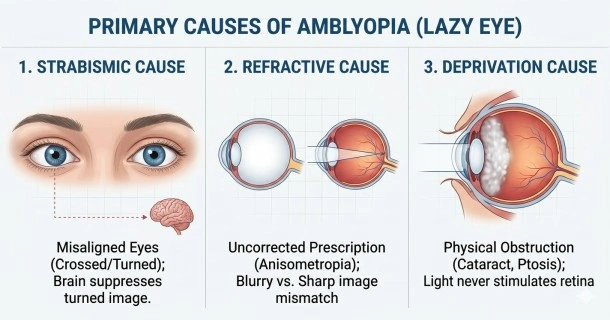
What causes a lazy eye? Discover the clinical triggers behind strabismic, refractive, and deprivation amblyopia, and how neurological suppression develops.
Understanding the Causes of Lazy Eye
Amblyopia, universally known as lazy eye, is not caused by a physical defect or weakness in the ocular muscles themselves. Instead, it is a neuro-developmental condition caused by an interruption in early childhood vision development.
The primary causes of lazy eye always trace back to an initial visual disparity between the two eyes. When the brain receives mismatched, conflicting, or severely blurry information from one eye during its critical developmental window (from birth up to age eight), it is unable to merge the inputs into a single, three-dimensional image. To prevent severe confusion or double vision, the brain's visual cortex undergoes a process of neurological suppression of vision, actively shutting off the signals coming from the weaker eye. Over time, the neural pathways connecting that eye to the brain atrophy, arresting its visual development.
The Three Primary Medical Triggers of Amblyopia
Depending on the structural or refractive issue that initially interrupts normal binocular vision, clinical specialists classify the root causes into three clear categories:
1. What Triggers Strabismic Amblyopia?
Strabismic amblyopia is caused by a constant, physical misalignment of the eyes (strabismus). This occurs when the extraocular muscles responsible for controlling eye movement fail to coordinate perfectly. As a result:
- One eye may noticeably drift inward (esotropia), outward (exotropia), upward (hypertropia), or downward (hypotropia).
- Because the eyes are pointing in different directions, they send two entirely different images to the brain, causing double vision (diplopia).
To protect the child's spatial orientation, the developing brain immediately suppresses the image from the turned eye, halting its visual acuity growth.
2. Refractive Amblyopia Causes and Mechanics
Refractive amblyopia is the most elusive type because the eyes look completely straight and healthy from the outside. The underlying refractive amblyopia causes are strictly optical and structural imperfections in the shape of the eyeball, cornea, or lens:
- Anisometropia: This is a significant discrepancy in the refractive prescription between the two eyes. For example, one eye might have normal vision, while the other eye has high hyperopia (farsightedness), myopia (nearsightedness), or astigmatism (irregular corneal curvature).
- Bilateral Isometropia: Less common, this occurs when both eyes suffer from an equally severe, uncorrected refractive error. The brain never receives a sharp image from either eye, causing a balanced, two-sided amblyopia.
Because the brain cannot successfully fuse a crystal-clear image with a deeply blurred one, it defaults to the sharp eye and ignores the blurry eye entirely.
3. Deprivation Amblyopia Causes
Deprivation amblyopia is the rarest, most rapid, and most severe form. It is triggered by physical barriers that block light from entering the eye, completely depriving the infant's retina of the visual stimulation necessary to wire the brain's visual cortex. Common causes include:
- Congenital Cataracts: A clouding of the eye's natural crystalline lens present right at birth.
- Ptosis: A severely drooping upper eyelid that sags low enough to physically cover the pupil.
- Corneal Opacity: Scarring or cloudiness on the clear front surface of the eye due to early birth trauma or infection.
Key Risk Factors for Amblyopia
While any infant can develop the condition, certain prenatal, genetic, and developmental risk factors for amblyopia drastically increase the likelihood of its onset:
- Family History: A genetic predisposition to strabismus, childhood cataracts, or high refractive errors.
- Premature Birth: Infants born significantly before their due date often have delayed neurological and ocular muscle development.
- Low Birth Weight: A statistically proven correlation exists between restricted fetal growth and structural vision issues.
- Developmental Delays: Children with systemic neuro-developmental conditions, such as Down syndrome or cerebral palsy, experience a much higher incidence of strabismus and subsequent amblyopia.
Frequently Asked Questions (FAQ)
Can an eye injury cause a lazy eye?
Yes, a severe eye injury during early childhood can lead to deprivation amblyopia. If trauma causes corneal scarring, damages the internal lens, or requires the eye to be heavily bandaged or patched for a prolonged period during the critical development years, the brain may permanently suppress that eye's vision.
Can electronics, screens, or reading in the dark cause amblyopia?
No. Watching television, using tablets, playing video games, or reading in low light do not cause amblyopia. The condition is strictly caused by structural, refractive, or alignment discrepancies between the two eyes that manifest during early childhood development.
Why does farsightedness cause amblyopia more often than nearsightedness?
Children are naturally born slightly farsighted (hyperopic), but if one eye is excessively farsighted, it requires intense focusing effort (accommodation) to see clearly. If the child cannot accommodate enough, that eye remains constantly blurred at all distances, triggering rapid brain suppression. Nearsighted children can usually still see up-close objects clearly with their nearsighted eye, providing enough periodic retinal stimulation to keep the brain's visual pathways somewhat active.