
How do you recognize a lazy eye? Discover the subtle physical signs, behavioral clues, and diagnostic symptoms of amblyopia in both children and adults.
Recognizing Amblyopia Symptoms
Because amblyopia (lazy eye) is fundamentally a neurological suppression of vision rather than a physical disease of the ocular structure, its symptoms can be incredibly subtle. The brain automatically compensates by relying heavily on the dominant, stronger eye. Consequently, many individuals—especially young children—are completely unaware that they are experiencing a significant vision deficit.
Identifying the signs early is critical to reversing visual suppression before childhood development ends. The symptoms generally manifest differently depending on age and the underlying cause of the condition.
Lazy Eye Symptoms in Children: What to Look For
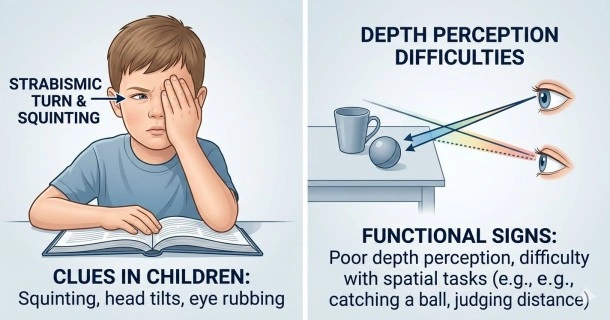
Young children rarely complain of poor vision because a blurry or suppressed eye is the only reality they have ever known. Parents, teachers, and caregivers must look for behavioral adaptations and physical indicators to determine how to tell if a child has a lazy eye:
- Frequent Eye Squinting or Shutting: A child may frequently close or squint one eye, particularly when stepping into bright sunlight or trying to focus on distant objects, to cut out the confusing or blurry visual information.
- Head Tilting or Turning: Children with amblyopia often tilt their head to an angle or turn their face to line up their dominant eye with the object they are trying to see.
- Poor Depth Perception and Clumsiness: Because normal 3D vision requires both eyes to work in tandem, children with amblyopia struggle to judge distances. This often presents as frequent tripping, bumping into objects on one side, or difficulty catching a ball.
- Irritability During Monocular Tasks: If a child becomes abnormally frustrated or resistant during activities that require close visual tracking (such as reading, writing, or drawing), it may indicate visual fatigue.
- Anxiety When One Eye is Covered: If you playfully block a child's dominant eye, they may quickly push your hand away or cry out because their remaining functional eye cannot see clearly.
Adult Amblyopia Signs and Functional Difficulties
While the neural pathways responsible for amblyopia are established during childhood, the functional impact remains highly noticeable throughout life. Recognizing adult amblyopia signs typically involves assessing daily visual performance:
- Chronic Eye Strain and Headaches: Adults often experience persistent frontal headaches or eye fatigue, particularly after prolonged screen use or reading, as the dominant eye overworks to compensate for the weaker one.
- Difficulty Driving and Parking: Severe amblyopia depth perception issues can make judging the distance of oncoming traffic, changing lanes, or parallel parking highly stressful and difficult.
- Struggles with 3D Media: Adults with severe suppression often cannot perceive the depth effects in 3D movies or virtual reality headsets.
- Reading Inefficiency: Text may appear to swim or lose clarity over time, causing adults to lose their place frequently or read at a slower pace.
Symptoms Based on the Type of Amblyopia
The visual and physical appearance of the condition changes depending on its root cause:
- Strabismic Amblyopia Symptoms: This is the most visually obvious form. It features a visible misalignment (strabismus) where one eye noticeably drifts inward (cross-eyed), outward (wall-eyed), upward, or downward.
- Refractive Amblyopia Symptoms: This form is visually invisible. The eyes look perfectly straight and normal, but a massive hidden prescription difference makes one eye intensely blurry. It is usually only detected through professional clinical testing.
- Deprivation Amblyopia Symptoms: This involves a visible physical obstruction to the pathway of light, such as a cloudiness in the pupil (cataract) or a severely drooping eyelid (ptosis) that sags down over the pupil.
Frequently Asked Questions (FAQ)
Can you have a lazy eye without a visible eye turn?
Yes. Refractive amblyopia occurs when there is a large prescription difference between the two eyes, leaving the eyes looking perfectly straight and aligned. Because there is no visible drift, this type of lazy eye can go completely unnoticed without a professional comprehensive eye exam.
Do lazy eye symptoms include double vision?
Double vision (diplopia) is typically a temporary symptom that occurs at the very beginning stages of an eye turn or eye injury. In true amblyopia, the brain’s survival mechanism actively suppresses the weaker eye's signal, eliminating the double vision but causing a loss of depth perception instead.
Can a child pass a school vision screening and still have amblyopia?
Yes. Basic school screenings often test both eyes open together or only check distance vision using a standard wall chart. A child with amblyopia can easily use their dominant eye to read the chart perfectly, masking the fact that the other eye is severely suppressed. A comprehensive examination by an optometrist or ophthalmologist is required for an accurate diagnosis.