
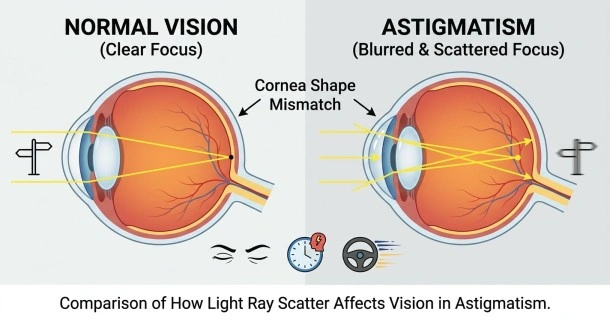
Learn the common symptoms of astigmatism, including blurred vision at all distances, night driving glare, and eye strain. Spot the signs in children early.
Recognizing Astigmatism Symptoms: Key Signs and When to Seek Care
While a mild imperfection in your eye's curvature might go completely unnoticed, moderate to severe refractive errors cause distinct changes in how you perceive the world. Understanding the core astigmatism symptoms can help you identify when it is time to schedule a comprehensive vision test.
Common Symptoms of Astigmatism in Adults
Because astigmatism alters how light curves and enters the eye, it leaves your visual system constantly struggling to compensate. This mismatch typically triggers several classic signs of astigmatism:
- Blurred Vision at All Distances: Unlike nearsightedness or farsightedness, which blur objects at specific ranges, astigmatism distorts your vision uniformly. Text on a page or a distant highway billboard may appear fuzzy, smeared, or double.
- Chronic Eye Strain and Fatigue: When your eye cannot focus light naturally, the tiny internal muscles work overtime to sharpen the image. You may notice your eyes feeling heavy, dry, or severely fatigued after reading, using a computer, or doing detailed needlework.
- Frequent Tension Headaches: The continuous effort to force focus frequently results in mild to moderate headaches, typically centered around the brow line or forehead.
- Frequent Squinting: You might find yourself unconsciously narrowing your eyelids to filter out scattered light and temporarily sharpen your focus.
- Distorted or Ghosted Vision: Straight horizontal or vertical lines might appear tilted, wavy, or accompanied by faint "ghost" outlines.
Night Driving Hazards: The Astigmatism Glare
One of the most disruptive symptoms is astigmatism night driving glare. In low-light environments, your pupils dilate to let in more light, which magnifies the underlying refractive error.
If you have astigmatism, headlights from oncoming traffic, streetlights, and glowing brake lights often appear to stretch, scatter, or burst into elongated halos and dramatic starburst patterns. This visual scattering makes it incredibly challenging to judge distances safely in the dark.
Spotting Astigmatism Symptoms in Children
Children rarely complain about blurry vision because they assume everyone sees the world exactly the way they do. However, uncorrected astigmatism can deeply impact a child’s development, learning retention, and athletic confidence.
Watch for these subtle behavioral pediatric astigmatism signs:
- Holding books, tablets, or homework unusually close to their face.
- Tilting their head at an angle or closing one eye to look at the TV or classroom board.
- Excessive eye rubbing or frequent blinking during visual tasks.
- Losing interest in schoolwork, falling behind in reading speed, or avoiding sports that require sharp hand-eye coordination.
Note: In severe, unmonitored cases, childhood astigmatism can prevent the brain from developing proper visual pathways, leading to a condition called amblyopia (lazy eye), which can cause permanent vision deficits if left untreated past early childhood.
When to See an Eye Care Professional
You should schedule a comprehensive eye exam if you or your child experience persistent eye fatigue, recurring headaches, or any degree of visual distortion that disrupts daily routines.
Eye care professionals recommend the following screening timeline:
- Infants: A baseline check during the first year of life.
- Children: Regular vision checks at age 3, before entering kindergarten, and annually throughout school.
- Adults: An exam at least every two years, or annually if you already wear corrective prescriptions or are over the age of 40.
Frequently Asked Questions (FAQs)
Can astigmatism cause sudden blurred vision?
No, astigmatism does not cause sudden vision loss or abrupt blurring. It is a structural variance in the shape of the cornea or lens that develops gradually or remains stable over many years. If you experience a sudden drop in your vision, it could indicate a medical emergency—such as a retinal issue, acute glaucoma, or sudden corneal swelling—and requires immediate medical evaluation.
Why do symptoms get worse when looking at computer screens or smartphones?
Digital screens emit high-contrast light and require sustained, close-range focus. Because an astigmatic eye cannot focus light sharply without muscle strain, staring at a digital device forces the eye to work even harder. Additionally, people naturally blink much less frequently when looking at screens, which dries out the tear film and dramatically worsens existing blurriness and fatigue.
How do eye doctors distinguish astigmatism symptoms from nearsightedness?
While both conditions cause blurry distance vision, an eye doctor differentiates them through a refraction test using a phoropter or an autorefractor. Nearsightedness (myopia) only requires a spherical lens to bring distant light forward onto the retina. Astigmatism requires a specialized cylindrical lens set at a precise mathematical angle (axis) to correct light scattering across different meridians.
Can eye strain from astigmatism permanently damage my eyes?
No, the eye strain, fatigue, and headaches caused by astigmatism do not cause permanent anatomical damage. However, living with these uncorrected symptoms creates unnecessary daily discomfort and reduces your productivity. Correcting the error with glasses or contact lenses will promptly relieve the strain and clear your vision.