
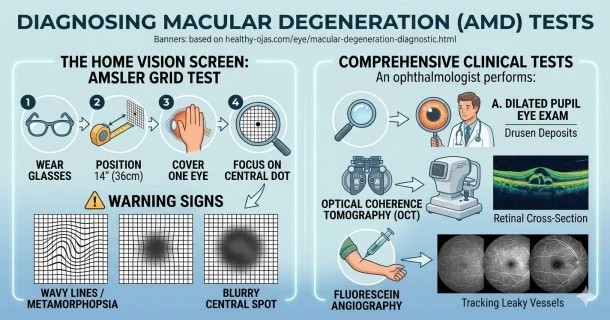
Worried about your central sight? Learn how to perform the Amsler Grid test at home to spot early macular degeneration signs, and explore advanced clinical eye exams.
Retinal and Macular Degeneration Tests: Amsler Grid & Clinical Exams
A macular degeneration test is a vital diagnostic protocol used to identify early micro-structural defects in the macula—the functional center of the retina responsible for sharp, straight-ahead vision. Because conditions like age-related macular degeneration (AMD) often progress painlessly, executing regular diagnostic screenings is critical for safeguarding your vision.
Catching changes early allows your ophthalmologist to introduce timely medical interventions that can effectively slow down or halt permanent vision loss.
The Home Vision Screen: Amsler Grid Test Protocol
The Amsler Grid is a highly effective, clinically validated home monitoring tool designed to catch subtle distortions or blank spots in your central visual field that might otherwise go unnoticed. It consists of a simple grid pattern of intersecting lines with a prominent black alignment dot positioned directly in the center.
Step-by-Step Instructions for Home Screening
- Keep Correct Eyewear On: If you routinely use prescription reading glasses or bifocals, wear them throughout the duration of the test.
- Establish Optimal Positioning: Position the Amsler Grid roughly 14 inches (36 centimeters) away from your face in a well-lit room.
- Perform Monocular Testing: Cover your left eye completely with your hand and focus the uncovered right eye directly on the central black dot.
- Analyze the Grid Integrity: While maintaining strict focus on the center dot, use your peripheral awareness to check the grid structure. Verify if all intersecting lines are perfectly straight, check if the boxes form crisp right angles, and ensure no areas appear faded or gray.
- Test the Alternate Eye: Cover your right eye and repeat the exact sequence with your left eye.
Clinical Red Flags to Watch For
If any lines on the grid appear noticeably bent, broken, curved, or wavy (metamorphopsia), or if sections of the grid look dark, blurry, or completely missing, you should contact a retina specialist or an eye doctor immediately.
Note: While the Amsler Grid is an exceptional tool for daily monitoring between checkups, it is a screening mechanism and never a substitute for a formal dilated eye exam performed by an eye care professional.
Comprehensive Clinical Tests for Macular Degeneration
If a home screening shows distortions or if you are over the age of 50, an ophthalmologist will run comprehensive clinical diagnostic tests to precisely evaluate the health of your retina:
- Dilated Pupil Eye Exam: The doctor uses specialized eye drops to widen your pupils, allowing them to look through a high-magnification lens to inspect the back of the eye for small yellow waste deposits called drusen, which are key markers of early AMD.
- Optical Coherence Tomography (OCT): A non-invasive, high-resolution imaging scan that captures cross-sectional, microscopic architectural maps of your retinal layers. It instantly detects fluid accumulation, cellular thinning, or swelling underneath the macula.
- Fluorescein Angiography: If wet AMD is suspected, a safe organic dye is injected into a vein in your arm. As the dye flows through the blood vessels inside your eye, sequential rapid photographs track if any fragile, abnormal blood vessels are actively leaking fluid or blood into the retina.
Frequently Asked Questions (FAQ)
How frequently should I use the Amsler Grid to check my eyes?
If you have been diagnosed with early dry AMD or have a strong family history of macular degeneration, eye care specialists recommend checking your vision with the Amsler Grid once every day. Keeping the chart on a refrigerator door or bathroom mirror serves as an excellent daily reminder to scan for sudden visual distortions.
Can an Amsler Grid test show signs of eye diseases other than AMD?
Yes. Because the grid monitors the overall function of your central visual field, abnormalities on the chart can also indicate cellular damage caused by advanced glaucoma, diabetic retinopathy, macular edema, or disorders directly impacting the optic nerve.
What should I do if the grid lines look wavy in one eye but normal in the other?
You must schedule an urgent appointment with an ophthalmologist. Wavy or distorted straight lines are classic diagnostic symptoms of Wet AMD, which occurs when abnormal blood vessels leak fluid under the macula. Immediate clinical evaluation is required because quick medical treatments (like anti-VEGF injections) provide the best chance of saving your sight.