
Learn how eye care professionals diagnose presbyopia. Explore the specific diagnostic tests used, from visual acuity checks to comprehensive refraction testing.
Presbyopia Diagnosis: How Eye Doctors Detect Age-Related Vision Loss
If you have started holding reading materials at arm's length or experiencing frequent eyestrain, scheduling an eye appointment is the first step toward reclaiming clear vision. Diagnosing presbyopia is a straightforward, completely painless process performed during a routine, comprehensive clinical eye checkup.
Because presbyopia is a natural, progressive physiological change within the eye’s crystalline lens, a formal medical diagnosis ensures you receive the exact prescription strength required to alleviate your symptoms and prevent further eye fatigue.
What to Expect During a Presbyopia Eye Exam
A clinical diagnosis can be completed by either an optometrist or an ophthalmologist. The evaluation checks your overall ocular health while isolating the precise drop in your eye’s amplitude of accommodation.
An eye care professional will utilize several sequential, standardized diagnostic steps:
1. Patient History and Symptom Review
The diagnostic process always begins with a detailed consultation. Your doctor will review:
- The exact age you first noticed close-up blurring (symptoms typically cross a noticeable threshold shortly after age 40).
- Daily visual habits, such as extensive computer screen work, reading, or sewing.
- The presence of secondary symptoms like dull tension headaches or ocular fatigue.
- Your general medical history, including any systemic chronic conditions like diabetes or a history of taking medications that alter focus flexibility.
2. Visual Acuity Testing
This baseline test measures how clearly you can see at varying distances.
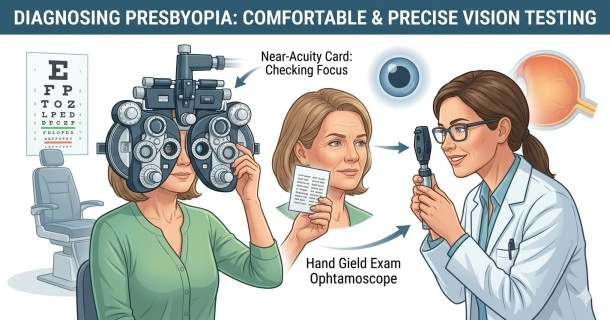
- Distance Acuity: You will look at a standardized wall chart (Snellen chart) to check your far-away sight. This ensures your baseline distance vision is stable.
- Near Acuity: You will hold a smaller, hand-held card (Jaeger card or Rosenbaum card) containing paragraphs of text in progressively smaller font sizes at a normal reading distance (about 14 to 16 inches). Your doctor will note the smallest print size you can read comfortably without squinting.
3. Comprehensive Refraction Test
The refraction assessment is the definitive diagnostic tool used to determine the exact nature of your refractive error.
- Your doctor will position an instrument called a phoropter in front of your eyes.
- You will look through a series of changing optical lenses while focusing on a target.
- By asking you which lens choice looks clearer ("Lens 1 or Lens 2?"), the doctor measures precisely how light bends as it enters your eye.
- For older adults, the doctor determines the "near addition" (or Add power)—the additional magnifying power needed on top of your distance prescription to pull light rays back onto your retina for sharp close-up focus.
4. Slit-Lamp Examination and Pupil Dilation
To rule out other age-related conditions that could mimic or complicate blurred vision (such as cataracts, glaucoma, or macular degeneration), your doctor will examine the physical structure of your eye.
- Using a high-powered biomicroscope called a slit lamp, the doctor inspects your cornea, iris, and crystalline lens.
- They may administer specialized eye drops to dilate your pupils. This allows a clear view of the retina and optic nerve at the back of the eyeball to confirm your overall eye health is pristine.
Why a Professional Evaluation Matters
Self-diagnosing by picking up generic reading glasses at a local retail store without an exam can lead to issues. A professional diagnosis ensures:
- Customized Vision Correction: You receive a prescription tailored perfectly to each individual eye, as one eye often requires a slightly different power than the other.
- Early Disease Detection: As we cross age 40, our statistical risk for asymptomatic eye diseases like glaucoma increases. A comprehensive exam catches these early when they are easiest to treat.
- Received your prescription? Explore all correction methods in our Presbyopia Correction & Treatment Guide.
Frequently Asked Questions (FAQ)
How often should I get tested for presbyopia after turning 40?
The American Academy of Ophthalmology recommends that all adults get a baseline eye evaluation at age 40. Because presbyopia is a progressive condition that causes the crystalline lens to continuously harden until around age 60, your near vision prescription will change over time. You should return for a re-evaluation every 1 to 2 years to adjust your lens power and check internal eye pressure.
Does a presbyopia diagnosis test hurt, or will my eyes be sore?
No, none of the diagnostic procedures hurt. The refraction test involves simply looking at letters through different lenses. If your doctor uses dilating drops to inspect the back of your eye, your eyes will be temporarily sensitive to bright lights and your close-up vision will be extra blurry for 4 to 6 hours. Bringing sunglasses to your appointment is highly recommended.
Can an online vision test accurately diagnose my presbyopia?
No. While an online app or print-out reading chart can tell you that your close-up vision is blurry, it cannot conduct a medical refraction test, measure eye pressures, or check the internal health of your retina. Online tests cannot rule out underlying conditions like cataracts or early diabetic retinopathy, which also cause vision blurring.