
Discover the early warning signs of presbyopia, including reading eyestrain and headaches. Learn how aging transforms the crystalline lens and ciliary muscles.
Presbyopia Symptoms: Why Close-Up Vision Changes With Age
If you have recently noticed that reading a text message or looking at a menu requires holding your phone or paper further away, you are experiencing the first signs of presbyopia.
Unlike other common vision conditions, presbyopia is not a disease and is not caused by the genetic shape of your eyeball. Instead, it is a universal, age-related physiological shift in how your eyes focus light. Understanding the exact symptoms and biological causes can help you know when it is time to seek professional care.
Common Signs and Symptoms of Presbyopia
The early signs of presbyopia develop gradually. You might first notice them when trying to read in a dimly lit room or when your eyes feel fatigued at the end of a long day.
Look out for these classic warning signs:
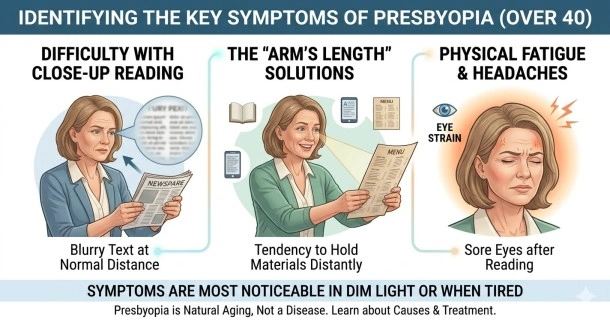
- The "Arm's Length" Habit: A persistent need to hold books, newspapers, smartphones, and product labels at arm's length to bring the text or images into a sharp, readable focus.
- Blurred Close-Up Vision: Experiencing a distinct, fuzzy blur when trying to look at objects at a normal reading or working distance.
- Reading Eyestrain: Feeling a dull ache, soreness, or tension in and around your eyes after performing prolonged close-up tasks, such as sewing, typing, or writing.
- Frequent Headaches: Developing tension headaches or systemic physical fatigue that directly follows intense near-vision focus or reading sessions.
- Fluctuating Vision: Finding that your close-up vision temporarily improves in bright sunlight, as your pupils naturally constrict to create a sharper depth of focus.
When to Seek a Professional Diagnosis
If you routinely experience eyestrain or have to hold reading materials at a distance, you should schedule a comprehensive eye examination with an optometrist or ophthalmologist.
During a standard eye checkup, a eye professional will perform simple, completely painless tests to measure precisely how your eyes refract and focus light. This diagnostic tracking pinpoints the exact power of the optical lenses needed to correct your close-up vision.
- Once you have a diagnosis, read about your options in our detailed guide to Presbyopia Correction & Treatments.
Frequently Asked Questions (FAQ)
At what exact age do presbyopia symptoms usually begin to appear?
For most individuals, symptoms become noticeably disruptive between the ages of 40 and 45. However, the internal hardening of the lens is a slow process that actually begins silently in early adulthood, only crossing the threshold into noticeable blurriness around your fourth decade of life.
Can a sudden onset of presbyopia symptoms be dangerous?
While true presbyopia always develops very slowly over several years, a sudden or rapid loss of your near or distance vision is not normal. Seek immediate medical emergency care if you experience an abrupt loss of sight in either eye, sudden double vision, painful eyes, or if you begin seeing flashes of light or a heavy curtain-like shadow over your field of vision.
Does reading a lot or looking at phone screens make presbyopia happen faster?
No. Spending long hours looking at digital monitors, reading books, or working in dim conditions can cause temporary digital eye fatigue or dry eyes, but it does not alter the physiological hardening of the crystalline lens. Presbyopia will progress at the exact same biological rate regardless of your daily screen usage habits.