
Is a dark shadow or a flash of light clouding your vision? Learn the definitive symptoms of retinal detachment and why immediate treatment is crucial.
Recognizing Retinal Detachment Symptoms: Critical Early Warning Signs Explained
A retinal detachment is completely painless because the sensory tissue at the back of the eye lacks pain fibers. However, the condition almost always presents distinct visual warning signs before advancing to total tissue separation.
Recognizing these warnings immediately can mean the difference between preserved sight and permanent legal blindness.
The Classic Warning Symptoms of Retinal Detachment
When the gel-like vitreous fluid pulls away or leaks behind the retina, it disrupts normal neural signals. This friction and structural displacement cause immediate, noticeable changes in your vision:
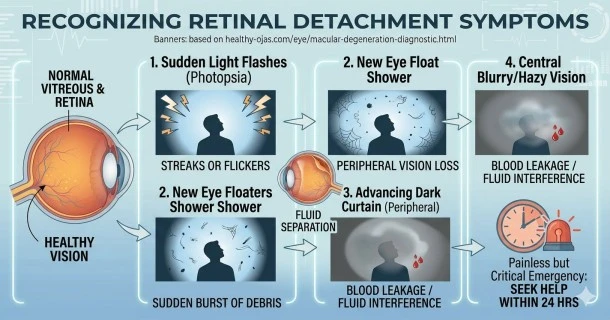
- Sudden Flashings of Light (Photopsia): The abrupt appearance of bright streaks, lightning bolts, or flickering stars—most noticeable in one eye and in dark environments—caused by the shrinking vitreous physically tugging on the retina.
- A Shower of New Eye Floaters: A rapid increase in the number of floaters, which look like tiny dark spots, cobwebs, strings, or specks of moving debris drifting across your visual path.
- An Advancing Dark Curtain or Shadow: A persistent dark grey or black shadow that starts in your far peripheral (side) sight and gradually creeps across the center, indicating the tissue is peeling away.
- Abrupt, Profound Blurry Vision: A sudden drop in visual acuity or general clarity that cannot be corrected by blinking or using artificial tears.
- Hazy or Cloudy Sight: A dense, foggy cloudiness that fills your vision, which happens if the pulling forces rupture small retinal blood vessels, causing blood to leak into the middle eye gel.
The Danger of Waiting: Why Temporary Relief is Deceptive
Many individuals delay seeking immediate medical care because they assume a painless issue cannot be a medical emergency, hoping the visual distortions will fade on their own.
Crucially, retinal detachment symptoms can sometimes weaken or plateau temporarily. This does not mean your eye is recovering. Instead, it is often a silent window before fluid shifts further, causing extensive central vision failure within the following days or weeks.
Postponing an assessment increases the likelihood that a simple tear converts into a massive, multi-quadrant detachment. Surgical repairs performed at an advanced stage carry a much higher rate of anatomical failure and frequently result in permanent vision deficits.
Frequently Asked Questions (FAQ)
If my floaters decrease after a few days, can I skip seeing an eye doctor?
No, absolutely not. Even if the immediate flash of light fades or floaters appear to settle due to gravity, a structural tear may still be actively leaking fluid behind your retina. Only a dilated eye exam can verify that the tissue is intact.
How fast does a retinal detachment progress after the first symptoms appear?
The progression timeline varies significantly. In some eyes, a tear can convert into a full retinal detachment within hours; in others, it may take a few weeks. Because it is impossible to predict the speed without advanced imaging, all new flashes and floaters must be evaluated as an emergency within 24 hours.
Can stress or high blood pressure cause light flashes and floaters?
Chronic high blood pressure can cause vascular changes in the retina, and ocular migraines can produce temporary shimmering lines in both eyes. However, true physical flashes and structural showers of floaters are driven by the mechanical separation of the vitreous gel from the retina, requiring an immediate physical eye check.