
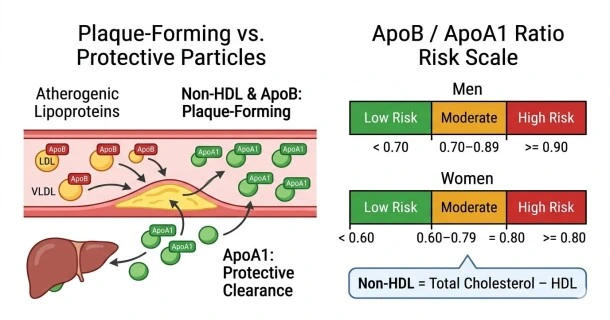
Calculate your ApoB to ApoA1 ratio and Non-HDL cholesterol (mg/dL or mmol/L) to assess plaque-forming particle burden and cardiovascular risk.
ApoB / ApoA1 Ratio & Non-HDL Cholesterol Calculator
Use this ApoB / ApoA1 Ratio & Non-HDL Cholesterol Calculator to evaluate the balance between plaque-forming ("bad") and protective ("good") lipid particles in your bloodstream—two markers that major cardiology guidelines recognize as stronger predictors of heart disease risk than standard LDL cholesterol alone.
Calculate Your ApoB/ApoA1 Ratio & Non-HDL Cholesterol
Enter your Total Cholesterol and HDL Cholesterol to calculate Non-HDL Cholesterol, and enter your Apolipoprotein B (ApoB) and Apolipoprotein A1 (ApoA1) values if included on your lab report.
What Are Non-HDL Cholesterol and the ApoB / ApoA1 Ratio?
- Non-HDL Cholesterol: Represents the total cholesterol carried inside all artery-clogging lipoproteins—including LDL, VLDL, intermediate-density lipoproteins (IDL), and Lipoprotein(a). It is calculated directly from a standard lipid panel without needing fasting.
- Apolipoprotein B (ApoB): Every single plaque-forming lipoprotein particle carries exactly one ApoB protein molecule. Measuring ApoB counts the exact number of atherogenic particles circulating in your blood.
- Apolipoprotein A1 (ApoA1): The primary structural protein of protective HDL ("good") cholesterol particles, which help clear excess cholesterol from artery walls back to the liver.
- ApoB / ApoA1 Ratio: Measures the balance between atherogenic particle load (ApoB) and protective cholesterol clearance capacity (ApoA1).
Formulas & Unit Conversions
- Non-HDL Cholesterol: Total Cholesterol − HDL Cholesterol *(works in both mg/dL and mmol/L)*
- ApoB / ApoA1 Ratio: Apolipoprotein B ÷ Apolipoprotein A1 *(both must use the same unit, such as mg/dL or g/L)*
- Unit Conversions: For Total & HDL Cholesterol, multiply mmol/L by 38.67 to get mg/dL. For ApoB and ApoA1, multiply g/L by 100 to get mg/dL.
ApoB / ApoA1 Ratio Reference Ranges (Men vs. Women)
Large international studies (including INTERHEART and AMORIS) establish sex-specific cardiovascular risk thresholds for the ApoB/ApoA1 ratio:
| Risk Category | Men (ApoB / ApoA1) | Women (ApoB / ApoA1) | Clinical Meaning |
|---|---|---|---|
| Low Risk (Optimal) | < 0.70 | < 0.60 | Favorable balance of protective ApoA1 over atherogenic ApoB particles. |
| Moderate Risk (Borderline) | 0.70 – 0.89 | 0.60 – 0.79 | Moderate plaque-forming particle burden; lifestyle optimization advised. |
| High Risk (Elevated) | ≥ 0.90 | ≥ 0.80 | High atherogenic particle load; strongly linked to coronary artery risk. |
Non-HDL Cholesterol & ApoB Target Guidelines
Cardiology guidelines (ESC/EAS, AHA/ACC, and the Lipid Association of India) set Non-HDL cholesterol targets roughly 30 mg/dL (0.8 mmol/L) higher than LDL-C targets:
| Cardiovascular Risk Profile | Non-HDL Target (mg/dL) | Non-HDL Target (mmol/L) | ApoB Target (mg/dL) |
|---|---|---|---|
| General / Low Risk | < 130 mg/dL | < 3.4 mmol/L | < 100 mg/dL |
| Moderate Risk | < 130 mg/dL | < 3.4 mmol/L | < 100 mg/dL |
| High Risk (e.g., Diabetes, CKD, High BP) | < 100 mg/dL | < 2.6 mmol/L | < 80 mg/dL |
| Very High Risk (Prior Heart Attack / Stroke) | < 85 mg/dL | < 2.2 mmol/L | < 65 mg/dL |
Why Non-HDL & ApoB Beat Standard LDL Cholesterol Alone
- Catches "Discordant" Small Dense LDL: People with insulin resistance, prediabetes, type 2 diabetes, or high triglycerides—patterns especially common in South Asian adults—often have normal LDL-C numbers but high numbers of small, dense, cholesterol-depleted LDL particles. Both ApoB and Non-HDL uncover this hidden risk.
- No Fasting Required: Unlike calculated Friedewald LDL cholesterol, Non-HDL cholesterol and ApoB remain accurate even in non-fasting blood samples or when triglycerides exceed 400 mg/dL.
Evidence-Based Ways to Improve Your ApoB/ApoA1 & Non-HDL
- Replace Saturated & Trans Fats: Swap butter, ghee, palm/coconut oil excess, fried snacks, and processed meats for unsaturated fats like olive oil, mustard oil, nuts, seeds, and fatty fish.
- Increase Soluble Fiber: Eat oats, barley, legumes (dal, beans, chickpeas), flaxseeds, and psyllium husk, which bind bile acids in the gut and lower ApoB and Non-HDL cholesterol.
- Regular Aerobic & Resistance Exercise: At least 150 minutes per week of brisk aerobic exercise helps raise protective ApoA1 and HDL while clearing triglyceride-rich particles.
- Medical Therapy When Indicated: For high-risk patients, prescribed lipid-lowering medications (such as statins, ezetimibe, or PCSK9 inhibitors) directly reduce ApoB particle count and Non-HDL cholesterol.
Frequently Asked Questions (FAQ)
What is a good ApoB / ApoA1 ratio?
An optimal ApoB / ApoA1 ratio is below 0.70 for men and below 0.60 for women. Ratios of 0.90 or higher in men and 0.80 or higher in women indicate elevated cardiovascular risk.
What is a normal Non-HDL cholesterol level?
For healthy adults without major cardiovascular risk factors, a Non-HDL cholesterol level below 130 mg/dL (3.4 mmol/L) is considered desirable. People with diabetes, high blood pressure, or heart disease generally need tighter targets below 100 mg/dL or 85 mg/dL.
Can I calculate Non-HDL cholesterol without ApoB and ApoA1?
Yes. Non-HDL cholesterol only requires Total Cholesterol and HDL Cholesterol from a basic lipid panel (Total Cholesterol − HDL Cholesterol). ApoB and ApoA1 are optional advanced lipid markers ordered separately.
Do I need to fast before testing Non-HDL cholesterol or ApoB?
No. Both Non-HDL cholesterol and Apolipoprotein B/A1 remain stable whether you have fasted or eaten, though your doctor may still request a 9- to 12-hour fast if triglycerides are being measured simultaneously.