
Calculate your daily protein, carbohydrate, and fat needs in grams based on your weight, activity level, and goal (weight loss, maintenance, or muscle gain).
Daily Protein & Macro Intake Calculator
Use this Daily Protein & Macro Intake Calculator to find your personalized daily calorie target along with exact grams of protein, carbohydrates, and healthy fats based on your body weight, activity level, and health goal.
Calculate Your Daily Protein & Macronutrients
Enter your age, biological sex, height, current weight, physical activity level, and primary nutrition goal.
How Daily Protein & Macro Needs Are Calculated
Accurate macronutrient planning starts with estimating your total daily energy expenditure (TDEE) and then dividing those calories into protein, carbohydrates, and fats:
- Estimate Basal Metabolic Rate (BMR): Uses the clinically validated Mifflin-St Jeor equation to determine the calories your body burns at complete rest.
- Adjust for Daily Activity (TDEE): Multiplies your BMR by an activity factor ranging from
1.2(sedentary desk job) to1.9(intense daily physical training). - Apply Goal-Based Calorie Targets: Keeps maintenance at 100% of TDEE, applies a moderate 15% to 20% calorie deficit for sustainable fat loss, or adds a 10% to 15% calorie surplus for lean muscle gain.
- Set Protein First, Then Fats & Carbs: Anchors daily protein to your body weight and goal, allocates 25% to 30% of calories to healthy fats for hormone support, and fills remaining energy needs with complex carbohydrates.
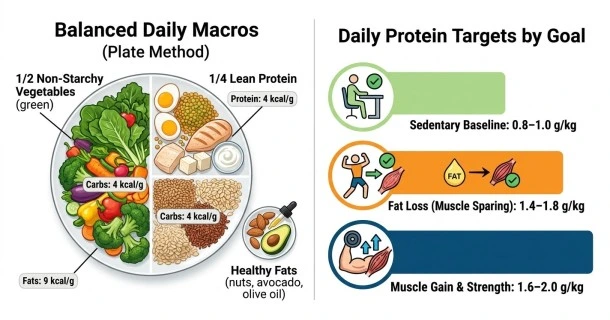
Calorie-to-Gram Conversion: Both protein and carbohydrates provide 4 calories per gram, while dietary fat provides 9 calories per gram.
Recommended Daily Protein Intake by Activity & Goal
While the basic Recommended Dietary Allowance (RDA) to prevent deficiency is 0.8 g per kg of body weight, clinical nutrition guidelines recommend higher targets depending on physical activity, age, and body composition goals:
| Lifestyle / Health Goal | Protein (g per kg body weight) | Protein (g per lb body weight) | Example for a 70 kg (154 lb) Adult |
|---|---|---|---|
| Sedentary Adult (Baseline) | 0.8 – 1.0 g/kg | 0.36 – 0.45 g/lb | 56 – 70 g/day |
| Regular Exercise / General Fitness | 1.2 – 1.4 g/kg | 0.55 – 0.64 g/lb | 84 – 98 g/day |
| Fat Loss (Muscle Preservation) | 1.4 – 1.8 g/kg | 0.64 – 0.82 g/lb | 98 – 126 g/day |
| Muscle Gain / Strength Training | 1.6 – 2.0 g/kg | 0.73 – 0.91 g/lb | 112 – 140 g/day |
| Older Adults (60+ Years) | 1.2 – 1.5 g/kg | 0.55 – 0.68 g/lb | 84 – 105 g/day |
Note for Individuals with Obesity: If your Body Mass Index (BMI) is 30 kg/m² or higher, calculating protein using your adjusted or target healthy body weight prevents overestimating calorie and protein needs.
Practical Ways to Hit Your Daily Macro Targets
- Distribute Protein Across Meals: Aim for 20 to 35 grams of protein per meal rather than eating it all at dinner to optimize muscle protein synthesis and satiety.
- Choose High-Quality Protein Sources: Combine lean animal proteins (eggs, fish, skinless chicken breast, Greek yogurt/curd) or diverse plant and dairy proteins (soya chunks, tofu, paneer, lentils/dal, chickpeas, whey or pea protein).
- Prioritize Fiber-Rich Carbohydrates: Select whole grains (oats, brown rice, millets, whole wheat), legumes, vegetables, and whole fruits to stabilize blood sugar and digestion.
- Include Unsaturated Fats: Use nuts, seeds, avocados, olive oil, mustard oil, or fatty fish while limiting deep-fried foods and trans fats.
- Follow the Simple Plate Method: Fill half your plate with non-starchy vegetables, one-quarter with lean protein, and one-quarter with whole grains or starchy carbs.
Important Medical & Safety Considerations
- Minimum Safe Calorie Floors: For sustainable metabolic health, daily calorie targets should generally not drop below 1,200 kcal/day for women or 1,500 kcal/day for men unless supervised by a physician.
- Kidney & Liver Conditions: Higher protein intakes (above 1.2 g/kg) are safe for healthy individuals, but people with Chronic Kidney Disease (CKD), reduced eGFR, or severe liver disease should consult a doctor or renal dietitian before increasing protein.
- Pregnancy & Breastfeeding: Caloric and protein requirements increase significantly during pregnancy and lactation; follow personalized obstetric nutrition guidance.
Frequently Asked Questions (FAQ)
How much protein do I need per day to lose weight?
During weight loss, aiming for 1.4 to 1.8 grams of protein per kilogram of body weight (roughly 25% to 30% of total calories) helps preserve lean muscle mass, reduces hunger hormones, and keeps your resting metabolism higher while in a calorie deficit.
What is the best macro ratio for weight loss or muscle gain?
A balanced starting macro split for most adults is 25%–30% protein, 40%–50% carbohydrates, and 25%–30% healthy fats. However, anchoring protein to your body weight in grams first is more accurate than relying strictly on fixed percentages.
Can eating too much protein harm healthy kidneys?
In adults with normal kidney function, clinical studies show that daily protein intakes up to 2.0 g/kg do not damage the kidneys. However, if you already have impaired kidney function or diabetic kidney disease, excess protein can strain filtration and requires medical supervision.
How can vegetarians meet high daily protein goals?
Vegetarians can comfortably reach 80–120+ grams of protein daily by pairing legumes (dal, rajma, chole) with dairy or soy foods such as soya chunks, tofu, paneer, low-fat Greek yogurt (hung curd), milk, and mixed seeds at every meal.
Should I adjust my macros as I lose or gain weight?
Yes. As your body weight changes by 3 to 5 kg (7 to 10 lb), your resting metabolic rate and protein requirements shift. Recalculating your macros every 4 to 6 weeks keeps your progress steady.