
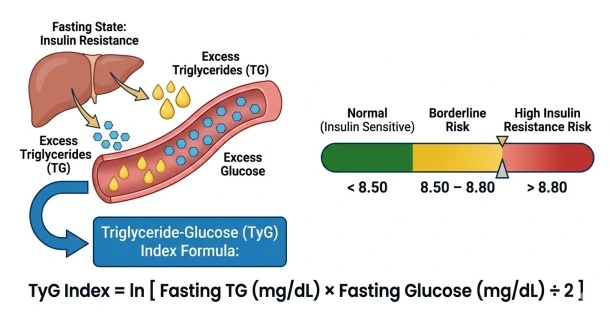
Calculate your Triglyceride-Glucose (TyG) Index using fasting triglycerides and fasting blood glucose (mg/dL or mmol/L) to screen for insulin resistance.
Triglyceride-Glucose (TyG) Index Calculator
Use this Triglyceride-Glucose (TyG) Index Calculator to screen for insulin resistance and metabolic syndrome risk using two routine fasting blood test values—fasting triglycerides and fasting plasma glucose—without needing a specialized fasting insulin test.
Calculate Your TyG Index Score
Enter your blood test results taken after an 8- to 12-hour overnight fast (water only). Select the matching units shown on your lab report.
What Is the Triglyceride-Glucose (TyG) Index?
The Triglyceride-Glucose (TyG) Index is a validated clinical marker developed by Simental-Mendía and Guerrero-Romero (2008) to estimate insulin resistance. It combines fasting triglycerides and fasting blood glucose on a logarithmic scale.
When muscle and liver cells become resistant to insulin, the liver increases triglyceride production and releases more glucose into the bloodstream. Because these two metabolic shifts happen together early on, the TyG Index correlates closely with gold-standard insulin clamp studies and HOMA-IR, while relying solely on standard, low-cost blood tests.
TyG Index Formula & Unit Conversions
The standard TyG equation requires both fasting triglycerides and fasting glucose in conventional units (mg/dL) before taking the natural logarithm (ln):
- Standard Formula (mg/dL): TyG Index = ln [ Fasting Triglycerides (mg/dL) × Fasting Glucose (mg/dL) ÷ 2 ]
- Triglycerides Conversion: Multiply mmol/L by 88.57 to convert to mg/dL
- Glucose Conversion: Multiply mmol/L by 18.02 to convert to mg/dL
Important Note: Always convert SI units (mmol/L) to mg/dL before applying the natural logarithm, otherwise the resulting score will be artificially low.
Triglyceride-Glucose (TyG) Index Normal Range & Cutoffs
Because baseline triglyceride and glucose distributions vary slightly by age, sex, and ethnicity, clinical research uses these general reference thresholds to interpret adult TyG Index scores:
| TyG Index Score | Metabolic Interpretation | Clinical Context |
|---|---|---|
| Below 8.50 | Optimal / Normal Range | Indicates healthy insulin sensitivity and low metabolic risk. |
| 8.50 – 8.80 | Borderline / Moderate Risk | Suggests early insulin resistance; often used as a preventive action threshold in South Asian/Indian adults. |
| Above 8.80 | Elevated / High Insulin Resistance Risk | Strongly associated with prediabetes, type 2 diabetes, fatty liver (MASLD), and cardiovascular risk. |
Why the TyG Index Is Useful Alongside HOMA-IR
- No Fasting Insulin Required: Routine health checkups rarely include fasting plasma insulin due to higher cost and lab assay variability, whereas fasting glucose and lipid panels are standard.
- Early Cardiometabolic Screening: Elevated TyG scores are linked to Metabolic Dysfunction-Associated Steatotic Liver Disease (MASLD/fatty liver), arterial stiffness, and future type 2 diabetes risk even before HbA1c rises above 5.7%.
- Easy Progress Tracking: Because triglycerides respond rapidly to dietary and exercise changes, repeating a fasting lipid and glucose panel every 3 to 6 months shows measurable improvement.
Evidence-Based Ways to Lower Your TyG Index
- Cut Refined Sugars & Simple Starches: Reducing sugary drinks, sweets, white rice/refined flour portions, and ultra-processed snacks directly lowers liver triglyceride synthesis and fasting glucose.
- Prioritize Regular Exercise: Combining at least 150 minutes per week of brisk aerobic exercise with 2 days of resistance training increases muscle glucose uptake and clears circulating triglycerides.
- Increase Soluble Fiber & Omega-3 Fats: Eating lentils, vegetables, oats, nuts, seeds, and fatty fish improves lipid profiles and insulin sensitivity.
- Limit Alcohol & Improve Sleep: Even moderate alcohol intake can spike fasting triglycerides, while 7 to 8 hours of quality sleep helps regulate morning blood sugar.
Important Limitations & Medical Caution
- Not a Standalone Diagnosis: The TyG Index is a screening estimate, not a diagnostic test for diabetes or heart disease. Always interpret your score alongside HbA1c, blood pressure, waist circumference, and medical history.
- Strict Fasting Required: Eating or drinking anything other than plain water within 8 to 12 hours of your blood draw sharply increases triglycerides and invalidates the result.
- Severe Hypertriglyceridemia: Genetic lipid disorders, uncontrolled hypothyroidism, or certain medications (such as corticosteroids or beta-blockers) can elevate triglycerides independently of insulin resistance.
Frequently Asked Questions (FAQ)
What is a normal Triglyceride-Glucose (TyG) Index score?
A TyG Index score below 8.50 is generally considered normal and reflects healthy insulin sensitivity. Scores between 8.50 and 8.80 indicate borderline insulin resistance, while scores above 8.80 signal elevated metabolic and cardiovascular risk.
Is the TyG Index better than HOMA-IR?
Both tools correlate well with clinical insulin resistance. While HOMA-IR directly incorporates fasting insulin, the TyG Index offers comparable accuracy using standard fasting triglycerides and glucose, making it far more accessible and cost-effective for routine screening.
Why does the TyG formula divide by 2 inside the natural logarithm?
Dividing the product of fasting triglycerides and fasting glucose by 2 before taking the natural logarithm (ln) normalizes the distribution of skewed lipid values into a compact, linear scale typically ranging between 7.5 and 10.5.
How long do I need to fast before testing for the TyG Index?
Fast for 9 to 12 hours (overnight) before your blood sample is collected. Drink only plain water and avoid alcohol for at least 24 hours beforehand, as alcohol and recent meals substantially raise triglyceride levels.