
Calculate your Fibrosis-4 (FIB-4) index using age, AST, ALT, and platelet count to screen for advanced liver fibrosis in fatty liver disease (MASLD/NAFLD).
Fibrosis-4 (FIB-4) Score Calculator
Use this Fibrosis-4 (FIB-4) Score Calculator to estimate your risk of advanced liver scarring (fibrosis) using four routine blood test and clinical inputs: age, AST (SGOT), ALT (SGPT), and platelet count.
Calculate Your Fibrosis-4 (FIB-4) Index
Enter your age and recent laboratory values. Pay close attention to your platelet count units as printed on your lab report.
What Is the Fibrosis-4 (FIB-4) Index?
The Fibrosis-4 (FIB-4) Index is a widely recommended, non-invasive clinical screening score originally developed by Sterling and colleagues (2006) and endorsed by major liver associations (AASLD, EASL, and INASL) to evaluate liver fibrosis risk—especially in people with fatty liver disease (MASLD / NAFLD), type 2 diabetes, or chronic viral hepatitis.
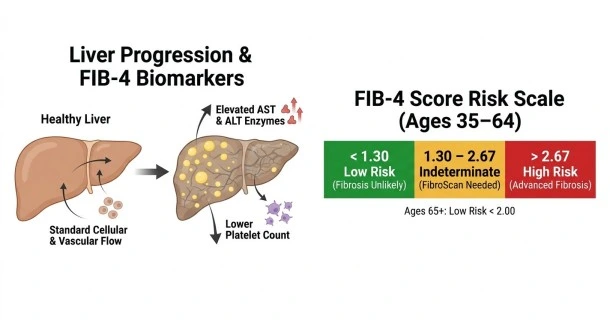
In early liver inflammation, liver enzymes (AST and ALT) fluctuate, while progressive liver scarring gradually slows platelet production and alters the AST-to-ALT ratio. Combining these four routine numbers helps doctors decide whether a patient can be managed with lifestyle care or needs specialized testing such as transient elastography (FibroScan).
FIB-4 Formula & Platelet Unit Conversions
The clinical FIB-4 equation requires age in years, AST and ALT in U/L (IU/L), and platelet count in 10⁹/L (or 10³/µL):
- FIB-4 Formula: [ Age (years) × AST (U/L) ] ÷ [ Platelet Count (10⁹/L) × √ALT (U/L) ]
- If Platelets Are in 10⁹/L or 10³/µL: Enter the number directly (e.g.,
240). - If Platelets Are in Lakhs/µL (Common in India): Multiply by 100 (e.g.,
2.4 lakhs/µL=240 × 10⁹/L). - If Platelets Are in Cells/µL (or /cumm): Divide by 1,000 (e.g.,
240,000/µL=240 × 10⁹/L).
FIB-4 Score Cutoff Ranges by Age (MASLD / NAFLD)
Current hepatology guidelines use age-adjusted lower cutoffs because natural aging slightly shifts AST and platelet counts:
| Age Group | Low Risk (Advanced Fibrosis Unlikely) | Indeterminate Risk (Further Testing Needed) | High Risk (Advanced Fibrosis Likely) |
|---|---|---|---|
| 35 to 64 years | < 1.30 | 1.30 – 2.67 | > 2.67 |
| 65 years and older | < 2.00 | 2.00 – 2.67 | > 2.67 |
How Doctors Interpret Each Category
- Low Risk (<1.30 for ages 35–64; <2.00 for ages 65+): Rules out advanced liver scarring (stage F3–F4) with roughly 90% certainty. Doctors typically recommend repeating FIB-4 every 1 to 2 years alongside healthy weight and metabolic management.
- Indeterminate Zone (1.30–2.67 or 2.00–2.67): Cannot confirm or exclude fibrosis on blood tests alone. Clinical guidelines recommend a secondary test such as a FibroScan (vibration-controlled transient elastography) or Enhanced Liver Fibrosis (ELF) blood test.
- High Risk (>2.67): Indicates a strong probability of advanced liver fibrosis or cirrhosis and warrants prompt referral to a hepatologist or gastroenterologist.
Important Limitations & Medical Caution
- Less Accurate Under Age 35: Because age is in the numerator of the FIB-4 formula, scores in adults younger than 35 years can appear falsely reassuring and should not be used alone to exclude liver scarring.
- Acute Liver Inflammation Spikes: Recent alcohol binges, viral infections, muscle injury from intense exercise, or medication-induced liver enzyme spikes can temporarily elevate AST and ALT, artificially inflating your FIB-4 score.
- Non-Liver Platelet Conditions: Low platelets caused by immune thrombocytopenia (ITP), dengue/viral fever recovery, vitamin B12 deficiency, or spleen conditions will raise FIB-4 even if the liver is healthy.
Frequently Asked Questions (FAQ)
What is a normal FIB-4 score?
For adults aged 35 to 64 years, a FIB-4 score below 1.30 is considered low risk for advanced liver fibrosis. For adults aged 65 and older, a score below 2.00 is considered low risk.
What are AST and ALT called on Indian lab reports?
On many diagnostic lab reports in India and Asia, AST is listed as SGOT (Serum Glutamic-Oxaloacetic Transaminase) and ALT is listed as SGPT (Serum Glutamic-Pyruvic Transaminase). Both are measured in U/L or IU/L.
Can a high FIB-4 score be reversed?
Early-to-moderate liver fat and fibrosis can often improve or stabilize when the underlying cause is treated—such as losing 7% to 10% of body weight in fatty liver disease, controlling blood sugar and triglycerides, stopping alcohol completely, or treating viral hepatitis.
Should I get a FibroScan if my FIB-4 score is above 1.30?
Yes. Hepatology guidelines recommend a FibroScan (a painless ultrasound-based liver stiffness scan) whenever a patient's FIB-4 score falls into the indeterminate or high-risk range.