
Calculate your Total Cholesterol to HDL ratio in mg/dL or mmol/L. Check ideal cardiac risk ranges for men and women and learn how to improve your lipid ratio.
Total Cholesterol to HDL Ratio Calculator (mg/dL & mmol/L)
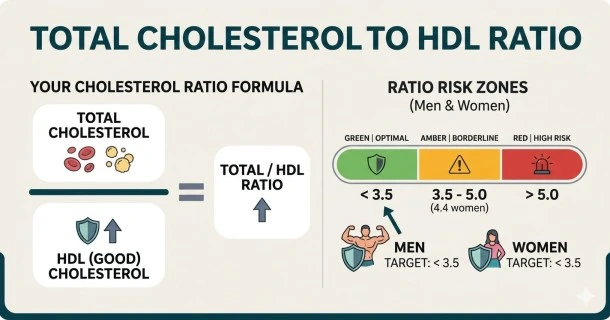
Your Total Cholesterol to HDL ratio is calculated by dividing your Total Cholesterol by your High-Density Lipoprotein (HDL) cholesterol—an ideal ratio is below 3.5, while a ratio above 5.0 indicates elevated cardiovascular risk. Use the interactive calculator below to check your result in either mg/dL or mmol/L.
Before interpreting your ratio in isolation, review your individual LDL, HDL, and triglyceride benchmarks on our main Understanding Cholesterol: Functions, Normal Levels, and Management hub page.
Interactive Total / HDL Cholesterol Ratio Calculator
Enter Your Lipid Panel Values (mg/dL or mmol/L)
Risk Category: Enter your numbers above to see your risk category.
Total Cholesterol to HDL Ratio Chart (Men & Women)
Because the Total-to-HDL ratio divides two values measured in the same unit, the ratio number is identical whether your lab report uses mg/dL or mmol/L. Clinical guidelines such as the American Heart Association (AHA) and Framingham Heart Study evaluate ratios using the benchmarks below:
| Risk Category | Men (Total / HDL Ratio) | Women (Total / HDL Ratio) | Clinical Interpretation |
|---|---|---|---|
| Optimal (Ideal) | Below 3.5 | Below 3.5 | Strong protective balance of HDL relative to total circulating lipids |
| Average / Borderline | 3.5 to 5.0 | 3.5 to 4.4 | Moderate cardiovascular risk; lifestyle optimization recommended |
| High / Elevated Risk | Above 5.0 | Above 4.4 | Higher proportion of atherogenic lipoproteins; requires medical evaluation |
How to Calculate Your Total / HDL Ratio Manually
You can calculate your ratio from any standard lipid profile using a simple division formula:
Total / HDL Ratio = Total Cholesterol ÷ HDL Cholesterol
- Example in mg/dL: If your Total Cholesterol is 200 mg/dL and your HDL is 50 mg/dL, your ratio is
200 ÷ 50 = 4.0(4.0 : 1). - Example in mmol/L: If your Total Cholesterol is 5.2 mmol/L and your HDL is 1.3 mmol/L, your ratio is
5.2 ÷ 1.3 = 4.0(4.0 : 1).
Why Does the Total / HDL Ratio Matter?
Looking at Total Cholesterol alone can sometimes be misleading. Two people can both have a borderline Total Cholesterol of 210 mg/dL, yet carry very different cardiovascular risks:
- Person A (Low Risk): Total Cholesterol is 210 mg/dL, and HDL is 70 mg/dL. Their ratio is 3.0 (optimal), meaning much of their total cholesterol consists of protective HDL particles clearing excess lipids from arteries.
- Person B (High Risk): Total Cholesterol is 210 mg/dL, and HDL is 35 mg/dL. Their ratio is 6.0 (high risk), indicating low protective HDL and a high burden of atherogenic LDL and triglyceride-rich particles.
Note: While ratios provide helpful context, modern cardiology guidelines prioritize absolute LDL cholesterol, Non-HDL cholesterol (Total minus HDL), and Apolipoprotein B (ApoB) when making treatment decisions.
5 Proven Ways to Lower Your Total / HDL Ratio
You can improve your ratio either by lowering Total/LDL cholesterol, raising protective HDL cholesterol, or doing both simultaneously:
- Cut Refined Sugars and White Flour: Reducing added sugars, sweetened beverages, and refined starches lowers triglycerides and prevents insulin-driven drops in HDL cholesterol.
- Increase Viscous Soluble Fiber: Eating 5 to 10 grams of soluble fiber daily from oats, barley, lentils, okra, apples, and psyllium husk binds bile acids and lowers Total and LDL cholesterol.
- Replace Saturated Fats With Unsaturated Fats: Swap butter, ghee, palm oil, and processed meats for extra-virgin olive oil, avocados, walnuts, almonds, and fatty fish rich in omega-3s.
- Engage in Regular Aerobic Exercise: At least 150 minutes per week of brisk walking, cycling, jogging, or swimming is one of the most reliable ways to boost protective HDL levels.
- Quit Smoking and Limit Alcohol: Stopping smoking can raise HDL cholesterol by 5% to 10% within weeks, while moderating alcohol prevents triglyceride spikes.
Frequently Asked Questions
What is a good Total Cholesterol to HDL ratio?
An ideal Total Cholesterol to HDL ratio is below 3.5 for both men and women. A ratio under 5.0 is generally considered acceptable for men, while women are advised to stay below 4.4 due to baseline hormonal differences in HDL levels.
Does the cholesterol ratio formula change for mmol/L vs mg/dL?
No. Because both Total Cholesterol and HDL are measured in the same unit on your lab report, the units cancel out when divided. A ratio of 3.5 in mg/dL is mathematically identical to a ratio of 3.5 in mmol/L.
Can my Total / HDL ratio be normal even if my LDL is high?
Yes. If you have naturally very high HDL cholesterol (for example, 80 mg/dL or higher), your Total-to-HDL ratio may look optimal even when your LDL ("bad") cholesterol is elevated above 130 or 160 mg/dL. For this reason, doctors always evaluate individual LDL and Non-HDL numbers alongside your ratio.
What is the difference between Total/HDL ratio and Triglyceride/HDL ratio?
The Total/HDL ratio measures the balance between all circulating cholesterol and protective HDL, whereas the Triglyceride/HDL ratio (ideally below 2.0 in mg/dL) specifically screens for insulin resistance and small, dense LDL particles.
Medical Disclaimer: This calculator is intended for educational and informational purposes only and does not replace professional medical advice, diagnosis, or treatment. Always review your complete lipid panel with a qualified healthcare provider.