
Sleep Deprivation
Sleep deprivation has become one for the most common cause for many health problems the world is facing. Many surveys estimate that people nowadays have sleep one and a half hours less than people had a century ago.
Sleeplessness causes
- lifestyle causes (working in shift system or those who travel between countries),
- health complications (other health conditions that disturb sleep),
- Medication side effects
Sleep Deprivation symptoms
- Tiredness - Feel lazy, no energy and tired always.
- Strange Appetite - Sleep deprivation affects your appetite; you may feel either always hunger or no hunger at all. Therefore, you may gain weight or lose weight.
- Lack of Concentration - Sleep deprivation affects your focus and concentration. In addition, it slows down your reaction time. Therefore, you start committing numerous mistakes.
- Memory Loss - Sleep deprivation affects your cognition. It is difficult to recollect anything in your mind.
- Inability to handle stress - May feels this whole world is on their shoulders, and it is impossible to solve this problem.
- Anger - Unnecessary anger even for minor mistakes
- Socially Inept - Inability to judge and interact with other people in an acceptable normal manner
Effects of Sleep Deprivation
Experts are even beginning to warn that the sleep deprivation is affecting human’s brainpower, creativity and their psychological behaviors.
In humans, the metabolic activity of the brain decreases significantly after 24 hours of continuous wakefulness.
Sleep deprivation results in
- A decrease in body temperature,
- A decrease in immune system function as measured by white blood cell count,
- A decrease in the release of growth hormone
- In addition, causes increased heart rate variability.
Short-term effects of sleep deprivation
Sleep deprivation for a short time can affect both physical and mental as below:
- Drop in daytime alertness. Loss of just one and half hours sleep can result in a 32% drop in daytime alertness.
- Impaired memory and cognitive - Diminished ability to think and process information.
- More than, double the risk of facing an occupational injury.
- Impaired immune system – diminished white blood cell count
Long-term effects of sleep deprivation
Long term of sleep dept may cause major health issues some of them as follows:
- dizziness and nausea
- irritability
- hallucinations
- hand tremors
- headaches
- increased blood pressure
- increased risk for diabetes
- increased risk of fibromyalgia
- Heart attack
- Heart failure
- Stroke
- Psychiatric problems such as depression and other mood disorders
- memory lapses or loss
- nystagmus (rapid involuntary rhythmic eye movement)
- obesity
Sleep Stages
Although sleep may once be, consider as a steady state, it has several stages that cycle throughout the night.
The brain wave (amplitudes and frequencies) present at a particular time decide the stage of sleep. Most important sleep stage (5th stage) occurs with clear dreams, called the Rapid Eye Moment (REM) stage.
REM sleep has rapid eye movement while dreaming; dreaming occurs even during the other sleep stages, but the most vivid dreaming only happens in REM stage.
REM & NREM Sleep Stage
Sleep follows a certain regular sleep cycle every night. There are two basic forms of sleep: rapid eye movement (REM) sleep and non-rapid eye movement (NREM) sleep. REM sleep can sometimes consider as paradoxical sleep.
Infants have about half of their sleep time in REM sleep. Adults have about 20% of their sleep time in REM, balance NREM sleep.
Older adults have fewer than 15% of their sleep time in REM sleep, balance NREM sleep.
Sleep Cycle
One sleep cycle takes about 90 to 100 minutes; thus for an average sleep time of eight hours, there will be a four to five complete sleep cycles.
The sleep cycle begins with four-stages of sleep called by Slow Wave Sleep (SWS) or non-rapid eye movement (NREM or Non-REM) sleep. After completing the first four stages, instead of continuing to fifth REM sleep the four stages quickly reversed and then followed by REM sleep.
The REM sleep will occur roughly after 90 minutes of falling asleep, and it will last only for about 10 minutes, giving the starting sleep cycle being around 100 minutes. The duration of the stages of sleep is not stable, and it varies. The duration of sleep stages 3 and 4 (also called delta or deep sleep) slowly wanes. On the other hand, the duration of sleep stage 5 (REM sleep) increases, up to about one hour in length after certain sleep cycles. Therefore, as the night continues, the dream may be for longer periods.
Sleep Pattern Summary – One Sleep Cycle
Sleep stage 1
Sleep stage 1 is the light sleep; with drift in and out of sleep, so can wake up easily during this stage. This stage has slow eyes movement and muscle activity. During this stage, many people experience sudden muscle contractions, preceded by a sensation of falling.
Common characteristics of sleep stage one
- the transition between sleep and wakefulness
- eyes roll slightly
- mostly contains theta waves (high amplitude and low frequency – slow wave)
- briefly contains alpha waves, similar to those present while awake
- stage 1 lasts only for a few minutes
Sleep stage 2
Sleep stage 2 has no eye movement; the brain waves become slower and only with an occasional burst of rapid brain waves.
Common characteristics of sleep stage two
- the amplitude of brain wave peaks becomes higher (sleep spindles)
- k-complexes (peaks suddenly descend and then rises) follow spindles
- stage 2 lasts for a few minutes
Sleep stage 3
Sleep stage 3 has slow brain waves called delta waves interspersed with smaller and faster waves. This stage can know as deep sleep, so it is difficult to wake up from this stage.
Common characteristics of sleep stage three
- called as delta sleep or deep sleep
- slow brain waves called delta waves (lower frequency than theta waves)
- 20 - 50% of brain waves are delta waves; the balances are theta waves.
Sleep stage 4
In Sleep stage 4, the brain produces delta waves almost exclusively. This sleep stage has a deep sleep, so it is difficult to wake up at this stage. In this stage, there is no eye movement or muscle activity. In this sleep stage, some children experience bed-wetting, sleepwalking, or night terrors.
Common characteristics of sleep stage four
- called as delta sleep or deep sleep
- More than 50% of brain waves are delta waves; the balances are theta waves.
- Last sleep stages before REM sleep; sleep stages reverse and then REM sleep begins.
Sleep stage 5 - REM
Sleep stage 5 is a REM stage, with more shallow rapid breathing, eyes jerks and paralyzes of limb muscles. The waveform during REM has low amplitudes, high frequencies that are just like a waking state. Early researchers called it "paradoxical sleep.” REM stage has increased heart rate, raised blood pressure, erection in males, and the body does not regulate its temperature. Most of the vivid dreams occur during REM sleep, once awaken at this stage a person can remember the dreams. Most people experience three to five times of REM sleep each night.
Common characteristics of sleep stage five
- beta waves - have a high frequency, and it happens when the brain is active, that is during REM sleep and while awake
- frequent bursts of rapid eye movement, with occasional muscular twitches
- heart beat faster with shallow and rapid breathing
- most vivid dreaming occurs during REM
Infants spent almost 50% of their sleep time in REM stage. Adults spend nearly half of their sleep time in stage 2, about 20% in REM and other 30% has shared between the other three stages. Older adults spend progressively less time in REM sleep.
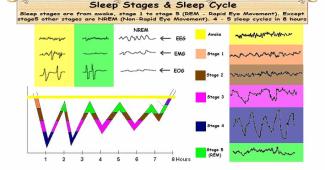
Look at the differences in the EEG (Electro-Encephalo-Gram shows the brain activity), EMG (Electro-Myo-Gram shows the muscle activity) and EOG (Electro-Oculo-Gram shows the eye movements) during waking, REM sleep, and NREM sleep.
Stages of sleep & waveform details
- During awake - the waveform has 15 to 50 Hz frequency and less than 50 microvolts amplitude.
- Pre-sleep - the waveform has 8 to 12 Hz frequency and about 50 microvolts amplitude, it is called as an alpha wave.
- Stage 1 - the waveform has 4 to 8 Hz frequency and 50 to 100 microvolts amplitude, it is called as theta wave.
- Stage 2 - the waveform has 4 to 15 Hz frequency and 50 to 150 microvolts amplitude, it is called as spindle wave.
- Stage 3 - the waveform has 2 to 4 Hz frequency and 100 to 150 microvolts amplitude, it is called as spindle and wave.
- Stage 4 - the waveform has 0.5 to 2 Hz frequency and 100 to 200 microvolts amplitude, it is called as slow and delta wave.
- Stage 5 (REM) - the waveform has 15 to 30 Hz frequency and less than 50 microvolts amplitude.
During asleep, our brain waves pass through different stages of sleep. Start first from stage1 sleep for few minutes; continue to stage2 sleep, stage3 sleep, stage4 sleep. It repeats in the reverse order stage3, stage2, and then REM sleep. After that, it will repeat down and up continuously as shown in the figure. In an 8-hour sleep, the brain cycles through these stages about 4-5 times.
Low Blood Pressure Symptoms
Low blood pressure symptoms are annoying; however, many experts claim non-symptomatic hypotension as nature's gift, because it is safer for many-bodily organs.
Are you hypotension? Many healthcare experts consider people with low pressure are lucky and gifted by nature. So be happy for your condition.
Still few may have some annoying low blood pressure symptoms difficult to manage. Many of you with low blood pressure are enjoying good physical condition with strong cardiovascular and having a lesser risk for heart attack & stroke. However, occasionally some may have an underlying problem such as heart disorder or if the blood pressure drops suddenly with annoying symptoms difficult to carry out daily activities. In such case, hypotension is a condition needs to manage properly to lead a healthier happy life.
12 Hypotension signs & symptoms
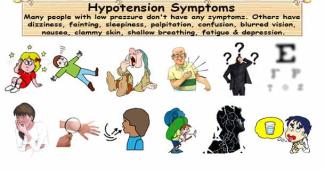
Many people with low blood pressure don't have any symptoms. In such a case, low blood pressure is of no consequence. However, others with unbearable low blood pressure symptoms should get prompt treatment to normalize their blood pressure.
Hypotension in a clinical sense implies a potential risk for under perfusion of vital organs.
Various symptoms of this decreased blood flow can include:
- Dizziness or light-headedness – Low blood pressure may leads to inadequate blood supply to the brain cells, so it cannot able to get needed oxygen and nutrients to energize the brain cells. This lack of energy can cause dizziness, lack of concentration and depression.
- Fainting (syncope) - sudden movement from lying or sitting to a standing position might produce fainting. Additionally, being in a very hot room can also cause faints.
- Sleepiness - the state of being sleepy may be due to lack of energy or low energy.
- Palpitations (a rapid, or irregular, heartbeat) – Brain receives a signal from the baroreceptors and directs the heart to pump faster to fulfill needed blood circulation. Thus, your heart palpitates that is an irregular heartbeat.
- Lack of concentration or confusion – shortage of oxygen & nutrient supply hinders the brain nourishment, which in turn leads to lack of concentration.
- Blurred vision – long standing low blood pressure puts kidney into the job of controlling blood pressure. It leads to an electrolyte imbalance that leads to blurred vision.
- Nausea - Nausea is a sensation of unease and discomfort in the upper stomach with an involuntary urge to vomit.
- Cold, clammy, pale skin - distributed circulation to the extremities results in the cold or clammy skin. Additionally, the skin may appear blue or gray, indicating serious low blood pressure that must be addressed.
- Rapid, shallow breathing – lack of blood circulation leads to low oxygen level in the blood, your body system try correcting it by rapid breathing.
- Fatigue or weakness – lack of circulation leads to the short supply of nutrient that produces fatigue and tiredness.
- Depression - lasting low blood pressure might trigger the release of adrenaline and cortisol, suppressing your serotonin (happy hormone), causing depression and anxiety.
- Thirst – low blood pressure induces correcting mechanism by triggering thirst to rehydrate. An inability to quench thirst are signs of hypotension.
Additional symptoms may include chest pain, head & neck pain (neck and shoulders with a coat hanger distribution), and a decline in cognitive functioning (difficulty concentrating).
These symptoms are due to insufficient blood in the blood vessels. Thus vital organs such as heart, brain, kidney and other organs receive inadequate oxygen and nutrients.
These symptoms might be due to internal bleed, septic shock, heart failure, various drug overdoses, etc. So, immediate low blood pressure diagnosis is a must to confirm there are no major health problems. Once confirmed, you can overcome these low BP symptoms by changing to hypotension lifestyle.
Hypertension Complications
When the blood pressure stays higher over long time, then it may lead to many complications such as coronary heart disease, heart failure, stroke, kidney failure, and other health problems.
Hypertension Complications
The high pressure on the artery wall's causes by high blood pressure can slowly damage the blood vessels, and organs in the body. The higher the blood pressure and the long term it goes undiagnosed and/or controlled, then greater the damage it can cause.
Metabolic syndrome is a set of disorders relating to body's metabolism that includes high triglycerides, low level of high-density lipoprotein (HDL) or good cholesterol, high blood pressure, and high insulin levels. Having high blood pressure can increase the risk of other components of metabolic syndrome. The more components you have, the greater your chances to develop eye problem, kidney problems, heart disease or stroke.
Aneurysm - High blood pressure can cause the blood vessels to weak and bulge, causing an aneurysm. If it ruptures, then it can be life threatening.
Eye problems - Thicken, narrowing or torn blood vessels in the eyes can result in vision loss.
Coronary Artery Disease - Coronary artery disease (CAD) is a condition in which plaque builds up inside the coronary arteries. These arteries supply your heart muscle with oxygen-rich blood.
Heart Failure - Heart failure is a condition in which your heart cannot pump enough blood to your body. Heart failure does not mean that your heart has stopped or is about to stop working. It means that your heart cannot fill-with or pump-with enough force, or both.
Stroke or Brain attack - A stroke is an interruption of the blood supply to any part of the brain. A stroke can also call as "brain attack."
Kidney problems - Weaken and narrowing of blood vessels in the kidneys can prevent it from functioning normally. The kidneys play a key role in keeping a person's blood pressure in a healthy range, and blood pressure, in turn, can affect the health of the kidneys. High blood pressure, also called hypertension, can damage the kidneys and lead to chronic kidney disease (CKD).
Arm Pressure Monitors
Upper arm blood pressure monitor measures blood pressure and pulse rate. It has two major parts; main unit with digital display and arm cuff with air tube & plug.
Upper-arm blood pressure-monitor
The upper arm blood pressure monitor measures blood pressure and pulse rate simply and quickly. It has two major parts; they are:
- Main unit with digital display to indicate the blood pressure measured.
- In addition, arm cuff with air tube and plug which is wrapping over the upper arm to sense the blood pressure.
- The blood-pressure readings are stored for further reference and treatment.
Upper-arm pressure-monitor usage procedure
- Sit upright with the back straight, remove any tight dress over upper arm, and place the arm on a support so that the cuff will be at the same level as the heart.
- Wrap the arm cuff correctly to get accurate results.
- Measurements can take with light clothing; remove thick clothes, such as sweaters, before taking a reading.
- Take a measurement on either the left or the right arm. The blood pressure can differ between the right and left arm, prefer left arm because it is nearer to the heart.
- Insert the air plug into the air jack on the main unit.
- Put the left arm through the cuff loop.
- The air tube should run down the inside of the forearm and be in line with the middle finger.
- The bottom of the cuff should be approximately one finger above the elbow.
- Press the START button in the main unit.
- Inflation of the cuff starts automatically and determines the ideal inflation level. The unit detects the pulse during inflation. During measurement, remain without any movement in a comfortable position.
- The measurement is complete when the arm cuff fully deflates. Now the Main unit displays the blood pressure and pulse rate.
Wrist Pressure Monitors
Blood pressure measured at doctor’s office may give an elevated pressure due to nervous, called as white-coat hypertension, so prefer home blood pressure measurement.
Digital Wrist Blood Pressure Monitors
Wrist blood pressure monitors are in the form of cuffs with large digital display to indicate the blood pressure. You have to wrap it around the wrist. The blood-pressure reading and the pulse rate are indicating on the large digital display; furthermore, it stores pressure reading and keeps the data as a record. The record is stored automatically no need to press the memory button after taking measurements. The wrist blood pressure monitors are convenient to use just put-on like a wristwatch.
Wrist Blood Pressure Monitor usage procedure
To get the most accurate reading in wrist blood pressure monitor,
- Wrap the wrist cuff correctly - Turn the left or right arm thumb upward and place the wrist cuff over the left or right wrist with the display of the unit facing upward.
- Cover the wrist cuff by leaving a width of an index finger between the edge of the wrist cuff and the bottom of the palm.Check if the wrist cuff completely covers the wrist.
- Pull the wrist cuff upward by holding the edge so that it can wrap closely. If you are not properly wrapping, then the reading is not reliable.
- Sit up straight comfortable position.
- Take five to six deep breaths before measurement, and then return to normal breathing. Relax the shoulders and arms.
- Adjust the height of the wrist to the level of the heart (i.e. close to nipple). It is must hold the hand with support and at the level of the heart while taking the reading. Many wrist blood pressure monitors have to position sensors, which can help us to hold the wrist at the correct position.
- During the measurement do not fold the fingers tightly, keep it in comfortable position without stress.
Blood Pressure Monitor
Automatic home blood pressure monitor is required, if have known or suspected high blood pressure, it is important to keep track of the blood pressure levels at home in addition to regular measurements taken at the healthcare professional’s office.
Home blood pressure machine
Blood pressure changes have on well-defined sign or symptoms, so have to measure it to get the facts. Blood pressure normally varies throughout the day; many things can affect blood pressure that includes - emotions, medications, food, and drink can temporarily affect the pressure. Some people may have higher readings at the doctor’s office but normal readings at home, a condition known as white-coat hypertension.
Monitoring the pressure at home can help determine whether really has high blood pressure and if so, whether the treatment plan is working.
Blood pressure monitoring guidelines
Ask the healthcare professionals help to select a suitable home monitor and how to use it. Few basic guidelines are as below:
- Make sure the cuff fits properly: measure around the upper arm and choose a monitor that comes with the correct size cuff.
- Do not smoke, drink caffeine-containing beverages, or exercise within the 30 minutes before measuring Blood pressure.
- Sit with the back straight and supported, feet should be flat on the floor; do not cross the legs. The arm should support on a flat surface with the upper arm at the heart level. Make sure the middle of the cuff is placing directly over the brachial artery. Go through the monitor’s instructions for an illustration or ask the healthcare provider help to show how to use?
- During measurement, take two or three readings a minute apart, and record all the results.
- It is advisable to take the readings at the same time each day.
Cholesterol Medication

Simple cholesterol guidelines or home remedies are enough to control cholesterol. If your cholesterol level is not controlled and having major heart disease or you have familial hypercholesterolemia, then you may need cholesterol-lowering drugs.
What are cholesterol-lowering medicines?
These are the class of drugs that lower the cholesterol level in the blood.
How can you support cholesterol medication treatment? Even if your doctor prescribes a cholesterol-reducing drug, this alone cannot do any magic, and you need to help it work better. Along with your cholesterol-lowering medication, you should still need to follow a cholesterol-lowering diet, be physical active to lower cholesterol, try to lose weight to lower cholesterol (if overweight), quit smoking (if you are a smoker), and control (or stop) all other risk factors for heart disease (such as high blood pressure, diabetes, and smoking).
Following all these can help you to lessen the dose of cholesterol medication or make the medication work more effectively. Additionally, it can lessen the risks associated with high cholesterol.
A cardiovascular patient is on a statin, can he/she stop taking it once blood cholesterol level drops to the recommended range? No cholesterol-lowering medicines can control high blood cholesterol, but they cannot cure. Thus, you must continue taking it to maintain your cholesterol level in the recommended range. Otherwise, your cholesterol level will again shoot up.
What can you expect from a Cholesterol lowering medication?
- Cholesterol medicine lower low-density lipoprotein (LDL), the so-called bad cholesterol that is once considered to increases your heart disease risks. But latest study shows there are two type LDLs; small dense LDL particle (bad) and big fluffy LDL particle (good).
- Cholesterol drug lower triglycerides; high triglycerides increase the heart disease risks.
- Cholesterol medication can increase your high-density lipoprotein (HDL), the so-called good cholesterol that is once considered to help reverse cholesterol transport and protect you from heart disease. But latest study shows; low levels of large HDL and high levels of small HDL is bad and high levels of large HDL & low levels of small HDL is good.
What are the types of Cholesterol Medication drugs?
There are five major classes of cholesterol-lowering medicines, they are:
- Statins - It can help lower the LDL cholesterol by reducing its production inside the liver. It is the most widely prescribed drugs of all times. Pharma claims, people who are taking statins experience no or very few side effects. However, many actual users feel statin side effects outweigh its benefits.
- Bile acid sequestrants - It binds to the intestinal bile acids and prevents its reabsorbed. The liver needs to produces more bile by consuming cholesterol, thus lower cholesterol specifically LDL-C. These medicines usually prescribed along with other cholesterol-lowering medicine e.g. Statins.
- Nicotinic acid - It is the common form of the B-vitamin niacin (vitamin B3). It reduces the production of triglycerides and VLDL. It leads to decreased LDL cholesterol, increased HDL cholesterol, and lowered triglycerides. You should take this medicine only with a doctor’s supervision.
- Fibrates - It reduces the liver's VLDL production and speeds up the removal of triglycerides from the blood. This drug lower blood triglyceride level. When used with statins, fibrates may increase the risk of muscle problems.
- Cholesterol absorption inhibitors - It works by blocking the small intestine from absorbing cholesterol. It does not affect the triglycerides or fat-soluble vitamins absorption.
Do your need Cholesterol lowering medication?
For most people, the answer is no. However, if you have familial hyperlipidemia or any cardiovascular condition, then you should take cholesterol medication to maintain recommended cholesterol range.
Most people do not need cholesterol medication; below example explain why?
The common cold is an infection caused by a microbe such as fungi, bacteria or virus. During the cold, there is excess mucus secretion, running nose, and nasal congestion. Excess mucus secretion is to protect against infectious agents such as fungi, bacteria, and viruses. Thus, the proper treatment for cold is not to stop mucus secretion; instead, to eradicate the infection.
Similarly, if there is any arterial inflammation, your body try to correct it by producing and releasing excess cholesterol into the bloodstream. However, if the inflammation is not stopped then excess cholesterol deposition for healing the inflammation might break down and cause an arterial block. Thus, the proper treatment should be to stop as well as heal the inflammation and not to suppress the cholesterol production. It will happen by its own.
Study shows lowering LDL-C and raising HDL-C is of no use
Lilly's CETP inhibitor evacetrapib discontinue development studies after it failed to reduce rates of major cardiovascular events.
The study participants who are taking this drug noted their LDL-C drops to an average 55 mg/dl from about 84 mg/dl. Additionally, their HDL-C raises to an average of 104 mg/dl from about 46 mg/dl. Still, 256 participants had heart attacks, and 92 patients had a stroke.
How can a drug that lower something associated with a heart risk, is not showing any benefit?
Evacetrapib reduced so-called bad LDL-C by 37% and raised so called good HDL-C by 130%. Still, this drug failed to reduce cardiovascular events. What can you learn from this drug failure? Reducing LDL-C or raising HLD-C is of no use in preventing cardiovascular events. Thus, you should concentrate on something else; it might be LDL & HDL particle size.
Reflexology for Hypertension

High blood pressure can control successfully by following hypertension home or lifestyle remedies and reflexology high blood pressure treatment. Reflexology is simple to do, has many benefits without side effects and controls blood pressure.
Reflexology high blood pressure massage
Always better to start the reflexology for high blood pressure treatment with massaging the endocrine glands, followed by organ responsible for the cause & effect by the condition.
Reflexology High blood pressure massage for Endocrine system
- Pituitary gland
- Pineal gland
- Thyroid & Parathyroid gland
- Thymus gland
- Adrenal gland
- Pancreas gland
To know more how to locate and massage endocrine glandular organs, visit reflexology for endocrine system.
Give special attention to the adrenal gland, because it is responsible for stressful situations (i.e. fight or flight).
Massaging adrenal reflex will make it calm, thus helpful in controlling blood pressure variations due to stress. Concentrate on all seven glands, because the hormones secreted by the glands are messages for the total control of the body system.
7 Reflexology areas for hypertension
- Kidneys/adrenal reflex - Inability of the kidneys to excrete sodium lead to edema and raised blood pressure. Adrenal gland is responsible for the fight-or-flight (stress) response. Massaging the adrenal reflex moderate this stress response and lower BP.
- Liver reflex - An overactive renin-angiotensin system leads to vasoconstriction and retention of sodium and water. The increase in blood volume leads to hypertension. Massaging the liver reflex helps moderate renin-angiotensin system that leads to vasodilation and thus lower blood pressure.
- Solar plexus reflex often called as the second brain or abdominal brain. The solar plexus is closely related to the digestive system.
- Lungs reflex – Is responsible for renin-angiotensin system and oxygenation of blood. Thus massaging lungs reflex help lower blood pressure.
- Head/Brain reflex - An overactive sympathetic nervous system, leading to increased stress responses.
- Spinal reflex - A spinal reflex is from the brain all the nerves travel through the spinal cord, thus for proper nervous function, the spinal should be healthy.
- Heart reflex - Proper functioning of heart valves is important for the heart's ability to pump blood through the body.
During the massage, if these reflex areas have pain or numbness, then special attention should be given to that specific area/point.
And a different sensation indicates, there is some problem with that organ. After massaging, if that specific point/area shows any improvement, then increases massage frequency to that location. Otherwise, discard that reflex point from massaging.
Reflexology to avoid high blood pressure complications
- Heart
- Brain (stroke)
- Kidney
These points are already massaged. Still, you can do it again for a better result. Massaging these reflex points will help avoid complications associated with hypertension. Thus, you are not only controlling the blood pressure but also safeguarding the organ that may be affected.
Is high blood pressure reflexology safe?
You can do reflexology treatment along with your hypertension medication (don't stop it).
If your blood pressure drops after few days of reflexology therapy, then you can reduce the dosage and monitor your blood pressure closely for any raise. If it raises, then change back to your original medicine dosage. In the other hand, if BP reduces further after some days of practice then again you can reduce the drug dose!
People with recent or healing fractures, unhealed wounds, or active gout affecting the foot should avoid reflexology. If you have osteoarthritis affecting the ankle or foot or severe circulation problems in the legs or feet, seek medical consultation before starting reflexology.
Caution should practice in pregnant women, based on reports that rigorous stimulation of the feet may cause contractions of the uterus.
Physical Activities Lower Cholesterol
Physical activity refers to any bodily movement results in the energy expenditure including a broad range of occupational, leisure and daily activities.
Physically inactivity is a major underlying risk factor for coronary heart disease. Thus, it is advisable to include consistent physical activity or exercise in your daily routine.
Physical activities and cholesterol
Physical activity can play a major role in the treatment of hyperlipidemia. Also, it reduces the risk of heart attack or stroke. It can also help lower your blood pressure, reduce insulin resistance, and favorably influence cardiovascular function.
More than 30% of adults are not sufficiently physically active in their daily life, and it is continuing to decline. Physical activity is one of the best public health’s “best buys.”
12 Surprising Benefits of Physical Activity
Good evidence suggests simply reducing the sitting time each day reduces death risk independently of other lifestyle factors.
There is incontrovertible evidence that regular physical activity contributes to the prevention of several chronic diseases and reduced risk of premature death.
- Enhances Lipoprotein Profiles – Reduces triglyceride, increases HDL cholesterol, and decreases LDL-to-HDL ratios. Reference: European Journal of Medical Research 1997; 2:259-64. Acta Paediatrica 1994; 83:1258-63.
- Reduce Inflammation - A recent study has shown that exercise training may cause marked reduction in C-reactive protein levels (inflammation marker). Reference: Canadian Medical Association Journal 2005 Apr 26;172(9):1199-209.
- Reduced Cardiovascular Risk - A systematic review revealed an inverse relation between physical activity and the risk of cardiovascular-related death. These protective effects are for as little as 1 hour of walking per week. Reference: American Journal of Preventive Medicine 2004 Jun; 26(5):407-18. The benefits of physical activity and fitness extend to patients with established cardiovascular disease. Regular walking and moderate or heavy gardening were sufficient to achieve this benefit. Reference: Circulation. 2000 Sep 19;102(12):1358-63.
- Type 2 Diabetes - In a large prospective study, each increase of 500 kcal in energy expenditure per week associated with a decreased incidence of type 2 diabetes of 6%. Reference: The New England Journal of Medicine 1991 Jul 18; 325(3):147-52. Physical activity improves insulin action and glucose tolerance in obese individuals. Reference: Medicine & Science in Sports & Exercise 1999;31: S619-23. Physical activity reduces the incidence of type 2 diabetes among high-risk people (overweight). Reference: The New England Journal of Medicine 2001 May 3; 344(18):1343-50. Diabetes. 2005 Jan; 54(1):158-65.
- Metabolic Syndrome - physical activity helps to prevent/treat metabolic syndrome. Reference: Applied Physiology, Nutrition, and Metabolism 2007 Feb;32(1):76-88. Diabetes Care 2010 Jul; 33(7): 1610-1617.
- Reduced Hypertension Risk - There are consistent findings regarding the protective effects of physical activity in the prevention of hypertension. Studies have shown physical activity is inversely associated with hypertension. Reference: Hypertension. 2010 Jul; 56(1):49-55. Blood Press. 2011 Dec; 20(6):362-9. Physical activity has an independent capacity to lower blood pressure in people with hypertension. Reference: Journal of Clinical Epidemiology 1992 May;45(5):439-47.
- Increased Self-Esteem - Physical activity improves psychological well-being through reduced stress, anxiety and depression. Reference: Medicine & Science in Sports & Exercise June 2001 - Volume 33 - Issue 6 - pp S587-S597.
- Good Life Expectancy - It has been shown to add years to your life, and life to your years. In a study, people who went from unfit to fit in a 5-year period had a reduction of 44% in the relative risk of death. Reference: JAMA. 1995 Apr 12; 273(14):1093-8.
- Supports Healthy Weight – Physical activity helps stay at or get to a healthy weight, and it is an important component of long-term weight control. Reference: The American Journal of Clinical Nutrition July 2005 vol. 82 no. 1 226S-229S.
- Protect against Osteoporosis - Routine physical activity can improve musculoskeletal fitness. Thus, improved overall health status and a reduction in the risk of chronic disease and disability. Reference: Canadian Journal of Applied Physiology 2001 Apr; 26(2):217-37. Canadian Journal of Applied Physiology 2001 Apr; 26(2):161-216.
- Improved Sleep Quality - Objectively-measured physical activity associated with several improved self-reported sleep-related parameters. Reference: Mental Health and Physical Activity Volume 4, Issue 2, December 2011, Pages 65–69.
- Cancer Prevention - A series of mechanisms may explain the 46% reduction in cancer rates observed with regular physical activity. Reference: Critical Reviews™ in Oncogenesis 1997; 8(2-3):219-72.
A Linear relation exists between the volume of physical activity and health status, such that the most physically active people are always healthier.
Increased physical activity results in a reduction in triglyceride, increase in HDL cholesterol, decrease in blood pressure, reduces insulin resistance, improved blood glucose control, better immune function, reduced fat storage, increased energy expenditure, and drop in a free-radical generation.
Share your physical activities with friends and family and make it as fun rather than an exercise.
8 Simple ways to incorporate Physical Activity into your daily routine
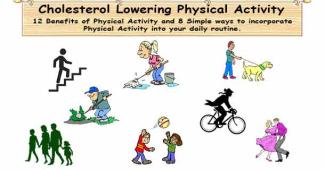
Daily physical activity is the cornerstone of a healthy lifestyle. The first obvious step would be the use of stairs instead of lifts and walking & cycling for short distance journeys.
- Take stairs if possible - Increasing the number of steps you take is an obvious first step to incorporate physical activity into your daily routine. If you have to go up/down a long way, then you may walk the first few floors, then take the elevator for the rest.
- Clean the house/car/utensils – Cleaning is a great workout than what you might think. Cleaning involves plenty of walking, lifting, bending, and stretching. Cleaning work is an easy way to burn some extra calories.
- Gardening & yardwork - Yardwork is great, because it increases your physical activity, also gives you an opportunity to establish a link with nature. Pulling weeds, mowing the lawn, trimming the hedge, and raking leaves are all very physically taxing as well as mentally relaxing.
- Family Walk after Dinner - Research has found walking after your dinner, can make wonders for your health. A family walk after dinner improves everyone’s health as well as provide an opportunity to discuss topics and share love.
- Walk if Possible - Walk your children to/from school will help them get physical activity. At work, walk over to see your co-worker instead of contacting them over the phone or emailing. Walk while talking on the phone. Walk the dog don't just watch the dog walk, walk with it. Walk up escalators rather than standing still.
- Do Cycling - If possible, prefer cycling to go to work and market. Enjoy cycling with your kids in the evening; this helps encourage your kids for a healthy lifestyle.
- Play Regularly – Instead of watching TV, encourage and take your child to play. Be active with your child; take them to swimming pool or play in the garden/park. If you are active, then your child will likely to be active too; be an example. If possible, involve the whole family and enjoy playing.
- Dancing – For dancing, all you need is some brisk music tunes, forget about work pressure, and interest to dance. It is a fun dancing with your family, specifically kids.